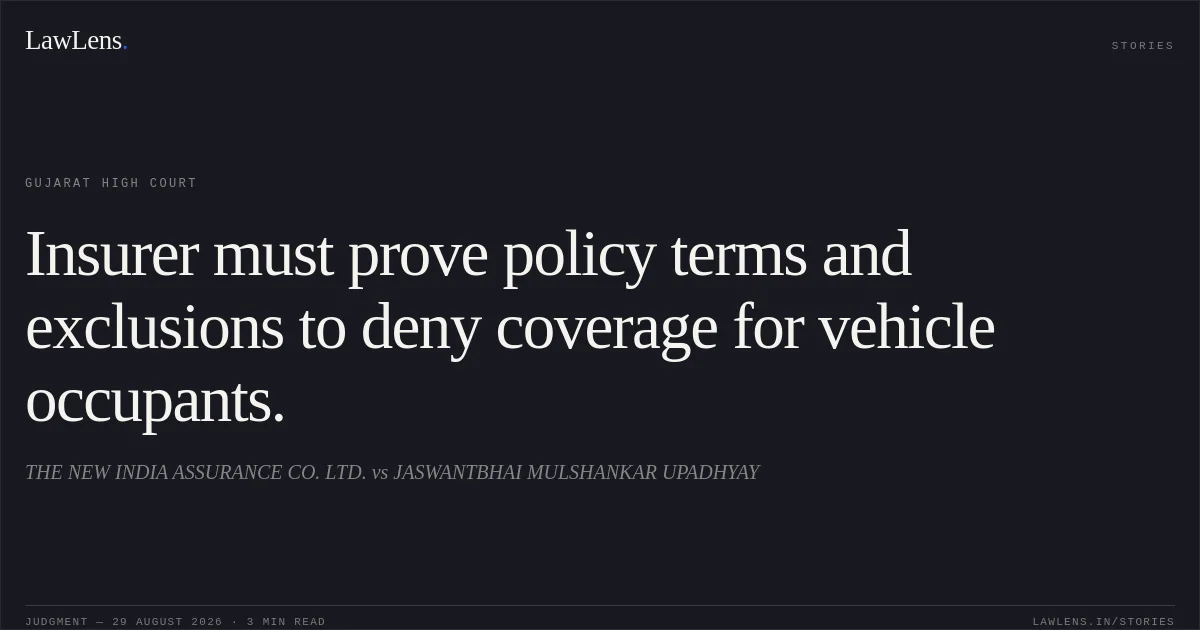
Facts
On 3 January 2010, Darmesh Jaswantbhai Upadhyay, aged approximately 22 years, was travelling as a passenger in a Scorpio car bearing registration No. GJ-12-AE-5575. The car, allegedly driven rashly and negligently while overtaking a tractor and trolley, collided with the rear of the tractor and trolley, causing fatal injuries to the deceased. His legal representatives filed M.A.C.P. No. 143 of 2010 seeking compensation, claiming that he earned approximately Rs.20,000 per month through performing Karmakand and reading katha.
Source reference: p.2, para. 2(i)–(ii)The Motor Accident Claims Tribunal, Gandhidham, partly allowed the claim and awarded Rs.5,59,200 with interest at 7% per annum from the date of the claim petition until realization.
Source reference: p.1, para. 1; p.3, para. 3The New India Assurance Co. Ltd., the insurer and original opponent No.4, challenged the award, contending that the insurance policy was an “Act-only policy” and did not cover the risk of the deceased, who was an occupant or gratuitous passenger in the car.
Source reference: p.3, para. 4Issues
Whether the insurer proved that the policy covering the Scorpio car was an “Act-only policy” that did not cover the risk of the deceased passenger.
Source reference: p.3, para. 4; p.5, paras. 9–12Whether, in the absence of proof of the policy terms and conditions, the insurer was entitled to exoneration from liability to satisfy the compensation award.
Source reference: p.5, paras. 10–13Law Applied
The Court applied the principle that the nature and extent of coverage under a motor vehicle insurance policy must be determined from the policy’s terms and conditions.
Source reference: p.5, para. 11In National Insurance Co. Ltd. v. Balakrishnan, the Supreme Court held that the policy documents must be examined to determine whether the policy is a comprehensive policy or an “Act-only policy”.
Source reference: p.5, para. 11Under United India Insurance Co. Ltd. v. Tilak Singh, the risk of a gratuitous passenger is not covered under an “Act-only policy”.
Source reference: p.5, para. 11The insurer, relying on such an exclusion, bears the burden of proving the relevant policy terms and establishing that the passenger’s risk was not covered.
Source reference: p.5, paras. 10–12Reasoning
The insurer produced only the cover note, marked Exh.32. Although the cover note recorded a total premium of Rs.2,895, it did not disclose the allocation of the premium among the various heads of coverage, and therefore did not establish whether any premium had been paid for covering the risk of the deceased passenger.
Source reference: p.5, para. 10The insurer also failed to produce the complete policy terms and conditions or examine an insurance officer to explain the nature and scope of the policy.
Source reference: p.5, paras. 10, 12Consequently, the insurer failed to discharge its burden of proving that the policy was “Act-only” and excluded the deceased’s risk.
Source reference: p.5, para. 12Since the factual foundation necessary to invoke the rules in Balakrishnan and Tilak Singh was not proved, those decisions did not assist the insurer.
Source reference: p.5, paras. 11–13Holding
The Gujarat High Court held that the insurer failed to prove that the deceased occupant’s risk was excluded from the policy.
The appeal was dismissed, and the Tribunal’s award of Rs.5,59,200 with 7% interest was upheld.
Source reference: p.6, para. 14The parties held liable by the Tribunal were directed to satisfy the award forthwith; upon deposit, the Tribunal was directed to disburse the entire amount to the claimants after due verification and deduction of any deficit court fee.
Source reference: p.6, para. 15Any statutory amount deposited before the High Court was directed to be transmitted to the concerned Tribunal, with no order as to costs.
Source reference: p.7, para. 16Original Court PDF
THE NEW INDIA ASSURANCE CO. LTD.vsJASWANTBHAI MULSHANKAR UPADHYAY
Click to open original judgment
Original judgment, available to read, download and summarize on LawLens.in
![A police constable cannot be removed for unauthorized absence without a Rule 359-compliant inquiry.. Mohammad Sidiq Khan vs D/o Home Ut Of Jammu & Kashmir. CAT - ['Srinagar']. LawLens](/stories/thumbnails/a-police-constable-cannot-be-removed-for-unauthorized-absence-without-a-rule-359-compliant-7b43fc316bd94f22a62676153bbc9d54.webp)
![A Review DPC lacks authority to determine or alter inter se seniority.. SAURABH KUMAR vs REVENUE. CAT - ['Patna']. LawLens](/stories/thumbnails/a-review-dpc-lacks-authority-to-determine-or-alter-inter-se-seniority-4b21640f20af46fcabdfc8273d2ce959.webp)