Facts
The appellant, the deceased Kariyappa’s mother, sought compensation after he died in an accident on 16 December 2015 while travelling in a Tata Ace goods vehicle following RCC construction work.
Source reference: para. 3–4The Tribunal found the accident resulted from the driver’s rash and negligent driving, treated the deceased as a gratuitous passenger, awarded ₹9,26,800, and placed liability on the vehicle owner.
Source reference: para. 8–10The appellant appealed for enhancement and to challenge the allocation of liability.
Source reference: para. 3–4, 8–10Issues
Whether the compensation awarded by the Tribunal was inadequate and required modification
Source reference: para. 12(i)Whether the Tribunal was justified in placing liability on the vehicle owner rather than requiring the insurer to pay the compensation
Source reference: para. 12(ii)Law Applied
Under the Motor Vehicles Act, 1988, Sections 147 and 149 govern compulsory insurance coverage and the insurer’s duty to satisfy third-party judgments and awards, subject to the statutory grounds and conditions for avoiding liability.
Source reference: para. 30–32For fatal accident compensation, Sarla Verma v. Delhi Transport Corporation supplies the applicable multiplier and deduction for a bachelor’s personal expenses; National Insurance Co. Ltd. v. Pranay Sethi provides for future prospects and the conventional heads of compensation, including their periodic escalation.
Source reference: para. 16–18, 20–22The Court also relied on the Karnataka Full Bench decision in New India Assurance Co. Ltd. v. Yallavva and coordinate Bench decisions applying a “pay and recover” direction, under which the insurer pays the claimant first and may recover the amount from the vehicle owner.
Source reference: para. 30–33Reasoning
The deceased was 27 years old, and no documentary proof supported the asserted monthly income of ₹25,000. Applying the Karnataka Legal Services Authority chart, the Court fixed notional income at ₹7,500 per month, added 40% for future prospects, deducted 50% for personal expenses because the deceased was a bachelor, and applied multiplier 17. This yielded ₹10,71,000 for loss of dependency; after revising consortium, funeral expenses and loss of estate, total compensation became ₹11,48,000.
Source reference: para. 15–23The policy was valid on the accident date and the driver held a valid licence. Although the deceased was treated as a gratuitous passenger in a goods vehicle, the Court held that the insurer should deposit the enhanced compensation and retain the right to recover it from the owner, relying on the statutory scheme and the cited Karnataka decisions.
Source reference: para. 24–33Holding
The appeal was allowed in part. The award was enhanced from ₹9,26,800 to ₹11,48,000.
The enhanced compensation carries interest at 6% per annum from the date of the claim petition until payment.
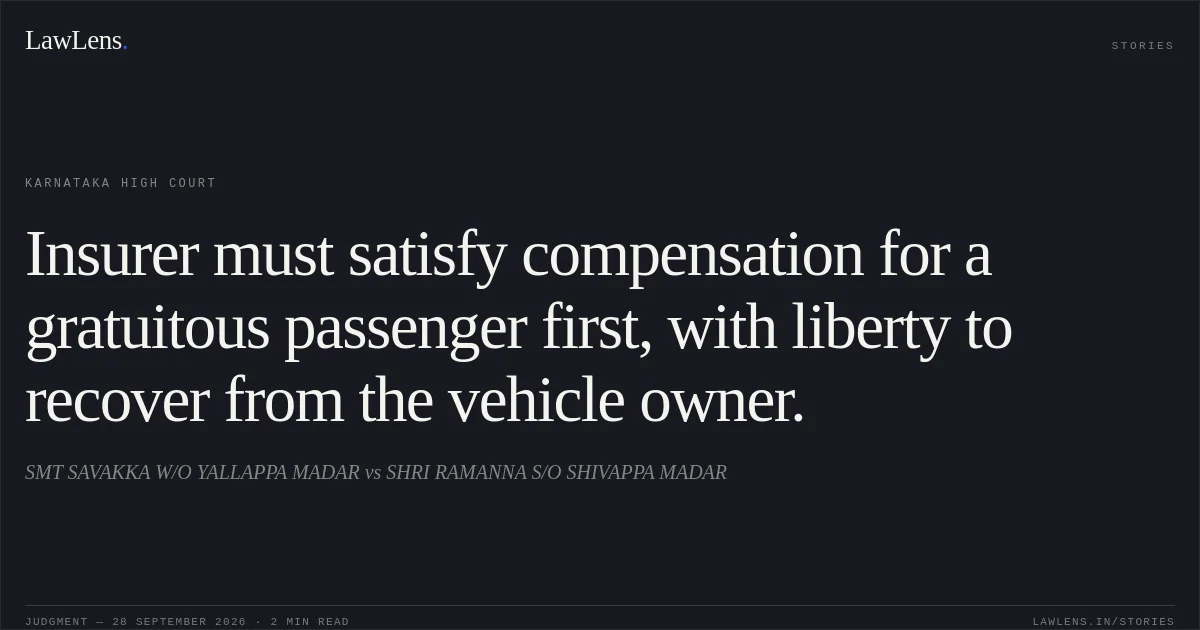
Source reference: para. 35The insurer was directed to deposit the enhanced compensation with accrued interest before the Tribunal within six weeks of receiving the certified judgment, with liberty to recover the amount from the vehicle owner; a modified award was directed.
Source reference: para. 35Acts & Sections Cited
5 provisions across 2 statutes referred to in this judgment. Each provision opens on LawLens.
Motor Vehicles Act, 19884
Code of Civil Procedure, 19081
Original Court PDF
SMT SAVAKKA W/O YALLAPPA MADARvsSHRI RAMANNA S/O SHIVAPPA MADAR
Click to open original judgment
Original judgment, available to read, download and summarize on LawLens.in