01Facts
On 28 August 2014, Maguram Naik, a pedestrian, was struck by a reversing water tanker and died.
¶ 3–4His wife and three daughters brought a claim under Section 166 of the Motor Vehicles Act, 1988, against the tanker’s owner and insurer.
¶ 3–4The Tribunal found the driver negligent and awarded ₹11,27,600, but absolved the insurer because it found that the tanker lacked a fitness certificate and permit on the accident date.
¶ 7The claimants appealed for enhanced compensation; the owner separately appealed the finding on liability.
¶ 2, 702Issues
i.1. Whether the Tribunal was justified in absolving the insurer from liability, having regard to the alleged absence of a fitness certificate and permit
¶ 12ii.2. Whether the claimants were entitled to enhancement of compensation
¶ 1203Law Applied
A claim for compensation arising from a motor accident may be brought under Section 166 of the Motor Vehicles Act, 1988; appeals from the Tribunal’s award were brought under Section 173(1).
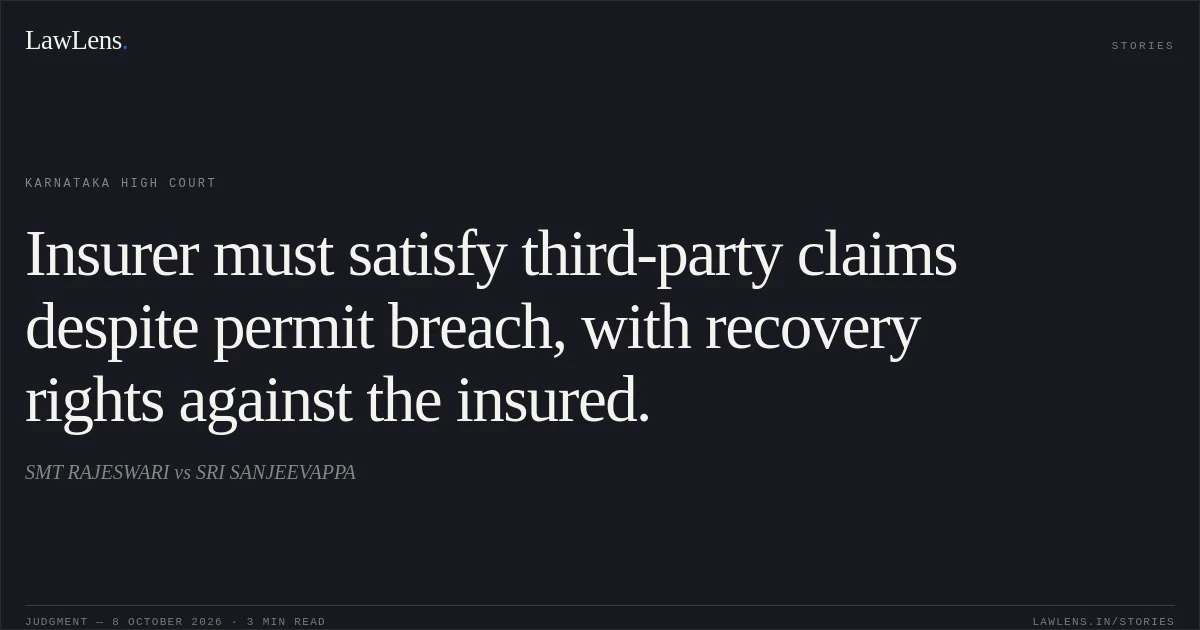
pp. 2–4Relying on Amrit Paul Singh v. Tata AIG General Insurance Co. Ltd., (2018) 7 SCC 558, the Court applied the rule that a breach involving absence of a permit does not permit the insurer to avoid payment to third-party claimants; the insurer may instead be directed to pay first and recover from the insured or driver.
¶ 14It also relied on a Karnataka High Court Division Bench decision in MFA No. 5993/2015, reported as 2020:KHC:26201/DB, for the proposition that an insurer cannot escape liability where a registration certificate has been issued and not cancelled.
¶ 14For compensation, the Court referred to National Insurance Co. Ltd. v. Pranay Sethi, (2017) 16 SCC 680, including the addition of amounts under conventional heads over time.
¶ 15–17Provisions in the judgment · 2 · Linked ones open on LawLens
Motor Vehicles Act, 1988 Section 173Section 166
04Reasoning
On liability, the Tribunal had relied on evidence that the permit and fitness certificate were valid only from dates after the accident.
¶ 13–14The High Court noted that Ex. R3 recorded registration/fitness validity up to 21 December 2015, and held that the insurer could not avoid third-party liability; for the permit breach, it directed the insurer to pay first and recover from the insured/driver.
¶ 13–14It rejected the separate challenge based on absence of a fitness certificate.
¶ 13–14On quantum, because the claimants had not substantiated the deceased’s asserted income, the Court adopted a notional monthly income of ₹8,500 for 2014.
¶ 15–17It applied a multiplier of 14, a one-fourth deduction for personal expenses, and added compensation for consortium, funeral expenses and loss of estate, with a further 20% under conventional heads.
¶ 15–17The judgment contains an apparent calculation inconsistency: paragraph 15 states that future prospects were added at 20%, but the stated loss-of-dependency figure of ₹13,38,750 corresponds to a 25% addition to ₹8,500 before the one-fourth deduction and multiplier of 14.
¶ 1505Holding
The Court partly allowed the claimants’ appeal and enhanced total compensation to ₹15,66,750, with interest at 6% per annum from the date of the claim petition until deposit.
¶ 18(i)It partly allowed the owner’s appeal, directing the insurer to pay the compensation first and recover it from the insured/driver without separate proceedings.
¶ 18(ii)The amount in deposit was to be transmitted to the Tribunal, and the Tribunal’s apportionment directions were to apply proportionately to the enhanced compensation.
¶ 18(iii)–(iv)Original Court PDF
SMT RAJESWARIvsSRI SANJEEVAPPA
Click to open original judgment
Original judgment, available to read, download and summarize on LawLens.in