Facts
The claimants, sons of Saraswathi, sought compensation under Section 166 of the Motor Vehicles Act, 1988, for her death in an accident involving a goods vehicle insured by the appellant.
Source reference: p. 2–4The vehicle had struck a tamarind tree after its driver swerved to avoid a dog.
Source reference: p. 2–4The Tribunal found the driver negligent and awarded ₹4,31,000, directing the insurer to pay and recover from the vehicle’s owner, in part because the driver lacked a badge endorsement.
Source reference: p. 2–4The insurer appealed, contending that Saraswathi was an unauthorised passenger in the goods vehicle.
Source reference: p. 4–5, 7–8The High Court treated the manner of the accident as undisputed and considered whether the deceased was covered as the owner or authorised representative of goods.
Source reference: p. 4–5, 7–8Issues
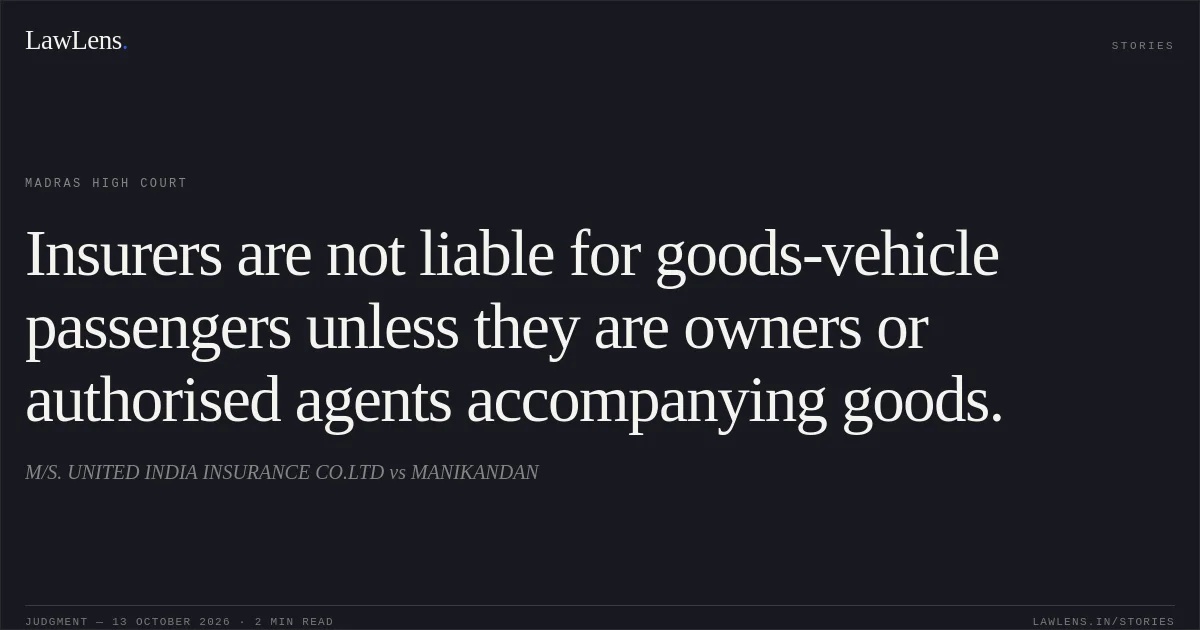
Whether the insurer was liable under Section 147 of the Motor Vehicles Act for the death of a person travelling in a goods vehicle, where the evidence did not establish that she was travelling as the owner or authorised representative of goods accompanying her.
Source reference: p. 9–12Whether the insurer could be directed to pay compensation and recover it from the vehicle owner despite the absence of statutory coverage for the deceased’s risk.
Source reference: p. 12Law Applied
Section 147 of the Motor Vehicles Act requires insurance coverage for the owner of goods or the owner’s authorised representative accompanying the goods in a goods vehicle, but does not require coverage for an ordinary passenger in such a vehicle.
Source reference: p. 8–10The Madras High Court Division Bench in Branch Manager, United India Insurance Co. Ltd. v. Nagammal and Others, 2009 (1) CTC 1, held that an insurer is not statutorily liable for a passenger in a goods vehicle unless that passenger is the owner or agent of the owner of goods accompanying them; pay-and-recover is not an inexorable rule and depends on the circumstances.
Source reference: p. 8–10Rule 236 of the Tamil Nadu Motor Vehicles Rules was also raised by the claimants in support of their position.
Source reference: p. 5Reasoning
Although the claimants asserted that Saraswathi was a vegetable vendor travelling to buy vegetables, the claim petition did not specifically plead that she was returning with purchased vegetables or travelling as their owner when the accident occurred.
Source reference: p. 10–12The FIR recorded that she and five others had travelled to purchase vegetables, while the evidence of PW2 alone was insufficient to establish that goods were in the vehicle and that Saraswathi was travelling as their owner or authorised representative.
Source reference: p. 10–12Applying Nagammal, the Court concluded that she was not shown to fall within the class whose risk Section 147 requires an insurer to cover.
Source reference: p. 12Since there was no statutory coverage, the Court held that pay-and-recover did not arise.
Source reference: p. 12Holding
The Court allowed the appeal and set aside the Tribunal’s award.
It exonerated the insurer from paying compensation and left the claimants at liberty to recover the amount from the vehicle owner, if so advised.
Source reference: p. 13No costs were awarded.
Source reference: p. 13Acts & Sections Cited
4 provisions across 1 statute referred to in this judgment. Each provision opens on LawLens.
Motor Vehicles Act, 19884
Original Court PDF
M/S. UNITED INDIA INSURANCE CO.LTDvsMANIKANDAN
Click to open original judgment
Original judgment, available to read, download and summarize on LawLens.in


