Facts
The husband of respondent no. 1, Bhanu Pratap Singh, died in a road accident on 29 November 2018.
Source reference: paras. 2–3Respondent no. 1 claimed ₹5,00,000 under the Mukhyamantri Kisan Evam Sarvhit Bima Yojna for the accidental death of the family’s earning member.
Source reference: paras. 2–3The petitioner-Insurance Company repudiated the claim on the ground that it was filed beyond the limitation period prescribed under the Scheme.
Source reference: paras. 2–3Following earlier proceedings before the High Court, the District Magistrate, Kanpur Nagar, reconsidered the claim and, by order dated 29 November 2025, directed payment of compensation to respondent no. 1.
Source reference: paras. 2–3The Insurance Company challenged that order under Article 226, contending that the District Magistrate had acted contrary to the limitation and other contractual conditions contained in the Memorandum of Understanding executed between the State Government and the petitioner.
Source reference: paras. 4–5Issues
Whether a writ petition under Article 226 at the instance of an Insurance Company is maintainable to challenge an order granting compensation under a governmental welfare scheme on the ground that the order is contrary to the terms of the MoU between the Insurance Company and the State Government?
Source reference: para. 6Whether the District Magistrate’s order directing payment of compensation suffered from perversity, jurisdictional error, or manifest illegality warranting interference under Article 226?
Source reference: para. 23Law Applied
The Court applied the distinction between enforcement of public-law or welfare entitlements and disputes arising from private-law contractual obligations.
Source reference: no citationA beneficiary seeking enforcement of an entitlement under a governmental welfare scheme may invoke Article 226 against State authorities.
Source reference: para. 11However, an Insurance Company seeking to resist payment on the basis of contractual terms in an MoU with the State Government asserts contractual and commercial rights, which ordinarily must be pursued before civil, commercial, arbitral, or other competent forums.
Source reference: paras. 8, 12, 15The Court relied on State of Bihar v. Jain Plastics and Chemicals Ltd., (2002) 1 SCC 216, Kerala State Electricity Board v. Kurien E. Kalathil, (2000) 6 SCC 293, and Joshi Technologies International Inc. v. Union of India, (2015) 7 SCC 728, concerning the ordinary exclusion of contractual disputes from writ jurisdiction.
Source reference: para. 15It distinguished ABL International Ltd. v. Export Credit Guarantee Corporation of India Ltd., (2004) 3 SCC 553, holding that its public-law exception did not apply where the insurer relied solely on contractual rights to oppose payment to a welfare-scheme beneficiary.
Source reference: paras. 13–14The Court further held that the pending proceedings concerning Gautam Yadav v. State of U.P., 2020 SCC OnLine All 1379, did not affect the maintainability of the present challenge to an individual claim determination.
Source reference: paras. 16–18Reasoning
The Court held that the Scheme had a welfare and social-security character for its beneficiaries, but the Insurance Company’s relationship with the State Government arose from a negotiated commercial MoU supported by payment of premium.
Source reference: paras. 7–9The petitioner was not seeking enforcement of an independent constitutional or public-law right; it was attempting to prevent payment to a beneficiary by invoking alleged breaches of contractual provisions concerning limitation, claim procedure, and allocation of liability.
Source reference: para. 12Since respondent no. 1 was not a party to the MoU, she could not be made to defend contractual disputes between the insurer and the State.
Source reference: para. 14The Court also distinguished the issue in Gautam Yadav, which concerned the general validity and operation of the limitation term, from the present case, which involved only the District Magistrate’s determination of an individual claim.
Source reference: paras. 16–18Consequently, entertaining the writ petition would improperly convert Article 226 into an appellate forum for contractual disputes and could delay welfare compensation intended for distressed families.
Source reference: paras. 19–21Independently, the Court found that the District Magistrate had recorded a categorical finding that the claim was within the prescribed period and that the beneficiary was entitled to compensation; no perversity, jurisdictional error, or manifest illegality was established.
Source reference: para. 23Holding
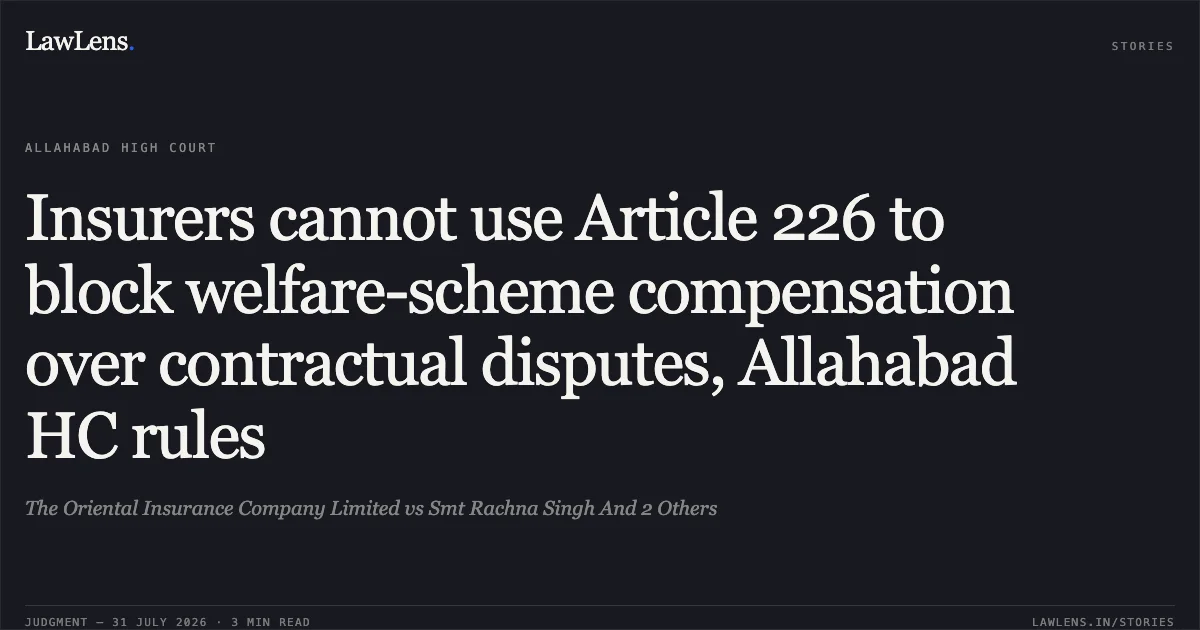
The Court answered the principal issue against the petitioner and held that the Insurance Company’s writ petition was not maintainable under Article 226 where the challenge was founded on contractual rights under the MoU with the State Government.
The writ petition was dismissed, and the petitioner was directed to release the compensation payable to respondent no. 1 within three months from the date of the judgment.
Source reference: paras. 26–27The dismissal did not preclude the Insurance Company from pursuing any otherwise available civil, commercial, arbitral, or other remedy against the State Government concerning its alleged contractual grievances under the MoU.
Source reference: para. 28Original Court PDF
The Oriental Insurance Company LimitedvsSmt Rachna Singh And 2 Others
Click to open original judgment
Original judgment, available to read, download and summarize on LawLens.in