Facts
Mahadev and Shantabai sought compensation for the death of Vilas in a road accident on 14 October 2012.
Source reference: p. 3The Tribunal awarded them ₹4,50,000 with 6% annual interest and directed the sole respondent, Mastan, to satisfy the award.
Source reference: p. 3The claimants appealed, principally alleging inadequate compensation. They later applied under Order I Rule 10(2) CPC to add Royal Sundaram Alliance Insurance Company and Reliance General Insurance Company as parties, asserting that they had learned after the Tribunal’s decision of insurance policies covering the vehicle. Reliance disputed the alleged policy and contended that it had never insured the vehicle. Neither insurer had been a party before the Tribunal. The appeal was accompanied by an application to condone a delay of 1,781 days.
Source reference: p. 3–6, 9–10Issues
1. Whether the proposed insurers could be added at the appellate stage, despite not having been parties before the Tribunal, where the existence and authenticity of the alleged policies were disputed.
Source reference: p. 4–82. Whether the Tribunal’s judgment should be set aside and the claim remanded for fresh adjudication, with an opportunity for the insurers to present their defences.
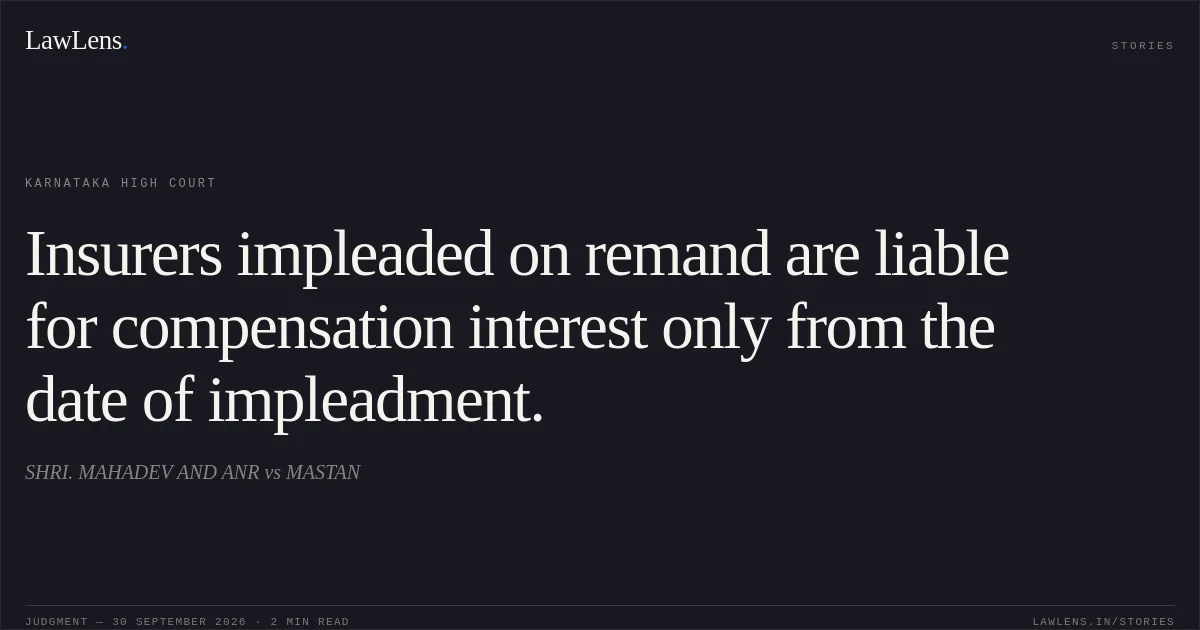
Source reference: p. 8–103. If the insurers were ultimately found liable, from what date should interest run against them.
Source reference: p. 10–11Law Applied
Section 173(1) of the Motor Vehicles Act provides for an appeal from an award of the Motor Accident Claims Tribunal, while Order I Rule 10(2) CPC empowers the court to add a party whose presence is necessary for effective adjudication.
Source reference: p. 4The Court also relied on the beneficial purpose of the Motor Vehicles Act—to provide just compensation to accident victims—and the need to afford parties a fair opportunity to contest disputed factual and documentary claims.
Source reference: p. 8–11To protect the proposed insurers from delay for which they were not responsible, the Court directed that any liability ultimately established against them for interest would commence only from the date they were impleaded before the Tribunal.
Source reference: p. 10–11No judicial precedents were cited.
Source reference: p. 4–11Reasoning
The Court found that the parties’ opposing accounts raised disputed questions requiring inquiry: the claimants asserted that the insurers had issued policies, while the insurers disputed the policies’ authenticity and coverage.
Source reference: p. 8–11Because those issues could not fairly be resolved on the appellate record, and because the insurers had not participated in the Tribunal proceedings, the Court considered remand appropriate.
Source reference: p. 8–11It directed that the insurers be added and given the opportunity to file written statements, produce documents, and lead evidence.
Source reference: p. 8–11In view of the time elapsed, it limited any interest liability of the insurers to the period beginning on the date they were impleaded.
Source reference: p. 10–11Holding
The appeal was allowed, and the Tribunal’s award dated 3 November 2014 was set aside.
The matter was remanded for fresh adjudication, with directions to permit the claimants to implead the two insurers and to allow all parties to present their evidence and contentions.
Source reference: p. 11–12All contentions were left open, and the Tribunal was directed not to be influenced by the High Court’s observations.
Source reference: p. 11–12Any insurer ultimately found liable would pay interest only from the date of its impleadment before the Tribunal.
Source reference: p. 11–12Acts & Sections Cited
1 provisions across 1 statute referred to in this judgment. Each provision opens on LawLens.
Motor Vehicles Act, 19881
Original Court PDF
SHRI. MAHADEV AND ANRvsMASTAN
Click to open original judgment
Original judgment, available to read, download and summarize on LawLens.in