Facts
The appellant, Reliance Industries Limited (RIL), held a 75% stake in Reliance Petroleum Ltd (RPL). In March 2007, RIL decided to divest 5% of its RPL holdings (22.50 crore shares) to raise capital.
Source reference: para. 4-5Between November 1 and 6, 2007, RIL engaged 12 "agents" to take short positions in the RPL November 2007 Futures segment, totaling 9.92 crore shares, while simultaneously selling RPL shares in the cash segment.
Source reference: para. 9-11SEBI alleged that RIL used these 12 entities to bypass "client-level" position limits (which were roughly 1.01 crore shares per client) to corner the market and manipulate the settlement price on November 29, 2007, by dumping 1.95 crore shares in the final 10 minutes of trading.
Source reference: para. 13-14The Securities Appellate Tribunal (SAT), in a 2:1 majority, upheld SEBI’s finding that RIL committed fraud under the PFUTP Regulations and ordered the disgorgement of ₹447.27 crore plus interest.
Source reference: para. 2, 15Issues
1. Whether the agency agreements between RIL and the 12 entities constituted a fraudulent and manipulative device under the PFUTP Regulations.
Source reference: para. 125, 2092. Whether the 9.92 crore open positions in the November 2007 futures segment constituted valid hedges or manipulative cornering.
Source reference: para. 125, 1813. Whether the sale of 1.95 crore RPL shares in the cash segment during the last 10 minutes of trading on November 29, 2007, was a fraudulent attempt to depress prices.
Source reference: para. 125, 198Law Applied
The Court interpreted Regulation 2(1)(c) of the SEBI (PFUTP) Regulations, 2003, which defines "fraud" broadly to include acts, omissions, or concealments that induce others to deal in securities.
Source reference: para. 131, 161It relied on SEBI v. Kanhaiyalal Baldevbhai Patel (2017) to establish that while the definition is expansive, "inducement" remains a necessary ingredient.
Source reference: para. 165Following SEBI v. Rakhi Trading (P) Ltd. (2018), the Court noted that if "manipulation" is cogently proved, inducement may be inferred.
Source reference: para. 176The Court also applied the "standard of proof" from Bater v. Bater (1951), holding that the test of "preponderance of probabilities" requires a higher degree of certainty when the consequences are grave and direct evidence of inducement is absent.
Source reference: para. 179-180Regarding position limits, the Court applied the 2001 SEBI Circular and the principle that one cannot do indirectly what is prohibited directly.
Source reference: para. 130, 139Reasoning
The Court held that RIL violated the 2001 SEBI Circular by using 12 agents to exceed position limits without disclosure, as the "person acting in concert" (PAC) loophole did not exempt the principal from the duty to disclose aggregate holdings.
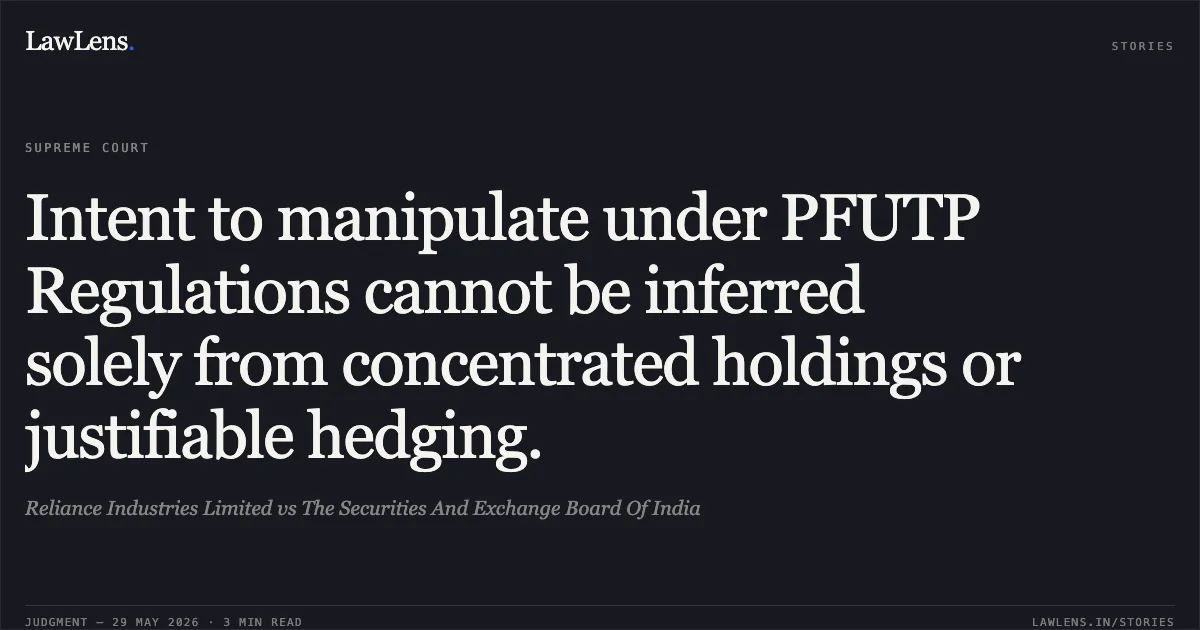
Source reference: para. 140-141However, it found that this regulatory breach did not ipso facto scale to "fraud" under PFUTP. The Court reasoned that the futures positions (9.92 crore) were "valid hedges" because they were significantly lower than the underlying 22.50 crore shares exposed to risk in the cash segment.
Source reference: para. 183, 191It rejected the "naked hedge" theory, noting that law does not require a perfect 1:1 ratio for hedging.
Source reference: para. 184-188Regarding the alleged price manipulation on the settlement day, the Court observed that as a 70% stakeholder, RIL had no rational motive to depress its own company’s valuation.
Source reference: para. 199It found that RIL sold the 1.95 crore shares at ₹210 (above its previous floor of ₹208) to capitalize on a sudden price spike, rather than to depress the market.
Source reference: para. 201-206The Court concluded that SEBI failed to meet the higher burden of proof required to establish manipulation where no third-party inducement was shown.
Source reference: para. 207-208Holding
The Supreme Court partly allowed the appeal. It set aside the findings of fraud under Regulations 3 and 4 of the PFUTP Regulations and quashed the order of disgorgement.
However, it upheld the penalty for the technical violation of the 2001 SEBI Circular regarding the non-disclosure of exceeding position limits.
Source reference: para. 230The Court ordered the refund of ₹250 crore deposited by RIL in the Investor’s Protection Fund.
Source reference: para. 229Final relief: Finding of fraud quashed; disgorgement set aside; penalty for position-limit disclosure breach sustained.
Source reference: para. 227-231Acts & Sections Cited
4 provisions across 2 statutes referred to in this judgment. Each provision opens on LawLens.
Securities and Exchange Board of India Act, 19923
Indian Contract Act, 18721
Original Court PDF
Reliance Industries LimitedvsThe Securities And Exchange Board Of India
Click to open original judgment
Original judgment, available to read, download and summarize on LawLens.in