Facts
On 1 September 2009 at approximately 4:30 p.m., the appellant, Yoosaf, allegedly attacked Suneesh near the appellant’s house at Valayam with a chopper, after suspecting that Suneesh maintained an illicit relationship with his wife. The prosecution case was that the appellant first attempted to assault Suneesh, causing defensive injuries to his hand, and then inflicted a further cut injury to his left thigh, severing the femoral artery, veins and nerve. Suneesh died while being taken to hospital.
Source reference: pp. 5–7, paras. 8–9The prosecution relied principally on the occurrence-witnesses, PW2 and PW3, whose evidence was supported by the medical testimony of PW15, the post-mortem certificate, recovery of the blood-stained weapon under Section 27 of the Evidence Act, and other corroborative evidence. Although the appellant was originally charged under Section 302 IPC, the Additional Sessions Court convicted him under Section 304 Part I IPC and sentenced him to seven years’ rigorous imprisonment, a fine of ₹1,00,000, and one year’s rigorous imprisonment in default of payment of fine. The appellant challenged both the conviction and sentence before the High Court.
Source reference: pp. 7–14, paras. 10–16; p. 3, para. 4Issues
Whether the prosecution proved that the appellant caused Suneesh’s death and was thereby guilty of culpable homicide not amounting to murder under Section 304 IPC?
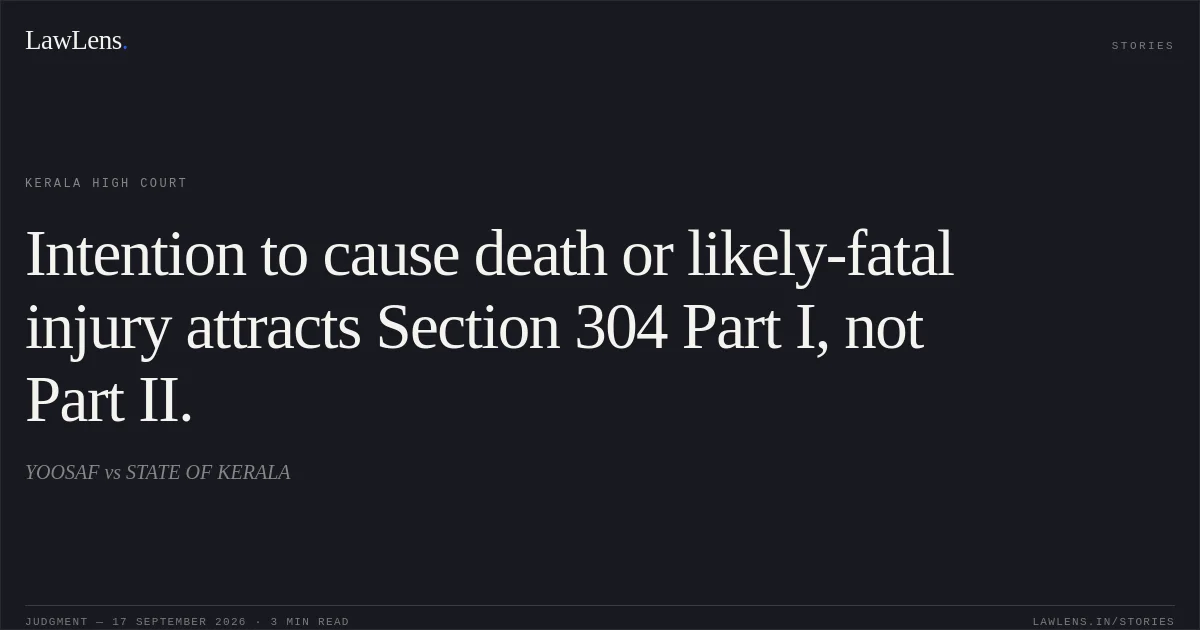
Source reference: p. 4, para. 7(i); pp. 15–19, paras. 18–19Whether the proved offence fell under Section 304 Part I IPC, involving intention to cause death or such bodily injury as was likely to cause death, or under Section 304 Part II IPC, involving only knowledge of the likelihood of death?
Source reference: p. 4, para. 7(i); pp. 15–19, paras. 18–19Whether the conviction and sentence imposed by the trial court required appellate interference?
Source reference: p. 4, para. 7(ii); pp. 19–20, paras. 20–22Law Applied
The Court applied Sections 299 and 304 IPC: culpable homicide is established where death is caused by an act done with the intention of causing death, with the intention of causing bodily injury likely to cause death, or with knowledge that the act is likely to cause death; Section 304 Part I applies where intention is present, whereas Part II applies where there is knowledge without the requisite intention.
Source reference: pp. 15–17, paras. 18–19The Court also considered the distinction between culpable homicide amounting to murder under Sections 300 and 302 IPC and culpable homicide not amounting to murder under Section 304 IPC. It relied on Richhpal Singh Meena v. Ghasi for the structured inquiry into homicide, culpable homicide, murder, and the applicable punishment, and on Jagriti Devi v. State of Himachal Pradesh for the distinction between “intention” and “knowledge” under Section 304 IPC. The Court further relied on Section 27 of the Evidence Act concerning discovery of a material fact pursuant to information given by an accused in custody.
Source reference: pp. 17–19, para. 19; pp. 12–14, paras. 16–17Reasoning
The Court found PW2 and PW3 to be consistent and reliable eyewitnesses, observing that no material contradiction affecting the occurrence or the appellant’s overt acts had been established. Their testimony was corroborated by the medical evidence, which established that the fatal thigh injury severed the femoral artery and that the hand injuries were defensive wounds. The recovery of the chopper pursuant to the appellant’s disclosure further supported the prosecution case.
Source reference: pp. 10–11, paras. 11–12; pp. 5–7, 9–12, paras. 8–9, 13–14; pp. 12–14, para. 16Applying Sections 299 and 304 IPC, the Court held that the appellant’s conduct demonstrated more than mere knowledge. He came armed with a chopper, uttered threats to kill, pursued Suneesh after the first assault, and inflicted a second cut on the vulnerable upper thigh, resulting in fatal blood loss. The Court therefore inferred an intention to cause death or bodily injury likely to cause death, notwithstanding the trial court’s decision not to convict under Section 302 IPC. The absence of a separately proved motive did not create reasonable doubt, particularly because the prosecution evidence established the appellant’s suspicion regarding Suneesh’s relationship with his wife and independently proved the assault.
Source reference: pp. 7–10, paras. 10–11; p. 19, para. 19; pp. 9–10, 19, paras. 10, 19Holding
The High Court held that the prosecution proved beyond reasonable doubt that the appellant caused Suneesh’s death and that the offence fell under Section 304 Part I IPC, not Section 304 Part II IPC.
The conviction and sentence of seven years’ rigorous imprisonment, a fine of ₹1,00,000, and one year’s rigorous imprisonment in default were confirmed as reasonable. The appeal was dismissed, the order suspending sentence and granting bail was cancelled, and the appellant was directed to surrender before the trial court forthwith to undergo the sentence.
Source reference: pp. 19–20, paras. 20–22; p. 20, paras. 22–23Acts & Sections Cited
9 provisions across 2 statutes referred to in this judgment. Each provision opens on LawLens.
Indian Penal Code, 18607
Code of Criminal Procedure, 19732
Original Court PDF
YOOSAFvsSTATE OF KERALA
Click to open original judgment
Original judgment, available to read, download and summarize on LawLens.in