Facts
The applicants, Indian Defence Estates Service (IDES) officers of the 2004 batch, were selected through the Main List (Tranche-I) of the Civil Services Examination (CSE) 2003. The private respondents were selected through the Reserve List (Tranche-II) of the same examination.
Source reference: para. 4.1Historically, the applicants were placed senior to the respondents in civil lists from 2005 to 2018 based on their earlier joining dates.
Source reference: para. 4.2Following DOPT OMs dated 08.08.2013 and 09.01.2014, and a 2013 CAT judgment (Neeraj Kumar Sharma case), the official respondents revised the seniority in 2019 to reflect aggregate marks obtained in the CSE, placing the higher-scoring private respondents above the applicants.
Source reference: para. 2, 7.5The applicants challenged this retrospective revision after nearly five years, claiming their seniority was "settled".
Source reference: para. 4.5, 14.1Issues
1. Whether candidates recommended through Tranche-I (Main List) and Tranche-II (Reserve List) of the same Civil Services Examination are to be treated as one common batch for fixing inter se seniority based on aggregate merit.
Source reference: para. 122. Whether the challenge to the seniority list published in 2019 is barred by limitation and the doctrine of laches/acquiescence.
Source reference: para. 14, 15Law Applied
The Tribunal applied Section 21 of the Administrative Tribunals Act, 1985, which mandates a one-year limitation period for filing applications.
Source reference: para. 7.10, 14DOPT OMs dated 22.12.1959, 03.07.1986, and 04.11.1992 establish that the seniority of direct recruits is determined by the order of merit (marks) assigned by the recruiting authority (UPSC), not the date of joining.
Source reference: para. 13.2, 13.4, 13.5The Tribunal cited Union of India v. Ramesh Ram (2010) regarding the nature of reserve lists and Shiba Shankar Mohapatra v. State of Odisha (2010) regarding the impermissibility of disturbing settled seniority after a long lapse of time.
Source reference: para. 13.10, 15.1Reasoning
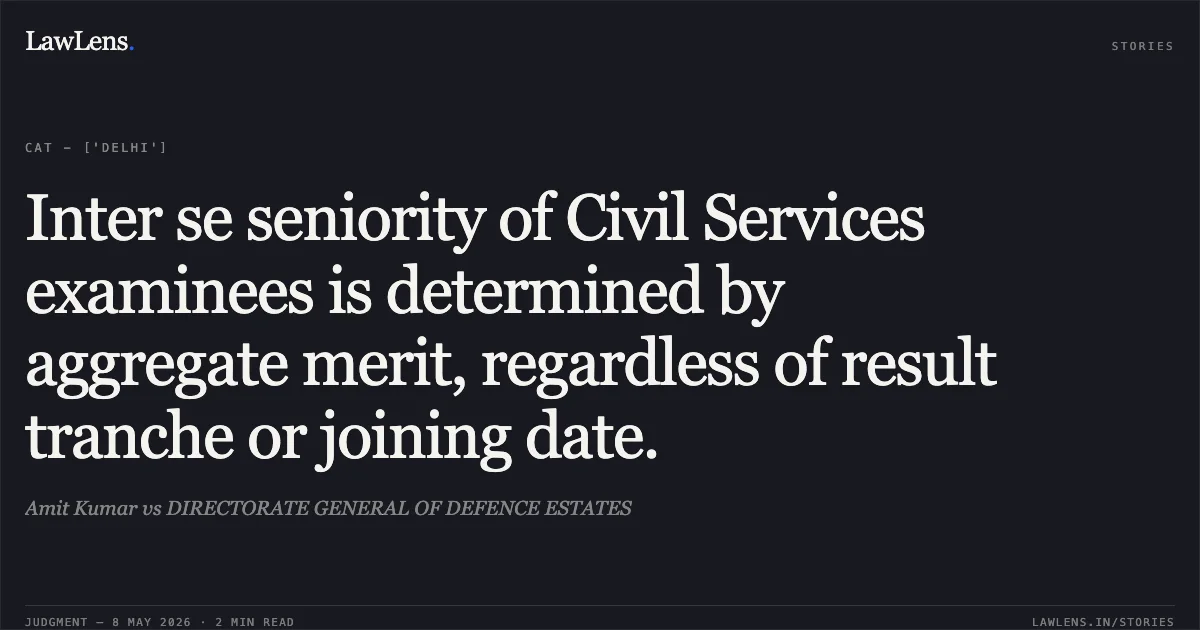
The Tribunal reasoned that since all parties were recruited through the same CSE-2003 cycle, they belong to the same batch; the declaration of results in two tranches was a mere administrative exigency and did not create separate recruitment years.
Source reference: para. 11, 13.11The "Rule of Merit" dictates that those with higher marks rank higher, regardless of joining date.
Source reference: para. 13.18Administratively, the applicants had acquiesced to the new seniority by failing to challenge the 2019 final list for five years, during which time consequential benefits like Non-Functional Upgradation (NFU) were granted based on that very list.
Source reference: para. 15.2, 15.3The Tribunal rejected the "continuing cause of action" argument, noting that subsequent annual civil lists merely reflected a completed administrative action from 2019.
Source reference: para. 14.4Holding
The Tribunal dismissed both OAs, holding that they were "hopelessly barred by limitation" as the cause of action arose in January 2019.
On merits, it held that inter se seniority must be strictly aligned with the merit ranking of the common examination, confirming the private respondents' seniority over the applicants due to their higher aggregate marks.
Source reference: para. 17, 17.1The Tribunal further directed the respondents to proceed with pending promotions for officers not involved in seniority disputes to prevent administrative stalemate and ordered no costs.
Source reference: para. 20, 22Acts & Sections Cited
2 provisions across 1 statute referred to in this judgment. Each provision opens on LawLens.
Administrative Tribunals Act, 19852
Original Court PDF
Amit KumarvsDIRECTORATE GENERAL OF DEFENCE ESTATES
Click to open original judgment
Original judgment, available to read, download and summarize on LawLens.in