Facts
The appellant, a public charitable trust registered under Section 12AA of the Income-tax Act, 1961, filed returns for Assessment Year 2017–18 declaring nil income. During scrutiny, the Assessing Officer noted that the trust had received fixed-deposit interest of approximately ₹1.81 crore. While ₹87,44,300 was credited to the Income and Expenditure Account, ₹94,39,503, together with savings-bank interest and other income aggregating to ₹94,66,848, was credited directly to the Balance Sheet under the “SJDT Sustainable Fund” account.
Source reference: pp.2–3The trust contended that the funds represented amounts received from Self-Help Groups and foreign donors for micro-credit programmes, which were held in a fiduciary or custodial capacity and were returnable with accrued interest. The Assessing Officer treated ₹94,66,848 as taxable revenue income, and the NFAC and Income Tax Appellate Tribunal affirmed the addition. The trust consequently filed the present appeal under Section 260A of the Act.
Source reference: p.3Issues
1. Whether interest earned on fixed deposits out of funds allegedly held for Self-Help Groups and foreign donors was assessable as income of the assessee-trust under the Income-tax Act.
Source reference: p.32. Whether the “SJDT Sustainable Fund” constituted funds belonging to the Self-Help Groups and was therefore not income of the assessee.
Source reference: p.33. Whether the interest on bank deposits, allegedly held by the trust as custodian and returnable under agreements with the Self-Help Groups, was taxable in the hands of the trust.
Source reference: p.3Law Applied
The Court applied Section 11(1)(d) of the Income-tax Act, 1961, under which voluntary contributions qualify for corpus exemption only where there is a specific written direction from the donor that the contribution forms part of the corpus.
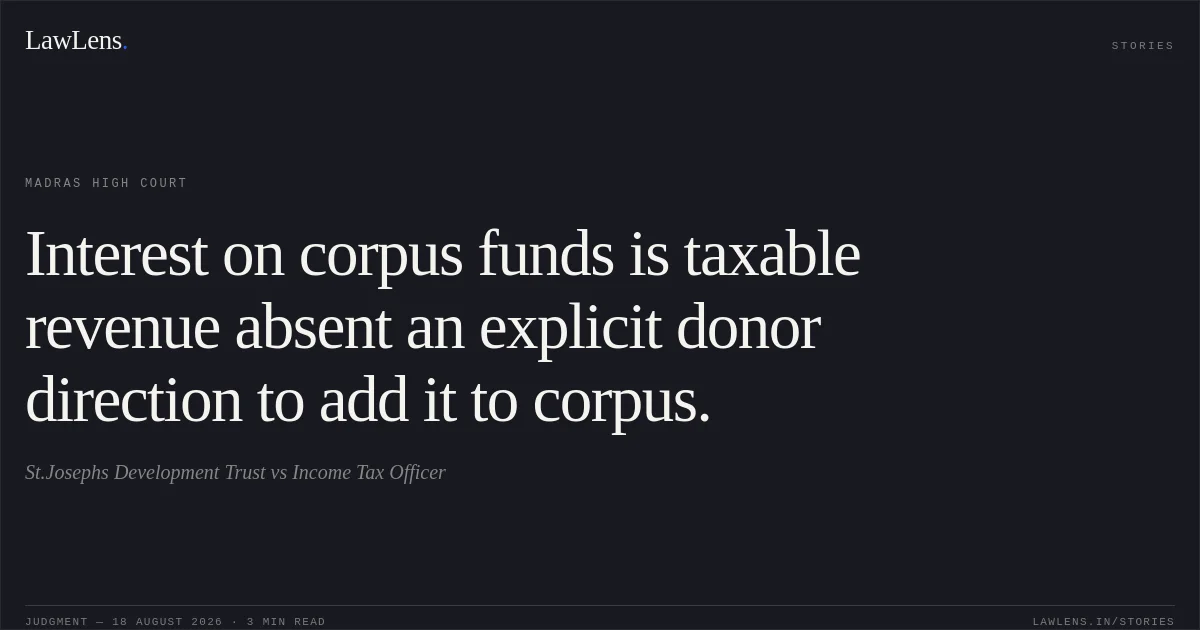
Source reference: p.4Interest earned from investing such funds is income generated by the trust and, absent an express donor direction that the interest itself should form part of the corpus, constitutes revenue receipt requiring appropriate accounting through the Income and Expenditure Account.
Source reference: pp.4–5The Court distinguished CIT (Exemptions) v. Mata Amritanandamayi Math, 2017 (9) TMI 1232, because that case involved express written donor directions concerning interest, and Director of Income Tax v. Society for Development Alternatives, 2012 (1) TMI 77, which concerned unspent project grants returnable under strict agency terms.
Source reference: pp.5–6The Court further applied the principles that a subsequent obligation to utilise income generally amounts to application of income rather than diversion at source, and that each assessment year is a separate assessment unit.
Source reference: p.7Reasoning
The Court found that the foreign-donor correspondence referred to micro-credit and revolving-loan programmes and permitted the distribution of refunded funds to Self-Help Groups, but did not expressly direct that interest earned on fixed deposits should be added to the trust’s corpus.
Source reference: p.4The fixed deposits were maintained in the trust’s name and the interest accrued directly from the trust’s investments; accordingly, the interest was treated as income generated by the trust rather than as funds held outside its income stream.
Source reference: p.6The trust’s assertion that it was merely a custodian was also weakened by its claim for TDS credit on the entire interest income, which was inconsistent with excluding that interest from its gross receipts.
Source reference: p.6Any later obligation or arrangement to use the interest for Self-Help Groups constituted application of income and not diversion at source.
Source reference: p.7The Court also held that the Revenue was not precluded from adopting the correct legal position for AY 2017–18 merely because similar interest had allegedly not been taxed in an earlier assessment year.
Source reference: p.7Holding
The Madras High Court answered all substantial questions of law in favour of the Revenue and against the assessee. It held that the interest income of ₹94,66,848 earned on bank fixed deposits was taxable revenue receipt and did not qualify for exemption under Section 11(1)(d), in the absence of specific donor directions treating such interest as corpus.
The appeal was dismissed, and the Tribunal’s order dated 29.12.2023 was affirmed, with no order as to costs.
Source reference: p.8Acts & Sections Cited
4 provisions across 1 statute referred to in this judgment. Linked provisions open on LawLens.
Income Tax Act, 19614
Original Court PDF
St.Josephs Development TrustvsIncome Tax Officer
Click to open original judgment
Original judgment, available to read, download and summarize on LawLens.in