Facts
The appellant, formerly ABN Amro Bank N.V., was a Netherlands-incorporated non-resident banking company carrying on business in India through a branch recognised as a permanent establishment (PE).
Source reference: para. 2For the assessment years 1999–2000, 2000–01 and 2001–02, it claimed taxation at the rate applicable to domestic companies, a deduction for interest paid to its head office and overseas branches, and deduction of offshore remuneration paid to expatriate employees.
Source reference: para. 3The Assessing Officer applied the higher rate applicable to foreign companies and disallowed the interest deduction of Rs. 99,77,325 under Section 40(a)(i) on the ground that tax had not been deducted at source.
Source reference: para. 4The Commissioner (Appeals) and the Tribunal affirmed these findings, the Tribunal relying on its earlier decisions and a Special Bench ruling concerning the appellant.
Source reference: para. 5The appellant also sought exclusion of Rs. 1,52,17,356 received as interest from its head office and overseas branches, contending that if interest paid to those entities was treated as a payment to self, the interest received should likewise be excluded; the Tribunal rejected this additional ground.
Source reference: para. 6Issues
Whether the appellant was entitled, under Sections 2(22A) and 90 of the Income-tax Act, 1961, CBDT Circular No. 333, the CBDT letter dated 21 November 1994, and Article 24(2) of the India–Netherlands DTAA, to be taxed at the rate applicable to domestic companies rather than the higher rate applicable to foreign companies.
Source reference: para. 7(i)Whether interest paid by the Indian PE to the appellant’s head office and overseas branches was allowable as a deduction in computing the PE’s taxable profits, notwithstanding the absence of tax deduction at source.
Source reference: para. 7(ii)Whether, if the interest paid to the head office and overseas branches was not deductible as a payment to self, corresponding interest received by the Indian PE from those entities was also required to be excluded from its taxable income.
Source reference: para. 7(iii)Law Applied
Section 2(22A) defines a “domestic company” as an Indian company or a company that has made prescribed arrangements for declaration and payment of dividends within India, while Section 2(23A) covers foreign companies.
Source reference: para. 10The Explanation to Section 90, inserted retrospectively by the Finance Act, 2001 with effect from 1 April 1962, provides that charging a higher rate of tax on a foreign company does not constitute less favourable treatment.
Source reference: para. 11Article 24(2) of the India–Netherlands DTAA prohibits less favourable taxation only where enterprises are in the same circumstances; Article 7 permits PE profits to be computed by treating the PE as a separate and distinct enterprise.
Source reference: paras. 12, 14Section 40(a)(i) disallows interest payable outside India where applicable tax has not been deducted or paid at source, and Section 195 imposes the relevant withholding obligation.
Source reference: paras. 13–16The Court also relied on CBDT Circular No. 740 concerning the treatment of a foreign bank’s Indian branch and on Royal Bank of Scotland N.V. v. Commissioner of Income Tax, reported in (2026) 494 ITR 171, regarding the effect of the Explanation to Section 90.
Source reference: paras. 11, 14Reasoning
The Court held that the appellant did not satisfy the statutory definition of a domestic company and was therefore a foreign company liable to the rate prescribed for foreign companies.
Source reference: para. 10The retrospective Explanation to Section 90 was treated as clarificatory and determinative against the appellant’s reliance on Article 24(2).
Source reference: para. 12The Court further reasoned that a foreign company taxed only on Indian-source income and a domestic company taxed on its global income are not in the same circumstances for purposes of the non-discrimination clause.
Source reference: para. 12On the interest issue, the Court applied the separate-entity fiction under Article 7: although the PE and head office are parts of the same legal entity, they are treated as separate enterprises for computing PE profits.
Source reference: paras. 13–16Accordingly, interest remitted to the head office was subject to the domestic withholding provisions, and failure to deduct tax attracted Section 40(a)(i) disallowance.
Source reference: paras. 13–16The Court rejected the appellant’s attempt to rely on the “payment to self” doctrine selectively, holding that the disallowance resulted from non-compliance with TDS requirements rather than from treating the PE and head office as a single entity for all purposes.
Source reference: paras. 17–19Correspondingly, interest received by the PE from the head office and foreign branches constituted taxable business income and could not be excluded as a payment to self or on the basis of mutuality.
Source reference: paras. 19–21Holding
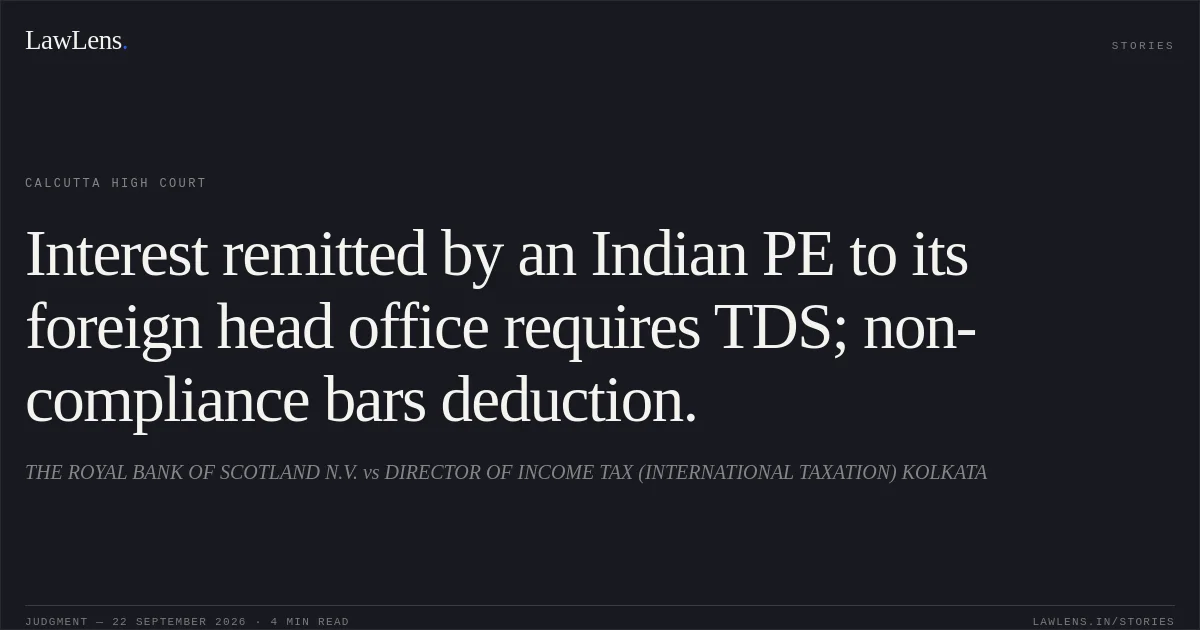
The Court answered all three substantial questions in the affirmative and against the appellant, holding that the appellant was liable to tax at the foreign-company rate, that the interest paid to its head office and overseas branches was disallowable under Section 40(a)(i) for failure to deduct tax at source, and that interest received from those entities was taxable in India.
The judgment states that the appeal was “allowed” but simultaneously records that all questions were answered against the assessee and directs that the impugned Tribunal order be set aside and consequential orders be passed by the Assessing Officer.
Source reference: para. 22Connected applications were disposed of and no order was made as to costs.
Source reference: paras. 23–24Acts & Sections Cited
6 provisions across 1 statute referred to in this judgment. Linked provisions open on LawLens.
Income Tax Act, 19616
Original Court PDF
THE ROYAL BANK OF SCOTLAND N.V.vsDIRECTOR OF INCOME TAX (INTERNATIONAL TAXATION) KOLKATA
Click to open original judgment
Original judgment, available to read, download and summarize on LawLens.in