Facts
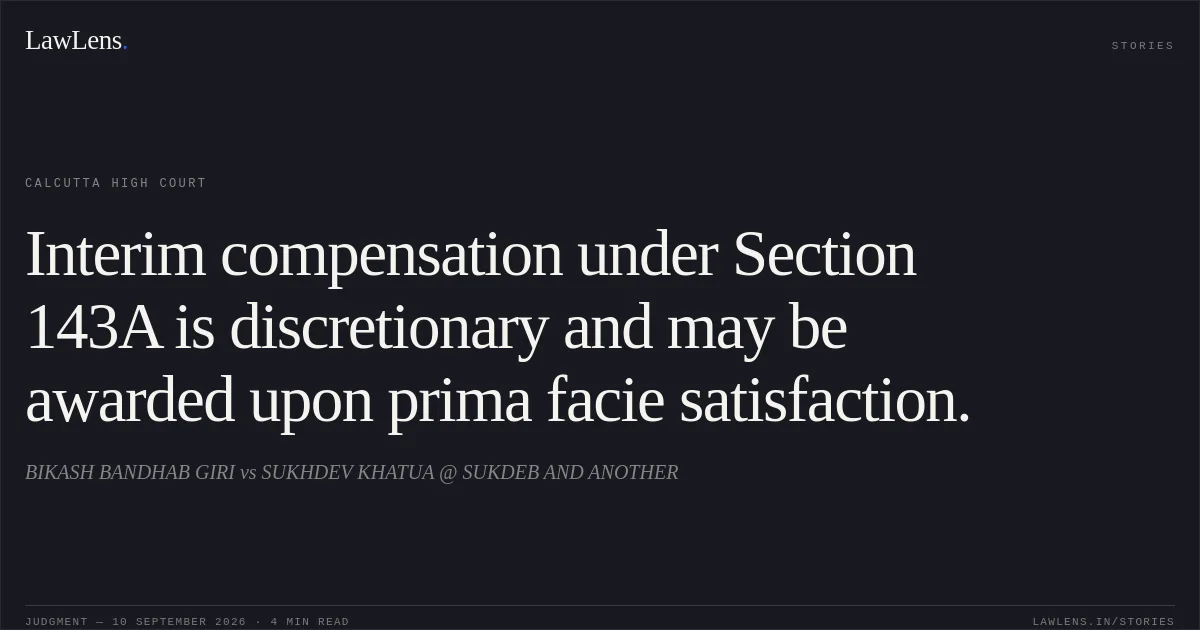
The petitioner challenged the order dated 6 May 2024 passed by the Judicial Magistrate, 1st Class, Datan, Paschim Midnapore, directing him to pay interim compensation under Section 143A of the Negotiable Instruments Act, 1881 (“NI Act”) equivalent to 20% of the cheque amount, namely ₹10 lakhs on a cheque of ₹50 lakhs, within 60 days.
Source reference: para. 1–2The complaint under Section 138 of the NI Act was filed on 12 May 2023; the petitioner appeared and was granted bail on 21 July 2023, and on 17 August 2023 the substance of accusation was explained to him under Section 251 of the Code of Criminal Procedure, 1973, to which he pleaded not guilty.
Source reference: para. 2The complainant alleged that the parties had business dealings involving paddy worth approximately ₹2.5 crores and that the petitioner had acknowledged dues of ₹5,30,89,143 in writing.
Source reference: para. 4–5The petitioner disputed the liability, alleging that the proceedings were based on blank security cheques and that the complainant had coerced him and his wife into executing a sale deed in relation to certain property.
Source reference: para. 6–7Issues
Whether the Magistrate was justified in directing the petitioner to pay interim compensation under Section 143A of the NI Act after he pleaded not guilty in the Section 138 proceedings.
Source reference: para. 2, 10–11Whether the direction to pay 20% of the cheque amount was legally unsustainable for want of adequate reasons or because the petitioner disputed the underlying liability and alleged that the cheque was a security cheque.
Source reference: para. 6–9, 12–13Whether failure to pay interim compensation could expose the accused to any consequence beyond the statutory recovery mechanism under Section 143A(5) read with Section 421 of the Code of Criminal Procedure.
Source reference: para. 10–11Law Applied
Section 143A(1)(a) of the NI Act empowers the court trying a summons case or summary trial under Section 138 to direct the accused to pay interim compensation when he pleads not guilty; the amount cannot exceed 20% of the cheque amount under Section 143A(2), and payment is ordinarily required within 60 days, extendable by up to 30 days for sufficient cause under Section 143A(3).
Source reference: para. 11If the accused is acquitted, the complainant must repay the interim compensation with applicable bank-rate interest under Section 143A(4), while Section 143A(5) permits recovery as if the amount were a fine under Section 421 CrPC.
Source reference: para. 10–11In G.J. Raja v. Tejraj Surana, the Supreme Court held that Section 143A is prospective and recognised the coercive statutory recovery mechanism under Section 421 CrPC.
Source reference: para. 10In Noor Mohammad v. Khurram Pasha, the Supreme Court held that the statutory method of recovering interim compensation must be followed and that the court cannot impose additional disabilities, such as closing the accused’s right to cross-examine, for non-payment.
Source reference: para. 11The power under Section 143A is discretionary rather than mandatory, but may be exercised where the court is satisfied that a prima facie case exists.
Source reference: para. 2Reasoning
The High Court found that the petitioner had pleaded not guilty in the Section 138 proceedings and that the Magistrate had recorded satisfaction regarding the existence of prima facie material against him.
Source reference: para. 2The cheques were prima facie issued by the petitioner and were dishonoured upon presentation.
Source reference: para. 12Accordingly, the statutory precondition for considering interim compensation under Section 143A was satisfied.
Source reference: no citationThe petitioner’s defence that the cheques were blank security cheques, his denial of the alleged dues, and the disputed commercial transactions concerned matters requiring adjudication at trial and did not, at this stage, negate the prima facie case recorded by the Magistrate.
Source reference: para. 6–7, 12–13The direction of 20% of the cheque amount was within the statutory ceiling prescribed by Section 143A(2), and the period of 60 days corresponded with Section 143A(3).
Source reference: para. 2, 11The High Court further noted that the order did not impose any impermissible consequence upon the petitioner; any failure to pay could be addressed only through the recovery procedure authorised by Section 143A(5) read with Section 421 CrPC, consistent with Noor Mohammad.
Source reference: para. 10–11Since the impugned order was found to be in accordance with law and caused no prejudice to the petitioner, revisional interference was unwarranted.
Source reference: para. 13Holding
The High Court held that the Magistrate was justified in directing payment of interim compensation under Section 143A of the NI Act.
The direction to pay ₹10 lakhs, being 20% of the ₹50 lakh cheque amount within 60 days, was affirmed.
Source reference: para. 2, 13The criminal revision, CRR 2279 of 2024, was dismissed, and the order dated 6 May 2024 was affirmed.
Source reference: para. 14–15No order was made as to costs; connected applications, if any, were disposed of, and any interim order was vacated.
Source reference: para. 16–18Acts & Sections Cited
7 provisions across 2 statutes referred to in this judgment. Each provision opens on LawLens.
Negotiable Instruments Act, 18812
Code of Criminal Procedure, 19735
Original Court PDF
BIKASH BANDHAB GIRIvsSUKHDEV KHATUA @ SUKDEB AND ANOTHER
Click to open original judgment
Original judgment, available to read, download and summarize on LawLens.in