Facts
The Appellant, a former director and 80% shareholder of M/s Earth Stein Private Limited (Respondent Company), claimed that his resignation and an undertaking to transfer certain vehicles (one Bolero, three Excavators, and one Tipper) were obtained through forgery and intimidation.
Source reference: p.2The Appellant asserted ownership as the vehicles were registered under his firm, M/s Pure Minerals.
Source reference: p.2The Respondent Company alleged that the Appellant misappropriated ₹1,73,11,894 from the company to purchase these vehicles.
Source reference: p.3Following a series of FIRs, counter-FIRs, and a disputed police seizure from the Respondent's factory, both parties sought interim custody.
Source reference: p.3-5The Trial Court denied both; however, the High Court granted interim custody to the Respondent Company, leading to this appeal.
Source reference: p.5-6Issues
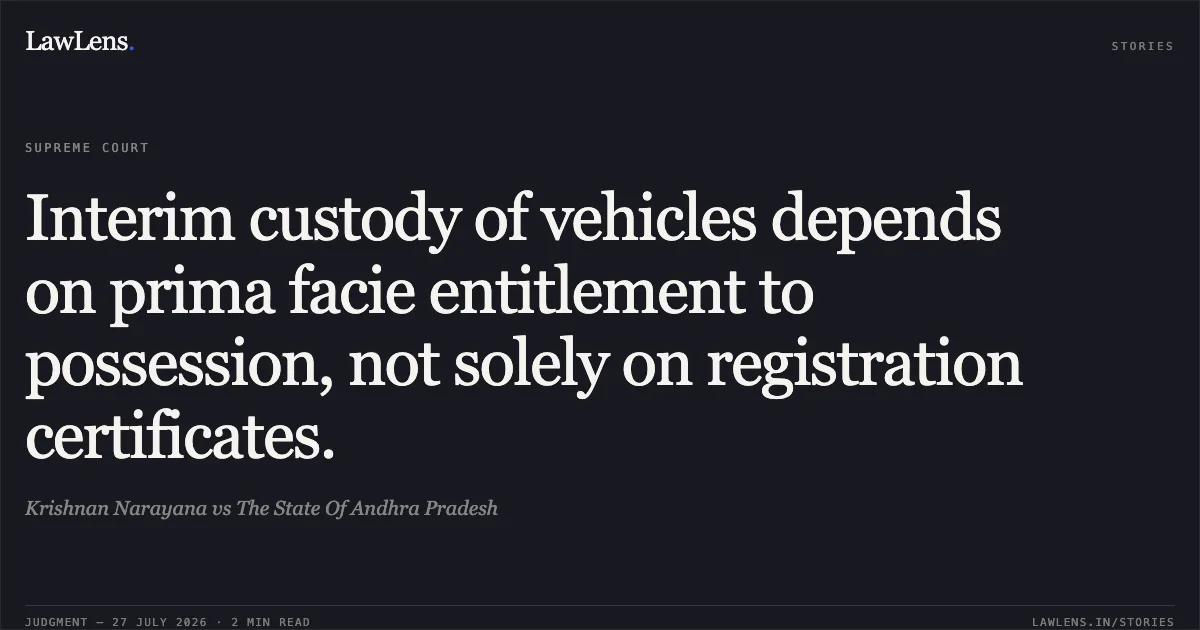
1. Whether the Appellant or the Respondent Company is better entitled to the interim custody of the subject vehicles pending trial under Sections 451 and 457 of the CrPC.
Source reference: p.10, para. 25Law Applied
Sections 451 and 457 of the Code of Criminal Procedure (CrPC), which grant the Magistrate judicial discretion to order the "proper custody" of property during inquiry or trial or to deliver it to the "person entitled to possession".
Source reference: p.10-11, para. 26-27N. Madhavan v. State of Kerala, establishing that the exercise of this discretion must be judicial, not arbitrary, based on reason and justice.
Source reference: p.11, para. 28Sunder Bhai Ambalal Desai v. State of Gujarat, which mandates that such powers be exercised expeditiously to prevent the waste, misuse, or deterioration of property, typically favoring the "ostensible owner" while ensuring the property remains available for trial.
Source reference: p.6-7, para. 17; p.12, para. 29Reasoning
The Court reasoned that Sections 451 and 457 focus on interim "possession" and "custody" rather than a final adjudication of "title" or "ownership".
Source reference: p.11, para 27; p.12, para 30While the Appellant held the Registration Certificates (RC), the Court determined that an RC is evidentiary but not conclusive of the right to interim possession.
Source reference: p.13, para. 32-33The Court noted three critical factors favoring the Respondents: (a) the vehicles were seized from the Respondent Company’s operational site where they were in active use; (b) the Respondent Company had been paying the hypothecation loan installments (EMIs) for the vehicles, which the Appellant failed to explain; and (c) the Appellant had executed an undertaking allowing the Respondent to use the vehicles until a settlement of accounts—an undertaking supported by the Appellant’s unexplained encashment of a share-transfer cheque.
Source reference: p.15, para. 35; p.16, para. 36; p.15, para. 35The Court concluded that these cumulative factors outweighed the mere existence of the RC.
Source reference: p.16, para. 37Holding
The Supreme Court dismissed the appeals and upheld the High Court’s order, holding that the Respondent Company is better entitled to interim possession of the subject vehicles.
The Court directed that the vehicles be released to the Respondent subject to an undertaking affidavit.
Source reference: p.6, para. 15The Court clarified that this decision is limited to interim custody and does not constitute an opinion on the merits of the underlying disputes regarding ownership, forgery, or misappropriation, which must be resolved in trial.
Source reference: p.17, para. 39Acts & Sections Cited
4 provisions across 2 statutes referred to in this judgment. Each provision opens on LawLens.
Code of Criminal Procedure, 19733
Indian Penal Code, 18601
Original Court PDF
Krishnan NarayanavsThe State Of Andhra Pradesh
Click to open original judgment
Original judgment, available to read, download and summarize on LawLens.in