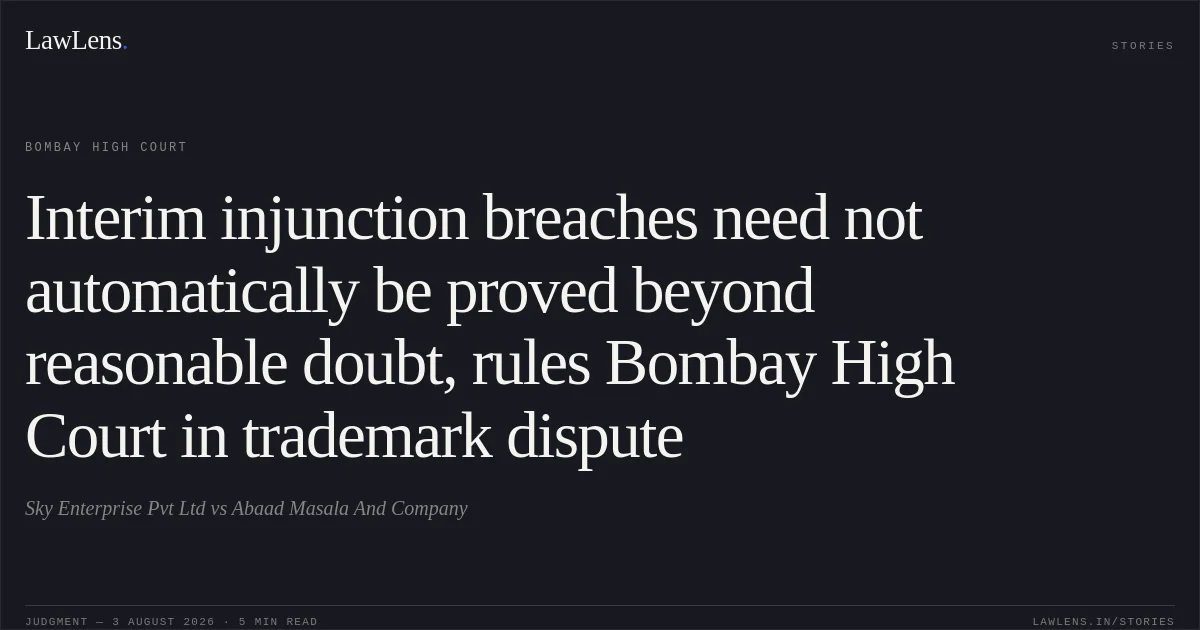
Facts
Sky Enterprise, engaged in the manufacture and marketing of masala powders and spices, owned registered marks including “Star Zing White Chinese Pepper Masala” and “Star Zing Black Chinese Pepper Masala”.
Source reference: paras. 2–4; pp. 2–3On 8 January 2020, the Bombay High Court restrained Abaad Masala from directly or indirectly advertising, displaying or using “White Chinese Pepper Masala”, “Black Chinese Pepper Masala”, or any identical or deceptively similar marks or words in that peculiar combination, and from passing off its goods as Sky’s goods.
Source reference: para. 1; p. 2After the injunction, Abaad replaced its earlier “Star King” branding with “Frize” and adopted the marks “Frize White Spicy Pepper Masala” and “Frize Black Spicy Pepper Masala”.
Source reference: paras. 5–6; pp. 3–4Sky alleged that these marks, together with Abaad’s substantially similar packaging and trade dress, were intended to circumvent the Interim Order and constituted disobedience under Order XXXIX Rule 2A of the Code of Civil Procedure, 1908 (“CPC”).
Source reference: paras. 7–8; pp. 5–6Abaad denied breach, contending that “Spicy” was materially different from “Chinese”, that the parties operated in different markets, and that the new marks had subsequently been registered.
Source reference: paras. 9–13; pp. 6–8The Court also noted that Abaad’s registrations were obtained in January 2025 without disclosing the Interim Order to the Trade Marks Registry.
Source reference: paras. 15(G)–(H); pp. 12–13Issues
Whether the marks “Frize White Spicy Pepper Masala” and “Frize Black Spicy Pepper Masala” were identical or deceptively similar to the marks protected by the Interim Order and therefore violated that order under Order XXXIX Rule 2A CPC.
Source reference: paras. 15(A)–(E), 18–21, 49–50; pp. 9–16, 35–36Whether Abaad’s altered packaging and trade dress constituted an indirect attempt to circumvent the substance and object of the Interim Order.
Source reference: para. 15(E); p. 11What standard of proof and legal approach governed an application under Order XXXIX Rule 2A CPC, and whether attachment of property or civil imprisonment was warranted.
Source reference: paras. 22–27, 31–48; pp. 17–34Whether Abaad’s subsequent registration of the modified marks barred the Court from examining or restraining their use in proceedings concerning breach of the Interim Order.
Source reference: paras. 15(G)–(H), 30; pp. 12–13, 22Law Applied
The Court applied Order XXXIX Rules 1, 2 and 2A and Section 151 CPC: Rule 2A enables enforcement of an interim injunction, while Section 151 permits remedial directions to secure compliance where punitive attachment or imprisonment is unnecessary.
Source reference: paras. 23–28, 49–54; pp. 17–21, 35–39Relying on Food Corporation of India v. Sukh Deo Prasad, the Court held that the obligation allegedly breached must be clearly contained in the injunction and cannot be created by conjecture or extrapolation.
Source reference: paras. 33–34, 47–48; pp. 24–25, 32–34It adopted a high degree of preponderance of probabilities for determining breach, while requiring exceptional caution before imposing attachment or civil imprisonment.
Source reference: paras. 48(B), 50; pp. 33–36Sitaram v. Ganesh Das and Samee Khan v. Bindu Khan established that Rule 2A is principally coercive and remedial, intended to secure obedience rather than punish, and that attachment or imprisonment is not automatic.
Source reference: paras. 25–27; pp. 19–21The Court relied on the “safe distance” principle in Pidilite Industries Ltd. v. Raghunath Chemicals, and on Ruston & Hornsby Ltd. v. Zamindara Engineering Co., Rana Steels v. Ran India Steels Pvt. Ltd. and Apex Laboratories Pvt. Ltd. v. Axis Life Sciences for the proposition that minor additions or substitutions do not cure deceptive similarity.
Source reference: paras. 16–21; pp. 14–16It also considered Amazon.com NV Investment Holdings LLC v. Future Retail Ltd., U.C. Surendranath v. Mambally’s Bakery and Dr. U.N. Bora v. Assam Roller Flour Mills Association on the distinction between enforcement under Rule 2A and punitive contempt jurisdiction.
Source reference: paras. 13, 32, 35–41; pp. 8, 23–30Applying Lupin Ltd. v. Johnson & Johnson, the Court held that a subsequent registration obtained without disclosure of the subsisting injunction did not prevent examination of the modified marks in the present proceedings.
Source reference: para. 15(G)–(H); pp. 12–13Reasoning
The Court found that the Interim Order expressly prohibited not only the two specified marks but also any deceptively similar marks or words used in their peculiar combination.
Source reference: paras. 1, 49; pp. 2, 35Abaad’s substitution of “Chinese” with “Spicy”, while retaining “White” or “Black” and “Pepper Masala”, and prefixing the marks with “Frize”, was viewed as a de minimis alteration that did not create a sufficiently safe distance from Sky’s marks.
Source reference: paras. 15(B)–(D), 18–21; pp. 9–16The Court considered the phonetic and visual similarity, the overall structure of the marks, the average consumer with imperfect recollection, the parties’ common family background and overlapping trade channels, and Abaad’s use of half-kilogram retail-sized packages.
Source reference: paras. 15(C)–(F); pp. 10–12Similar trade dress and packaging were treated as an indirect means of achieving the very conduct prohibited by the Interim Order, notwithstanding that trade dress had not been separately pleaded in the original suit.
Source reference: para. 15(E); p. 11The later registration did not assist Abaad because it was obtained after the injunction and without disclosure of that order to the Registrar.
Source reference: paras. 15(G)–(H), 30; pp. 12–13, 22Although the Court found a violation, it considered attachment or imprisonment disproportionate in the circumstances, particularly because the proceedings arose from a family commercial dispute and remedial directions could secure compliance.
Source reference: paras. 28, 51–53; pp. 21, 36–37Holding
The Court held that “Frize White Spicy Pepper Masala” and “Frize Black Spicy Pepper Masala” were deceptively similar to Sky’s protected marks and did not comply with the Interim Order.
Treating the application as one under Order XXXIX Rule 2A CPC, rather than as a contempt petition under the Contempt of Courts Act, the Court restrained Abaad from using the two modified marks and prohibited further de minimis variations that failed to maintain a safe distance from Sky’s registered marks.
Source reference: paras. 31, 54(A)–(C); pp. 22–23, 37Abaad’s partners were directed to file audited quarterly sales and inventory affidavits within four weeks.
Source reference: para. 54(D)–(F); p. 38Abaad was permitted to remove and repackage the contents of unsold products using compliant branding, but was directed within eight weeks to destroy all packaging, stationery and promotional material bearing the impugned marks and remove related advertisements.
Source reference: para. 54(G)–(H); pp. 38–39Non-compliance would expose Abaad’s property to attachment through the Court Receiver.
Source reference: para. 54(I); p. 39The suit and rectification proceedings were directed to be listed for directions on 27 August 2026.
Source reference: para. 55; p. 40Original Court PDF
Sky Enterprise Pvt LtdvsAbaad Masala And Company
Click to open original judgment
Original judgment, available to read, download and summarize on LawLens.in
![Relief is made contingent on the Supreme Court’s eventual determination in the analogous pending case.. Ashok Tolani vs REVENUE. CAT - ['Jaipur']. LawLens](/stories/thumbnails/relief-is-made-contingent-on-the-supreme-courts-eventual-determination-in-the-analogous-pe-0a05b6600e0644cf9facfda571d15955.webp)