Facts
The underlying dispute involves 91 Bighas 08 Biswas of agricultural land in Dera Mandi, Delhi. Respondent No. 1 (plaintiff) initially claimed ownership based on 1998 sale deeds
Source reference: p. 3In 2022, a compromise decree was passed in a prior suit, recording that the plaintiff had given up all rights, title, and interest in favor of late Karan Luthra, who was declared the owner
Source reference: p. 4Subsequently, an execution petition led to the registration of a sale deed in favor of Karan Luthra on 21.06.2024, confirming full payment and delivery of possession
Source reference: p. 5Following Karan Luthra’s death in August 2024, the plaintiff filed a fresh suit in December 2025, alleging a collateral oral understanding for additional payments and seeking to restrain Luthra’s legal heirs (appellants) from creating third-party interests
Source reference: p. 4-5On 03.01.2026, the Trial Court granted an interim injunction against the appellants
Source reference: p. 2-3Issues
1. Whether a plaintiff is entitled to a discretionary interim injunction based on an alleged oral agreement that contradicts a registered sale deed and a compromise decree
Source reference: p. 10 / para. 162. Whether the suppression of execution proceedings and a registered title deed disentitles a party to equitable relief under Order 39 Rules 1 & 2 of the CPC
Source reference: p. 10 / para. 16Law Applied
The Court applied the principles governing interlocutory injunctions under Order 39 Rules 1 & 2 of the Code of Civil Procedure (CPC), 1908, requiring the concurrent establishment of a prima facie case, balance of convenience, and irreparable loss
Source reference: p. 10It further relied on the doctrine of "clean hands" in equity, which dictates that a party suppressing material facts—specifically execution proceedings and registered deeds—is disqualified from seeking discretionary relief
Source reference: p. 10Additionally, the Court enforced the principle that a written, registered title deed and a court-certified compromise decree carry a legal presumption of validity that cannot be displaced by vague, unpleaded oral understandings at an interlocutory stage
Source reference: p. 6, 10Reasoning
The Court reasoned that the plaintiff’s reliance on a General Power of Attorney (GPA) dated 05.07.2022 to prove an oral understanding was legally untenable because the plaintiff’s own prayer in the suit sought to declare that very GPA null and void
Source reference: p. 7The Court found no evidence of the alleged "broader oral understanding," noting that the plaintiff failed to plead specific terms or explain why such terms were excluded from the 2022 compromise decree or the 2024 registered sale deed
Source reference: p. 8Furthermore, the Court observed that the plaintiff participated in the execution proceedings without objection, allowing the sale deed to be registered
Source reference: p. 9The Court held that the suppression of these execution proceedings in the plaint constituted a material concealment of facts
Source reference: p. 10Since the settlement and sale deed explicitly recorded that all claims were satisfied and possession was delivered, the balance of convenience resided entirely with the appellants
Source reference: p. 10Holding
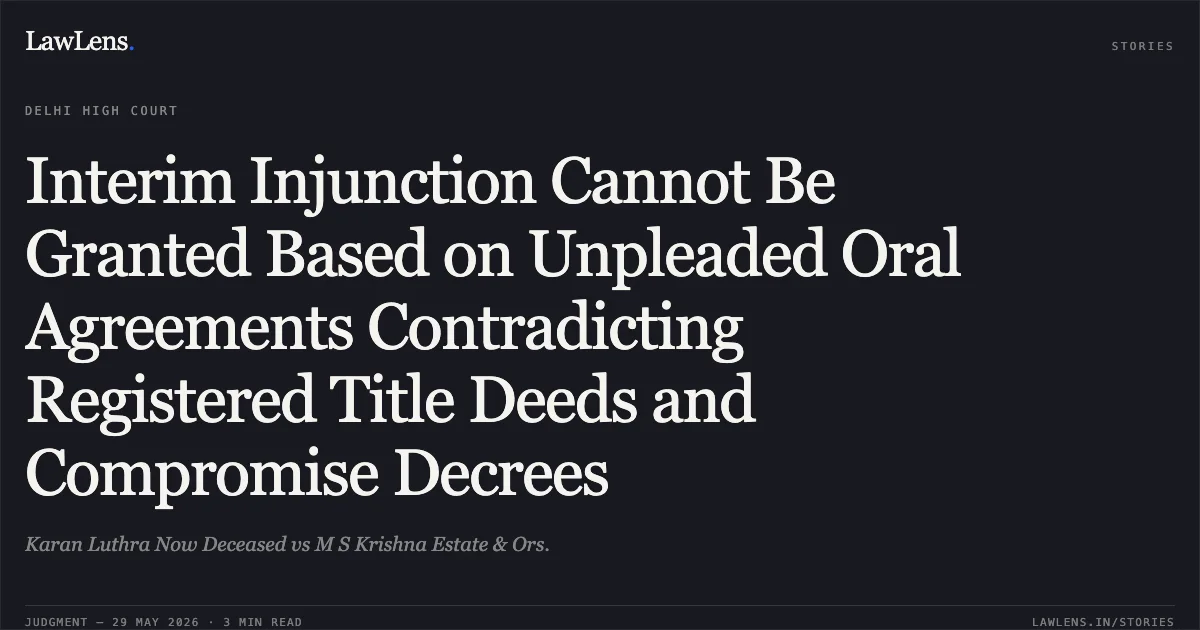
The High Court allowed the appeals and set aside the Trial Court's order dated 03.01.2026. The Court held that a discretionary interim injunction cannot be granted based on a "complete mystery" or a vague oral agreement that seeks to override a registered title deed
The Court ruled that the plaintiff’s failure to approach the court with clean hands by suppressing the execution of the sale deed disentitled them to equitable relief. The defendants (appellants) are no longer restrained from creating third-party interests in the subject properties
Source reference: p. 10Acts & Sections Cited
3 provisions across 1 statute referred to in this judgment. Each provision opens on LawLens.
Code of Civil Procedure, 19083
Original Court PDF
Karan Luthra Now DeceasedvsM S Krishna Estate & Ors.
Click to open original judgment
Original judgment, available to read, download and summarize on LawLens.in