Facts
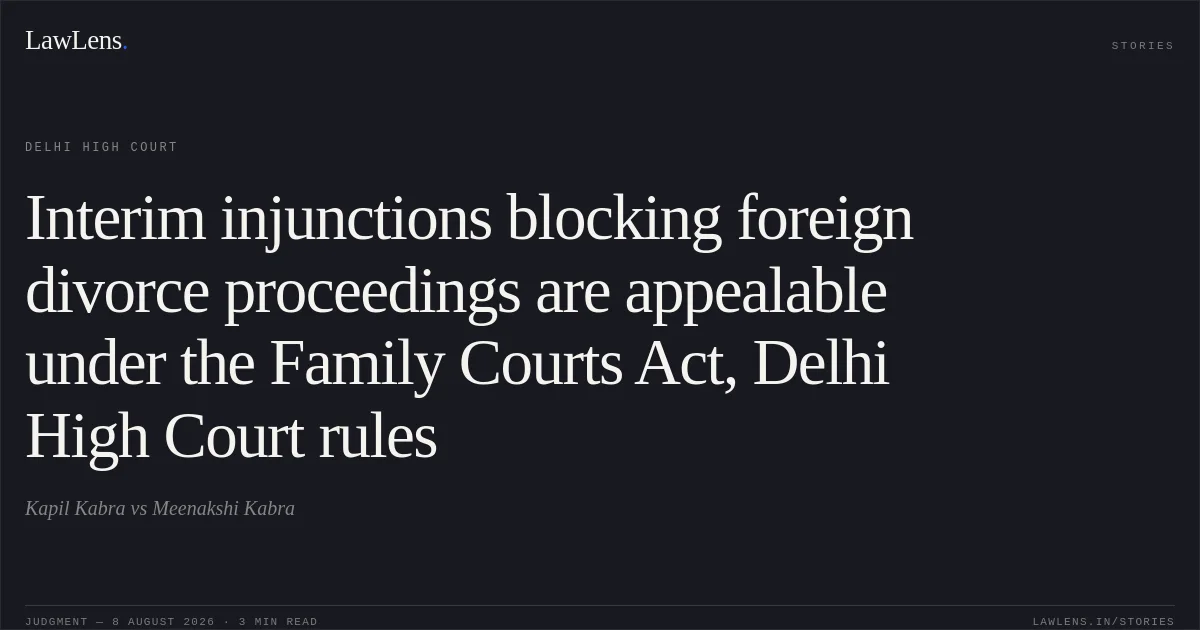
The Petitioner challenged, under Article 227 of the Constitution, the Family Court’s order dated 25 March 2026 granting an ad-interim anti-suit injunction against him.
Source reference: pp. 1–2, paras. 1–2The injunction restrained him from prosecuting divorce proceedings pending before the Superior Court of New Jersey, Chancery Division–Family Part, Somerset County, until final adjudication of the Respondent’s suit before the Family Court.
Source reference: pp. 1–2, paras. 1–2The Respondent objected to maintainability, contending that the injunction was not an “interlocutory order” under Section 19(1) of the Family Courts Act, 1984 (“FC Act”), and was therefore appealable before the High Court.
Source reference: pp. 2–4, paras. 4–12The Petitioner argued that the injunction was temporary, merely preserved the status quo, and did not finally determine the parties’ substantive rights.
Source reference: pp. 4–6, paras. 13–18Issues
Whether an ad-interim anti-suit injunction restraining a party from prosecuting matrimonial proceedings before a foreign court is an “interlocutory order” excluded from the appellate remedy under Section 19(1) of the FC Act?
Source reference: p. 8, para. 23Whether the Petition under Article 227 of the Constitution was maintainable when an appeal under Section 19(1) of the FC Act was available?
Source reference: pp. 16–17, paras. 32–33Law Applied
Section 19(1) of the FC Act provides an appeal against every judgment or order of a Family Court, except an interlocutory order; purely procedural orders that do not possess trappings of finality are excluded from appeal.
Source reference: p. 8, para. 25Since the FC Act does not define “interlocutory order,” its character must be determined by its substance, effect on the parties’ rights, and legal consequences, rather than by its nomenclature or the stage at which it was passed.
Source reference: p. 9, paras. 26–28Relying on the Full Bench decision in Dr. Geetanjali Aggarwal v. Dr. Manoj Aggarwal, 2024 SCC OnLine Del 7220, and Shah Babulal Khimji v. Jayaben D. Kania, (1981) 4 SCC 8, the Court held that an order materially affecting valuable rights or possessing the trappings of finality is appealable even if passed at an interim stage.
Source reference: pp. 9–16, paras. 27–31The Court also applied the principle that Article 227 jurisdiction should ordinarily not be exercised where an efficacious statutory appellate remedy is available.
Source reference: p. 16, para. 32; p. 24, para. 59Reasoning
The Court held that the impugned injunction was not merely procedural or intended to regulate the Family Court proceedings.
Source reference: pp. 17–19, paras. 35–38It immediately disabled the Petitioner from prosecuting matrimonial proceedings already instituted before a competent foreign court, thereby directly restricting his ability to pursue a legal remedy and producing substantive civil consequences.
Source reference: pp. 17–19, paras. 35–38The injunction also had a direct nexus with the permanent anti-suit relief sought in the Family Court suit and operated in aid of that substantive relief.
Source reference: pp. 18–19, paras. 39–42Its temporary duration or description as an order maintaining status quo did not make it interlocutory, since temporariness concerns duration and does not determine whether the order materially affects valuable rights.
Source reference: pp. 18–20, paras. 40–45The decisions relied upon by the Petitioner concerning interim maintenance and temporary arrangements were distinguished because they did not restrain a party from pursuing an independent substantive proceeding before a foreign court.
Source reference: pp. 20–23, paras. 47–55The earlier order passed by a Coordinate Bench was also held not to constitute a precedent on maintainability because that issue had not been considered or decided therein.
Source reference: pp. 23–24, paras. 56–57Holding
The Court held that the anti-suit injunction materially affected the Petitioner’s valuable rights and possessed the trappings of an appealable order; it was therefore not an “interlocutory order” under Section 19(1) of the FC Act.
Since the Petitioner had an appellate remedy under Section 19(1), the Article 227 Petition was held to be not maintainable.
Source reference: pp. 24–25, paras. 59–60The Petition and pending applications were dismissed, with liberty to the Petitioner to pursue such remedy as may be available in law.
Source reference: p. 25, paras. 61–63The Court expressly left all questions on the merits of the anti-suit injunction open.
Source reference: p. 25, paras. 61–63Acts & Sections Cited
12 provisions across 5 statutes referred to in this judgment. Each provision opens on LawLens.
Code of Civil Procedure, 19086
Family Courts Act, 19842
Guardians and Wards Act, 18901
Hindu Marriage Act, 19551
Bombay High Court (Letters Patent) Act, 1866.2
Original Court PDF
Kapil KabravsMeenakshi Kabra
Click to open original judgment
Original judgment, available to read, download and summarize on LawLens.in