Facts
The respondent-wife filed an application under Section 125 of the Code of Criminal Procedure, 1973, seeking maintenance of ₹15,000 per month from the applicant-husband; the parties had married on 26 January 2004 and had a son.
Source reference: p.2; para. 5During the pendency of the proceedings, the Family Court directed the husband to pay interim maintenance of ₹7,000 per month from the date of the application under an order below Exh.39 dated 9 July 2015.
Source reference: p.2; para. 5The husband challenged the interim order before the High Court, which directed the Family Court to decide the main maintenance proceedings but did not set aside or modify the interim maintenance order.
Source reference: pp.3, 6; para. 5, 9The Family Court subsequently rejected the wife’s application for final maintenance on 23 May 2016. The wife thereafter sought recovery of arrears of interim maintenance for the period from 29 August 2013 to 23 May 2016.
Source reference: pp.3–5; paras. 5, 7By a common order dated 21 July 2016, the Family Court allowed the recovery applications and directed payment of the arrears at ₹7,000 per month.
Source reference: pp.3–5; paras. 5, 7Issues
Whether the husband remained liable to pay interim maintenance accrued under a subsisting interim order during the pendency of the Section 125 CrPC proceedings, notwithstanding the subsequent rejection of the wife’s claim for final maintenance.
Source reference: pp.6–8; paras. 9–11Whether the Family Court’s order directing recovery of arrears of interim maintenance disclosed any jurisdictional error, material irregularity, perversity, or patent illegality warranting interference in revision.
Source reference: p.8; para. 12Whether the husband was entitled to a refund of interim maintenance already paid or recovered pursuant to the interim order.
Source reference: pp.5–8; paras. 7, 9–11Law Applied
Section 125 CrPC provides a statutory remedy for maintenance to persons unable to maintain themselves, and an interim-maintenance order creates an independent and enforceable obligation for the period during which it remains operative.
Source reference: pp.6–8; paras. 9, 11Such liability accrues from month to month and is not retrospectively extinguished merely because the principal maintenance proceedings are ultimately dismissed.
Source reference: pp.6–8; paras. 9, 11The Supreme Court’s decision in Rajnesh v. Neha, (2021) 2 SCC 324, recognizes interim maintenance as a social-justice measure and emphasizes the effective enforcement and recovery of maintenance orders.
Source reference: p.7; para. 10In revision, the High Court’s jurisdiction is limited to correcting jurisdictional error, material irregularity, patent illegality, or perversity; it does not permit interference with a lawful order merely because another view may be possible.
Source reference: p.8; para. 12Reasoning
The interim order directing payment of ₹7,000 per month was operative throughout the pendency of the proceedings and had not been set aside, modified, or nullified by any superior court or by the Family Court.
Source reference: p.6; para. 9The High Court’s earlier order only directed expedited adjudication of the main maintenance application and did not disturb the interim-maintenance direction.
Source reference: pp.3, 6; paras. 5, 9Accordingly, the husband’s liability for the period during which the interim order remained in force had accrued as a vested and enforceable obligation.
Source reference: pp.6–8; paras. 9–12The subsequent rejection of final maintenance concerned the wife’s entitlement going forward and did not retrospectively invalidate the interim relief already granted.
Source reference: pp.6–8; paras. 9–12Since the Family Court had not ordered any refund and the husband could not demonstrate jurisdictional error, perversity, or material irregularity, the recovery order was not amenable to revision.
Source reference: pp.6–8; paras. 9–12Holding
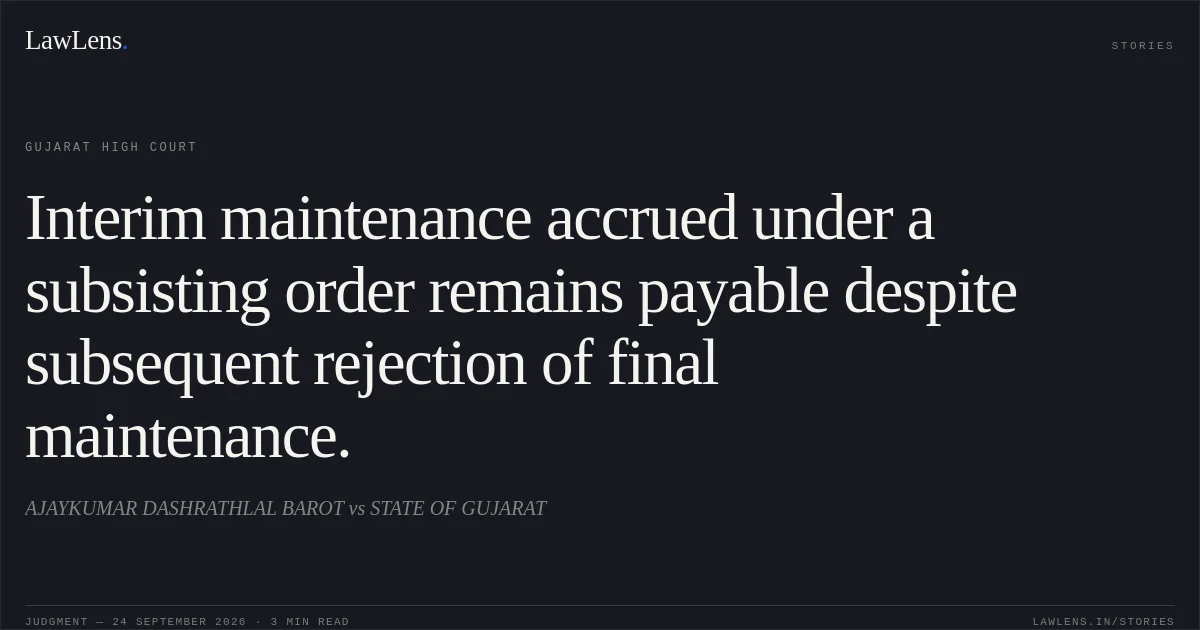
The High Court held that rejection of the wife’s final maintenance claim did not extinguish the husband’s liability to pay interim maintenance accrued under the subsisting order.
The wife was therefore entitled to recover ₹7,000 per month for the period from 29 August 2013 to 23 May 2016, and the husband was not entitled to a refund of the amount paid or recovered.
Source reference: pp.6–8; paras. 9–12The revision application was dismissed, Rule was discharged, and the Family Court’s common order dated 21 July 2016 was confirmed.
Source reference: p.9; para. 13Acts & Sections Cited
2 provisions across 2 statutes referred to in this judgment. Each provision opens on LawLens.
Code of Criminal Procedure, 19731
Hindu Marriage Act, 19551
Original Court PDF
AJAYKUMAR DASHRATHLAL BAROTvsSTATE OF GUJARAT
Click to open original judgment
Original judgment, available to read, download and summarize on LawLens.in