Facts
The applicant and respondent were married on 12.12.2016.
Source reference: para. 2The applicant alleged that following the marriage, she was subjected to physical and mental cruelty regarding dowry demands.
Source reference: para. 2She further alleged that the respondent abandoned her at Raipur Airport on 15.11.2024 and filed for divorce in Bengaluru.
Source reference: para. 2On 30.12.2024, the applicant filed for maintenance under Section 125 of the CrPC, seeking Rs. 70,000 per month and interim maintenance of Rs. 50,000 per month.
Source reference: para. 2-3The applicant contended that the respondent, a Senior Manager at Canara Bank, earns a monthly salary exceeding Rs. 1 lakh.
Source reference: para. 3On 19.02.2026, the Principal Judge, Family Court, Durg, partly allowed the interim application, directing the respondent to pay Rs. 3,000 per month.
Source reference: para. 1The applicant moved the High Court in revision, seeking enhancement of this amount, claiming the order was arbitrary and ignored the respondent's financial capacity.
Source reference: para. 4Issues
1. Whether the interim maintenance of Rs. 3,000 per month was perverse, inadequate, or lacked proper application of mind given the respondent's income and status.
Source reference: para. 42. Whether the impugned order suffered from material illegality or infirmity requiring interference by the High Court in its revisional jurisdiction.
Source reference: para. 6Law Applied
The court primarily applied Section 125 of the CrPC, which provides for the maintenance of wives, children, and parents.
Source reference: para. 1The court referenced the procedural mandates established by the Supreme Court in Rajnesh v. Neha, requiring both parties to file affidavits of disclosure of assets and liabilities to determine the quantum of maintenance.
Source reference: para. 3The court also noted the principle that proceedings under Section 125 are quasi-civil and quasi-criminal in nature, where the standard of proof is based on the preponderance of probabilities.
Source reference: para. 4Reasoning
The High Court examined the submissions and the record of the trial court to determine if the Family Court had erred in its discretion.
Source reference: para. 5It observed that the Family Court’s decision was reached after perusing the available evidence and hearing the statements regarding the conditions of both parties.
Source reference: para. 6Although the applicant argued that the respondent’s status as a Senior Manager and his high salary were disregarded, the High Court found that the lower court had sufficiently balanced the materials on record.
Source reference: para. 6The High Court concluded that there was no patent illegality, perversity, or infirmity in the interim order that necessitated exercise of revisional powers.
Source reference: para. 6-7The court emphasized that the order in question was for interim maintenance and the final determination of maintenance would be decided during the conclusion of the main proceedings.
Source reference: para. 8Holding
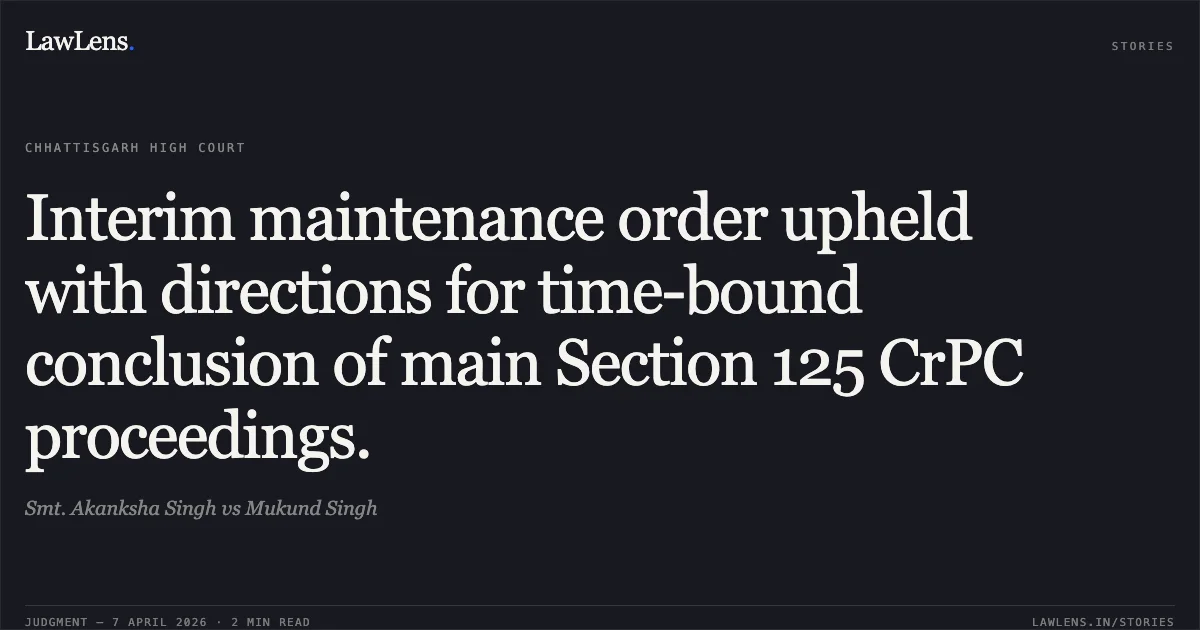
The High Court refused the prayer to quash or enhance the interim maintenance order, finding no merit in the revision petition.
The revision was disposed of with a direction to the Family Court, Durg, to conclude the main proceedings under Section 125 of the CrPC within three months from the date of the order, provided no legal impediments exist.
Source reference: para. 8Acts & Sections Cited
1 provisions across 1 statute referred to in this judgment. Each provision opens on LawLens.
Code of Criminal Procedure, 19731
Original Court PDF
Smt. Akanksha SinghvsMukund Singh
Click to open original judgment
Original judgment, available to read, download and summarize on LawLens.in