Facts
The respondent-wife filed a maintenance proceeding against the petitioner-husband and separately sought ad-interim maintenance.
Source reference: p.2–3, para. 3Both parties filed affidavits disclosing their assets and liabilities.
Source reference: p.2–3, para. 3The parties’ marriage was solemnised on 10 July 2017, and they had been living separately since 10 March 2019 following matrimonial discord.
Source reference: p.2–3, para. 3The husband contended that the wife had voluntarily left the matrimonial home and that, in a proposed mutual-consent divorce proceeding, she had acknowledged receipt of ₹19,00,000 as permanent alimony.
Source reference: p.3–4, para. 4He therefore argued that she was disentitled to maintenance under Section 125(4) Cr.P.C.
Source reference: p.3–4, para. 4The wife disputed receipt of the amount, asserting that the cheque allegedly issued towards the sum had been dishonoured.
Source reference: p.4, para. 5The Additional Judge, Family Court, granted the wife ad-interim maintenance by order dated 18 March 2025 in Crl. Misc. (Int.) No. 110 of 2024 arising from Crl. Misc. No. 108 of 2024.
Source reference: p.2, para. 1The husband challenged that order under Sections 397 and 401 Cr.P.C. read with Section 19(4) of the Family Courts Act, 1984.
Source reference: p.2, para. 1The main maintenance proceeding remained pending.
Source reference: p.4, para. 6Issues
Whether the Family Court was justified in granting ad-interim maintenance when the husband had produced material indicating that the wife had received ₹19,00,000 as permanent alimony in connection with a proposed mutual-consent divorce proceeding?
Source reference: p.5–6, paras. 7–8Whether the disputed questions concerning receipt of permanent alimony, the wife’s alleged voluntary separation, and the husband’s alleged neglect or refusal to maintain her could be conclusively determined at the interim stage?
Source reference: p.5–6, paras. 8–9Whether the order dated 18 March 2025 suffered from perversity or material infirmity warranting interference in revision?
Source reference: p.6, paras. 8–10Law Applied
The Court exercised revisional jurisdiction under Sections 397 and 401 of the Code of Criminal Procedure, 1973, read with Section 19(4) of the Family Courts Act, 1984, to examine the legality, correctness, propriety, and perversity of the Family Court’s interim order.
Source reference: p.2, para. 1The Court also considered the principle under Section 125(4) Cr.P.C., relied upon by the husband, that a wife may be disentitled to maintenance in circumstances including voluntary living apart without sufficient reason; however, the Court did not finally adjudicate the wife’s entitlement under that provision.
Source reference: p.5–6, paras. 8–9At the interim stage, the Court was required to consider the parties’ competing documentary assertions and determine whether immediate interim relief was justified without prejudging the pending main proceeding.
Source reference: p.5–6, paras. 8–9Reasoning
The Court found material inconsistencies in the wife’s case.
Source reference: p.4–5, para. 7In the proposed mutual-consent divorce proceeding, she had sworn an affidavit and executed a declaration on e-stamp paper indicating receipt of the ₹19,00,000 amount, although she later denied receiving it and withdrew from the divorce proceeding on the ground that the agreed terms had not been fulfilled.
Source reference: p.4–5, para. 7The Court held that whether the amount was actually paid or received remained a disputed question requiring adjudication in the main proceeding or an appropriate independent proceeding.
Source reference: p.5, para. 8Nevertheless, the documentary material prima facie supported the husband’s assertion that the amount had been paid.
Source reference: p.5, para. 8The wife’s interim application also did not adequately state the date from which the husband allegedly refused or neglected to maintain her, and the accompanying affidavit appeared incomplete.
Source reference: p.5–6, para. 8In these circumstances, the Court held that the Family Court had failed to sufficiently consider the husband’s material contentions and that there was no immediate necessity to grant ad-interim maintenance while the main proceeding was pending.
Source reference: p.6, paras. 8–9The Court clarified that the main proceeding had to be decided independently and without being influenced by the revisional order.
Source reference: p.6–7, para. 10Holding
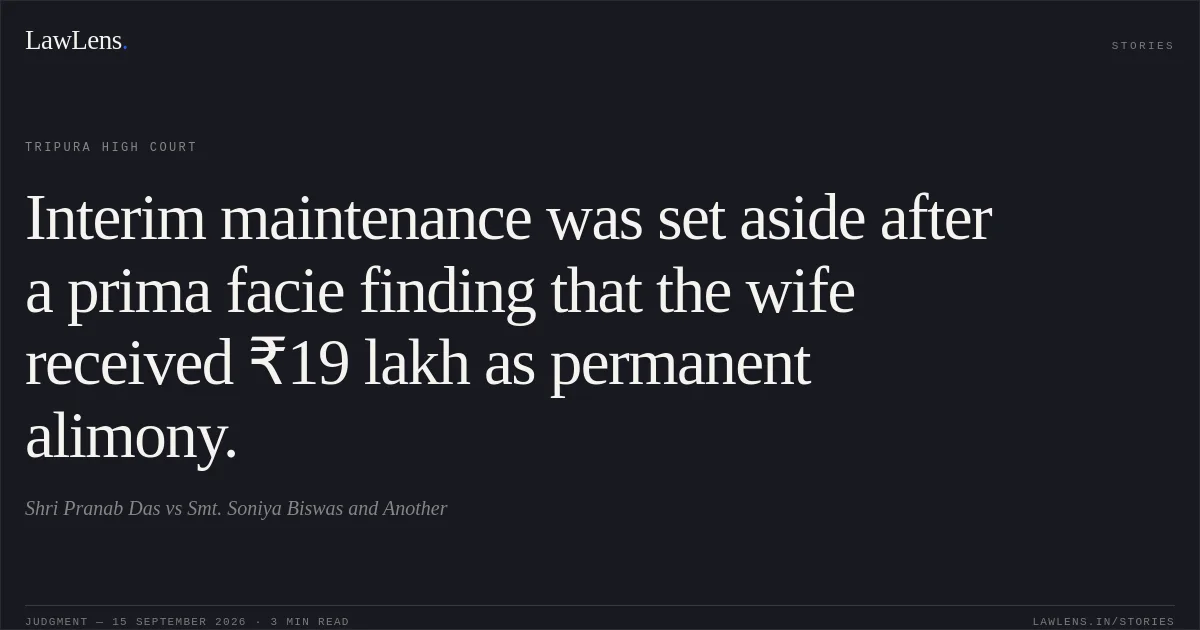
The High Court allowed the revision petition and set aside the Family Court’s order dated 18 March 2025 granting ad-interim maintenance to the wife, holding that the order suffered from perversity and material infirmity in view of the husband’s prima facie documentary evidence regarding payment of ₹19,00,000 as permanent alimony.
The Court did not finally decide whether the wife had actually received the amount or whether she was ultimately entitled to maintenance.
Source reference: p.6–7, paras. 9–10The Family Court was directed to dispose of the main maintenance proceeding within nine months of receiving the order, uninfluenced by the High Court’s observations.
Source reference: p.6–7, para. 10Acts & Sections Cited
4 provisions across 2 statutes referred to in this judgment. Each provision opens on LawLens.
Code of Criminal Procedure, 19733
Family Courts Act, 19841
Original Court PDF
Shri Pranab DasvsSmt. Soniya Biswas and Another
Click to open original judgment
Original judgment, available to read, download and summarize on LawLens.in