Facts
The Petitioner entered into an Agreement for Sale (dated 26.03.2019) and subsequent Supplemental Agreements with the Respondents regarding commercial units in Gurugram
Source reference: p. 2-3On 27.04.2026, the Petitioner served a Section 9 notice under the Arbitration and Conciliation Act, 1996, upon the Respondents seeking to protect his rights
Source reference: para. 2On 28.04.2026, the Respondents issued a letter terminating the allotment, citing "force majeure" and commercial frustration
Source reference: para. 2, 12, 21On 30.04.2026, the Respondents purportedly allotted the same units to a third party (M/s Amrit Skyline Builders) for nominal token amounts
Source reference: para. 9-10, 18The Petitioner moved the High Court seeking interim stay on the termination and a restraint on the creation of third-party rights
Source reference: p. 2Issues
1. Whether the court can grant interim protection under Section 9 of the Act to stay a termination letter and preserve the status quo of immovable property
Source reference: para. 16-172. Whether the Respondents’ invocation of "force majeure" for events dating back to 2020 justifies termination in 2026 after subsequent affirming conduct
Source reference: para. 21-223. Whether the purported third-party allotments were bona fide commercial transactions or sham proceedings intended to frustrate the Petitioner's rights
Source reference: para. 10, 18, 24Law Applied
The court primarily applied Section 9 of the Arbitration and Conciliation Act, 1996, regarding interim measures
Source reference: p. 1-2It relied on Rahul Bhargava v. Neo Developers (P) Ltd., establishing that in real estate disputes, preservation of property is central to ensuring final adjudication remains effective
Source reference: para. 7The court noted the 2018 amendment to Section 10 of the Specific Relief Act, 1963, which emphasizes the enforcement of contractual rights in immovable property
Source reference: para. 6, 8Regarding the non-enforceability of terminated contracts, the court distinguished JLT Energy SAS v. Hindustan Cleanenergy Ltd. and Bharat Catering Corpn. v. IRCTC, holding that there is no "straitjacket" rule barring protective relief if the termination appears prima facie retaliatory or contrary to agreed contractual procedures
Source reference: para. 11-16Reasoning
The court found the timing of the termination (one day after the Section 9 notice) to be prima facie retaliatory and intended to defeat the Petitioner’s rights
Source reference: para. 17It observed that the Respondents failed to comply with the mandatory notice and 90-day cure period stipulated under Clauses 7.10.1 and 7.10.2 of the Agreement
Source reference: para. 19-20The "force majeure" plea was rejected at the prima facie stage because the Respondents had executed Supplemental Agreements and transfer certificates as recently as 2024 and 2025, long after the COVID-19 events cited
Source reference: para. 21-22Furthermore, the court viewed the third-party allotments with suspicion, noting that units worth crores were purportedly transferred for only nominal token amounts immediately following the termination
Source reference: para. 10, 18, 24Consequently, the court determined that the balance of convenience favored the Petitioner to prevent irreparable prejudice
Source reference: para. 23Holding
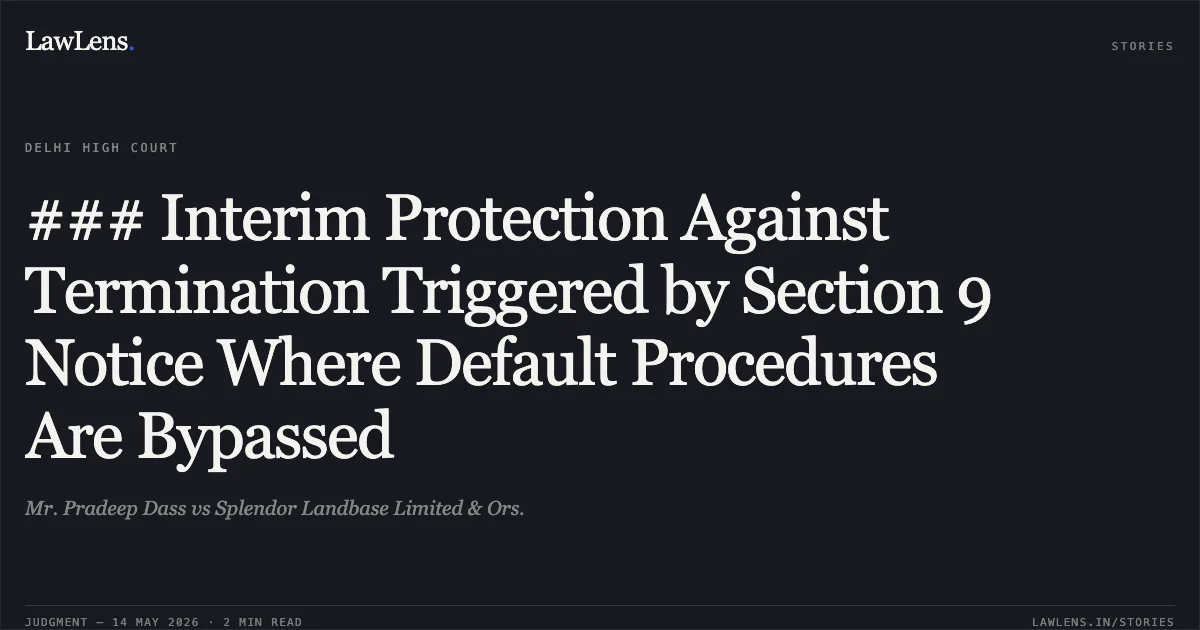
The court stayed the impugned termination letter and directed that consequential third-party allotments shall not be given effect
The court appointed Hon’ble Mr. Justice Rajesh Bindal (Retd.) as the Sole Arbitrator to resolve the disputes
Source reference: para. 31The Section 9 petition was ordered to be treated as an application under Section 17 before the learned Arbitrator. The petition was disposed of with all rights and contentions left open for the merits of the arbitration
Source reference: para. 36, 35-39Acts & Sections Cited
6 provisions across 2 statutes referred to in this judgment. Each provision opens on LawLens.
Arbitration and Conciliation Act, 19965
Specific Relief Act, 19631
Original Court PDF
Mr. Pradeep DassvsSplendor Landbase Limited & Ors.
Click to open original judgment
Original judgment, available to read, download and summarize on LawLens.in