Facts
The dispute involves co-trustees of the "Gayatri Chetna Foundation," which runs an academic institute.
Source reference: para 3A Trial Court previously formulated a scheme (Order No. 14) appointing Joint Special Officers (JSOs) and an Executive Committee to monitor the institute's "affairs" and restrained parties from taking "policy decisions" without court leave.
Source reference: para 4, 10Subsequently, Appellant No. 3 (a trustee) issued a meeting notice to discuss new courses and address sexual harassment allegations against the Principal based on Internal Complaints Committee (ICC) recommendations.
Source reference: para 6The Respondents sought an injunction to block the meeting. The Trial Court partially granted the injunction, restraining discussions on new courses but refusing to interfere with the POSH Act proceedings against the Principal.
Source reference: para 8Both parties appealed.
Source reference: no citationIssues
1. Whether the trustees are prohibited by the court-mandated scheme from convening meetings or taking policy decisions without the mediation of the Joint Special Officers.
Source reference: para 10, 20-212. Whether the introduction of new courses and a prospectus constitutes a "policy decision" requiring prior leave of the court under the scheme.
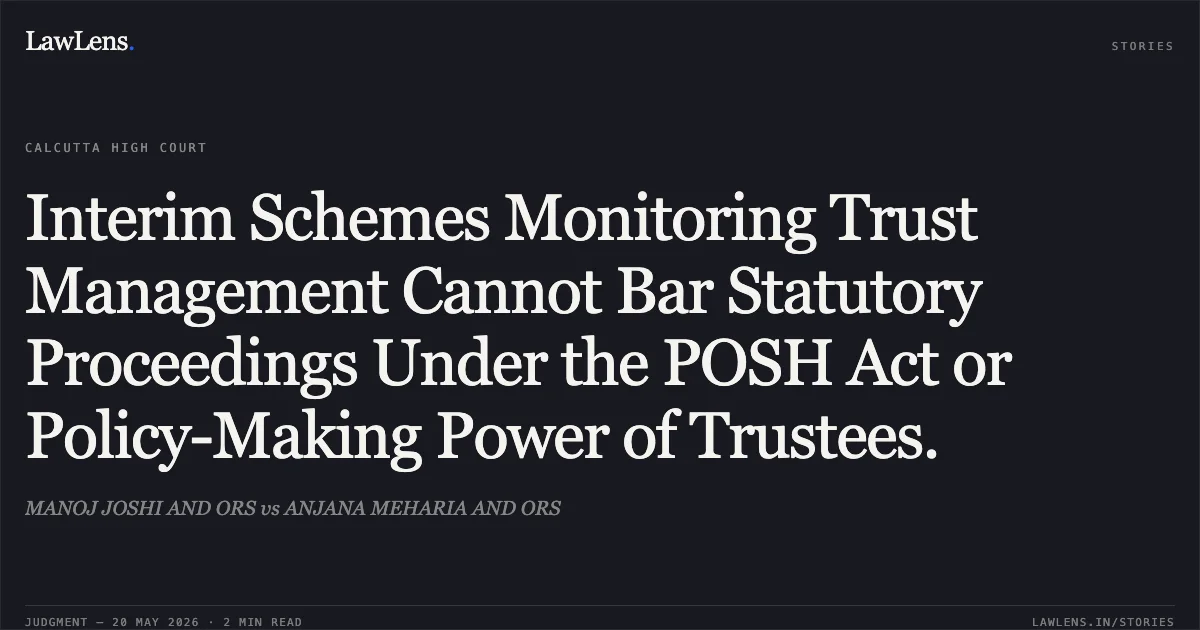
Source reference: para 13, 223. Whether the court has jurisdiction to restrain proceedings initiated against the Principal under the Sexual Harassment of Women at Workplace (POSH) Act, 2013.
Source reference: para 8, 30Law Applied
The court applied principles of trust management and judicial scheme implementation under Section 92 of the Code of Civil Procedure (CPC).
Source reference: para 30It distinguished between "monitoring affairs" (supervisory) and "taking policy decisions" (executive power).
Source reference: para 20It further applied the Sexual Harassment of Women at Workplace (Prevention, Prohibition and Redressal) Act, 2013 (POSH Act), holding that statutory disciplinary proceedings operate under a distinct legal regime independent of civil trust disputes.
Source reference: para 30-31Reasoning
The High Court found that the Trial Court misinterpreted Clause 7 of the established scheme; while JSOs monitor day-to-day "affairs," the power to take policy decisions remains with the trustees, subject only to court leave—not JSO approval.
Source reference: para 20-21The court observed that the Trial Court misread "prospectus" as "prospects," clarifying that introducing new courses is a matter of regular functioning, not necessarily a policy shift.
Source reference: para 22Regarding the POSH Act, the Court reasoned that the "Chair of the Principal" mentioned in the scheme refers to the office, not the individual; therefore, disciplinary action against a specific incumbent does not violate the scheme’s requirement for the Principal to sit on the Executive Committee.
Source reference: para 31-32Furthermore, since the Appellants committed to seeking court approval after the meeting but before implementing decisions, the injunction was deemed premature.
Source reference: para 34-35Holding
The High Court allowed FMA 365 of 2026 and dismissed FMA 434 of 2026.
It set aside the restraint on holding the trust meeting, ruling that trustees may convene to discuss new courses.
Source reference: para 36It affirmed the Trial Court’s refusal to enjoin the POSH Act proceedings, holding that the court lacks jurisdiction to stay such statutory processes within the scope of this civil suit.
Source reference: para 30, 36The injunction against the meeting was vacated.
Source reference: no citationActs & Sections Cited
1 provisions across 1 statute referred to in this judgment. Each provision opens on LawLens.
Code of Civil Procedure, 19081
Original Court PDF
MANOJ JOSHI AND ORSvsANJANA MEHARIA AND ORS
Click to open original judgment
Original judgment, available to read, download and summarize on LawLens.in