Facts
The Delhi Race Club (Respondent) occupied 84.484 acres of land under a 1926 lease granted for a "Race Course." The lease expired on 31.12.1994
Source reference: p. 3Following a history of litigation where a 1999 eviction notice was quashed in 2012 with liberty to the Union (Appellants) to decide on renewal representations, the Union eventually rejected the renewal due to defense and security needs
Source reference: p. 4After a 2026 civil suit was disposed of with the observation that eviction must follow due process, the Estate Officer issued a fresh show cause notice dated 17.04.2026 under Sections 4(1) and 4(2)(b)(ii) of the Public Premises (Eviction of Unauthorized Occupants) Act, 1971 (PP Act)
Source reference: p. 5The Respondent challenged this notice via a writ petition. The learned Single Judge, via an interim order dated 24.04.2026, stayed the eviction proceedings citing the "chequered history" of the case
Source reference: p. 2, 9Issues
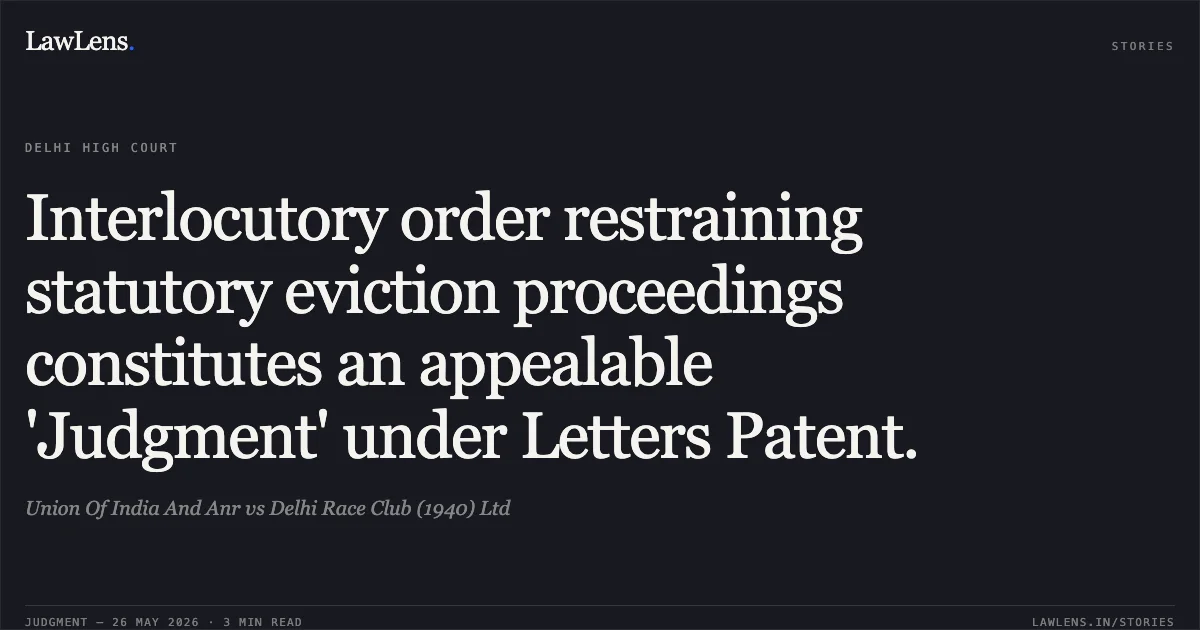
1. Whether the intra-court appeal is maintainable against an interlocutory order, and whether such an order qualifies as a "Judgment" under Clause 10 of the Letters Patent
Source reference: p. 12, para. 18(a)2. Whether the Single Judge’s order deferring statutory eviction proceedings without assigning reasons or finding a prima facie case is legally sustainable
Source reference: p. 12, para. 18(b)Law Applied
The court applied Clause 10 of the Letters Patent (Lahore) and Section 10 of the Delhi High Court Act, 1966, regarding the maintainability of appeals against a "Judgment"
Source reference: p. 12-13It relied on Shah Babulal Khimji v. Jayaben D. Kania, which established that "Judgment" includes interlocutory orders that possess "trappings of finality" and affect vital rights
Source reference: p. 15-18The court applied Section 2(g) and Section 4 of the PP Act, interpreting "unauthorized occupation" as per Escorts Heart Institute v. DDA, which includes occupants whose initial authority has ceased
Source reference: p. 26-29Finally, it applied the principles for interim relief under Article 226/Order XXXIX CPC as defined in Union of India v. Era Educational Trust and Deoraj v. State of Maharashtra, requiring a three-pronged test: prima facie case, balance of convenience, and irreparable injury
Source reference: p. 30-33Reasoning
The Division Bench determined that the appeal was maintainable because the stay on the show cause notice directly impacted the Appellant's statutory right to reclaim public premises under Section 4 of the PP Act, thus qualifying as a "Judgment" under the Shah Babulal Khimji test
Source reference: p. 25-27Analyzing the merits of the stay, the court found the Respondent was an "unauthorized occupant" under Section 2(g) of the PP Act as the lease had expired in 1994
Source reference: p. 26The Bench held that the Single Judge erred by failing to record findings on the prima facie case, balance of convenience, or irreparable loss. It noted that a "very strong prima facie case" is required to stay a statutory notice
Source reference: p. 32-33The court rejected the Respondent's claim of "pre-meditated" action, noting that following the statutory procedure of the PP Act constitutes "due process of law" as previously directed by the civil court
Source reference: p. 28Holding
The Court held that the intra-court appeal is maintainable as the interim stay affected a "matter of moment" and vital statutory rights
It further held that the Single Judge’s order was unsustainable for lack of reasoning and failure to apply the legal standards for granting injunctions. The appeal was allowed, and the direction staying the Estate Officer from proceeding with the show cause notice dated 17.04.2026 was set aside
Source reference: p. 33-34Acts & Sections Cited
13 provisions across 3 statutes referred to in this judgment. Each provision opens on LawLens.
Public Premises (Eviction of Unauthorised Occupants) Act, 19714
Delhi High Court Act, 19664
Code of Civil Procedure, 19085
Original Court PDF
Union Of India And AnrvsDelhi Race Club (1940) Ltd
Click to open original judgment
Original judgment, available to read, download and summarize on LawLens.in


