Facts
The Appellant, a Scientist at ICAR Tripura, filed a complaint on 05.12.2018 alleging sexual harassment by Respondent No. 7 (Joint Director).
Source reference: para. 5-7An Institute Complaints Committee (ICC) was formed, but its members were subordinate in rank to the accused.
Source reference: para. 10, 57The ICC report (09.04.2019) characterized the dispute as a behavioral clash without specific findings on harassment.
Source reference: para. 12The Appellant’s statutory appeal was dismissed by the Secretary, ICAR (Respondent No. 2) on 30.07.2021.
Source reference: para. 22A Single Judge of the High Court subsequently dismissed her writ petition, holding that the ICC report was a mere "preliminary inquiry" and that the matter should have been raised before the Central Administrative Tribunal (CAT).
Source reference: para. 25-27Issues
1. Whether a writ petition challenging an ICC report and the subsequent appellate order is maintainable, or if it constitutes a "service matter" within the exclusive jurisdiction of the Administrative Tribunal?
Source reference: para. 30(i)2. Whether the ICC report was vitiated due to the committee members being subordinate in rank to the respondent and the failure to provide the Appellant with cross-examination rights?
Source reference: para. 30(ii)Law Applied
The Court applied Section 11 of the Sexual Harassment of Women at Workplace (POSH) Act, 2013, which mandates inquiries be conducted in accordance with applicable service rules.
Source reference: para. 40Rule 14(2) of the CCS (CCA) Rules, 1965, stipulates that the Complaints Committee is a "deemed inquiring authority" and must follow the prescribed procedure for major penalties.
Source reference: para. 45The Court relied on Aureliano Fernandes v. State of Goa (2024), which established that an ICC inquiry is not a mere "fact-finding" exercise but a formal inquiry that must adhere to natural justice.
Source reference: para. 46-47Regarding bias, the Court applied the "real likelihood of bias" test from Badrinath v. Govt. of T.N. and Krishnadatt Awasthy v. State of M.P., alongside DOPT O.M. dated 07.01.1971, which requires Inquiry Officers to be senior in rank to the delinquent officer.
Source reference: para. 60-65Reasoning
The Court first resolved the jurisdictional issue, citing a previous inter-partes Division Bench judgment (WA No. 183/2021) which held that POSH complaints have repercussions (compensation, trauma, IPC registration) beyond simple "service matters," thus making writ jurisdiction appropriate.
Source reference: para. 33-35On the merits, the Court found the ICC’s procedure fundamentally flawed. It rejected the "preliminary inquiry" defense, noting that under the POSH Act and CCS Rules, the ICC must act as the final Inquiring Authority; failing to allow cross-examination or supply witness depositions violated Rule 14 of the CCS Rules and natural justice.
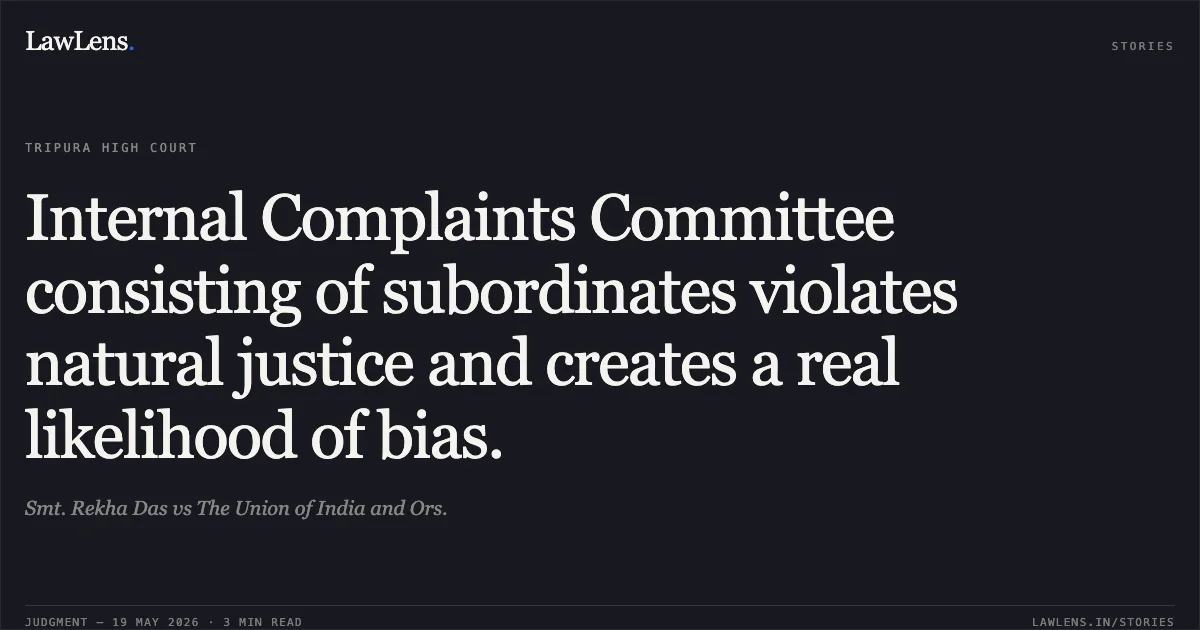
Source reference: para. 48-50Furthermore, the Court found a "real likelihood of bias" because all ICC members were subordinates of Respondent No. 7, who, as Joint Director, controlled their Annual Performance Appraisal Reports (APARs).
Source reference: para. 63, 71The failure to transfer the accused during the inquiry further allowed him to exercise a dominant and coercive influence over witnesses.
Source reference: para. 72-73Holding
The Court allowed the appeal, setting aside the ICC report (09.04.2019), the appellate order (30.07.2021), and the Single Judge's judgment.
The Court held that an inquiry by junior officers against a senior cannot command confidence and violates the principle of "justice being seen to be done".
Source reference: para. 64-66It directed Respondents 1-5 to constitute a new ICC comprising members senior to Respondent No. 7 within 4 weeks. This new committee must conduct a fresh inquiry under Rule 14 of the CCS (CCA) Rules, ensuring full evidence sharing and cross-examination, and conclude within six months.
Source reference: para. 75-76Acts & Sections Cited
11 provisions across 3 statutes referred to in this judgment. Each provision opens on LawLens.
Sexual Harassment of Women at Workplace (Prevention, Prohibition and Redressal) Act, 20138
Indian Penal Code, 18601
Administrative Tribunals Act, 19852
Original Court PDF
Smt. Rekha DasvsThe Union of India and Ors.
Click to open original judgment
Original judgment, available to read, download and summarize on LawLens.in


