Facts
The Appellant filed a Writ Petition [W.P.(C) 18571/2025] before a Single Judge of the Delhi High Court alleging mismanagement, financial irregularities, and the use of fictitious identities within Raj Vidya Kender (RVK), a society registered under the Societies Registration Act, 1860
Source reference: para. 2–3The Appellant sought directions for the Registrar of Societies and police authorities to act upon findings of illegality
Source reference: para. 5The Single Judge dismissed the Writ Petition on 20.04.2026, holding that the grievances pertained to internal management and should be pursued before a Civil Court
Source reference: para. 3The Appellant challenged this via the present Letters Patent Appeal (LPA), arguing that the failure of statutory authorities to act created a public law challenge justiciable under Article 226
Source reference: para. 4–7Issues
1. Whether disputes relating to the internal management and alleged irregularities of a society registered under the Societies Registration Act, 1860, are maintainable under the writ jurisdiction of the High Court
Source reference: para. 112. Whether the failure of statutory authorities to intervene in the affairs of a private society warrants the issuance of a writ
Source reference: para. 11–12Law Applied
The court applied the principle that matters purely concerning the internal management and private affairs of a registered society do not fall within the ambit of the High Court's extraordinary jurisdiction under Article 226 of the Constitution of India
Source reference: para. 11It relied on the doctrine of "alternative efficacy remedy," holding that the Societies Registration Act, 1860, provides a framework for dispute resolution through competent Civil Courts
Source reference: para. 3, 12The Court specifically cited the precedents of Satya Prakash Ravidas v. Alakh Niranjan Prasad Singhna, 2026:DHC:837 [para. 8], and Satya Prakash Ravidas v. Registrar of Societies, LPA 240/2026 [para. 9], which established that internal society disputes are not amenable to writ jurisdiction.
Source reference: para. 8, 9Reasoning
The Court examined the prayer clause of the original Writ Petition and determined that the essence of the Appellant’s grievance was the internal administration of RVK
Source reference: para. 11Although the Appellant framed the issue as a failure of public authorities (Registrar and Police) to perform statutory duties, the Court found the core dispute remained a private management conflict
Source reference: para. 11The Bench reasoned that the existence of allegations regarding "fictitious identities" or "unauthorized interstate functioning" does not automatically transform a private society dispute into a public law matter
Source reference: para. 6, 11Given that prior Division Bench rulings had already settled this specific point against the Appellant, the Court held that the Single Judge correctly relegated the Appellant to a Civil Court for a trial on facts
Source reference: para. 12Holding
The Court dismissed the appeal, affirming the Single Judge's order
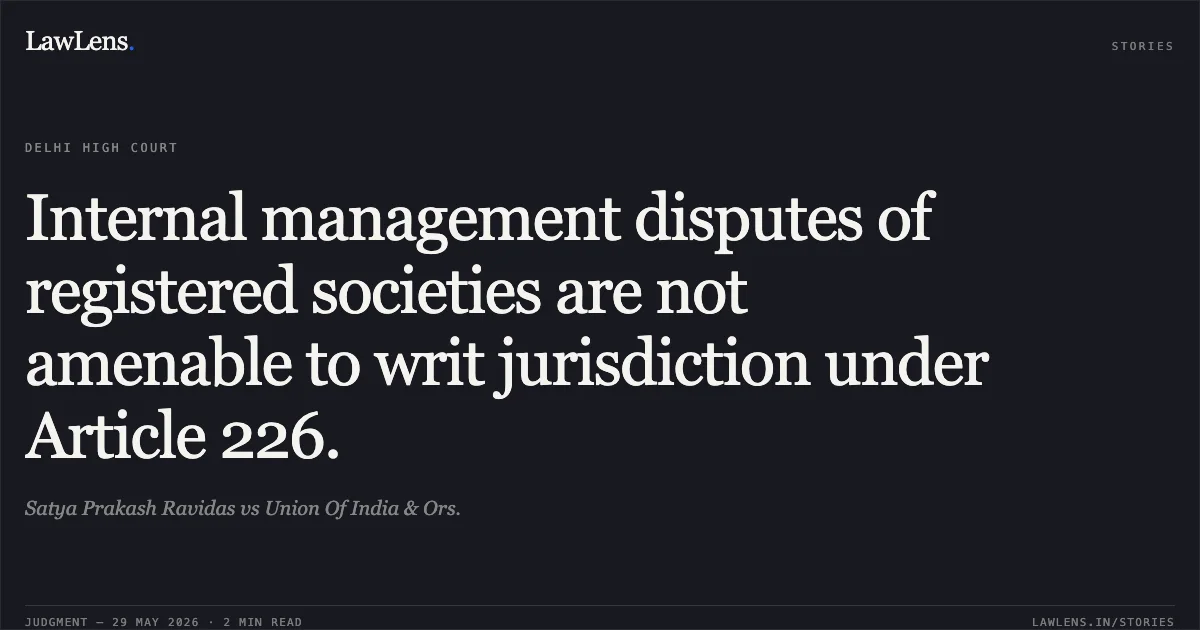
It held that disputes regarding the internal management of registered societies are not amenable to adjudication under Article 226
Source reference: para. 11The Court granted the Appellant liberty to institute a Civil Suit before a competent Civil Court, clarifying that all rights and contentions remain open for such proceedings
Source reference: para. 12–13No costs were awarded
Source reference: para. 14Acts & Sections Cited
1 provisions across 1 statute referred to in this judgment. Linked provisions open on LawLens.
Societies Registration Act, 18601
Original Court PDF
Satya Prakash RavidasvsUnion Of India & Ors.
Click to open original judgment
Original judgment, available to read, download and summarize on LawLens.in