Facts
The Commissioner of Central Excise and other appellants filed several miscellaneous appeals under Section 35G of the Central Excise Act, 1944, and Section 130 of the Customs Act, 1962
Source reference: para. 3, 9The respondents raised a preliminary objection regarding the maintainability of these appeals
Source reference: para. 4They argued that Section 35G was omitted by the National Tax Tribunal Act, 2005 (NTTA), effective from December 28, 2005
Source reference: para. 4The respondents contended that even though the Supreme Court subsequently declared the NTTA unconstitutional in Madras Bar Association v. Union of India (2014), the omitted provisions of the Central Excise Act did not automatically revive, leaving the High Court without jurisdiction
Source reference: para. 4-5Issues
1. Whether the right to appeal before the High Court still exists under Section 35G of the Central Excise Act, 1944, after its omission by the National Tax Tribunal Act, 2005
Source reference: para. 22. What is the legal effect of the judgment in Madras Bar Association v. Union of India (2014), which declared the National Tax Tribunal Act, 2005, ultra vires, on the previously omitted statutory provisions
Source reference: para. 2Law Applied
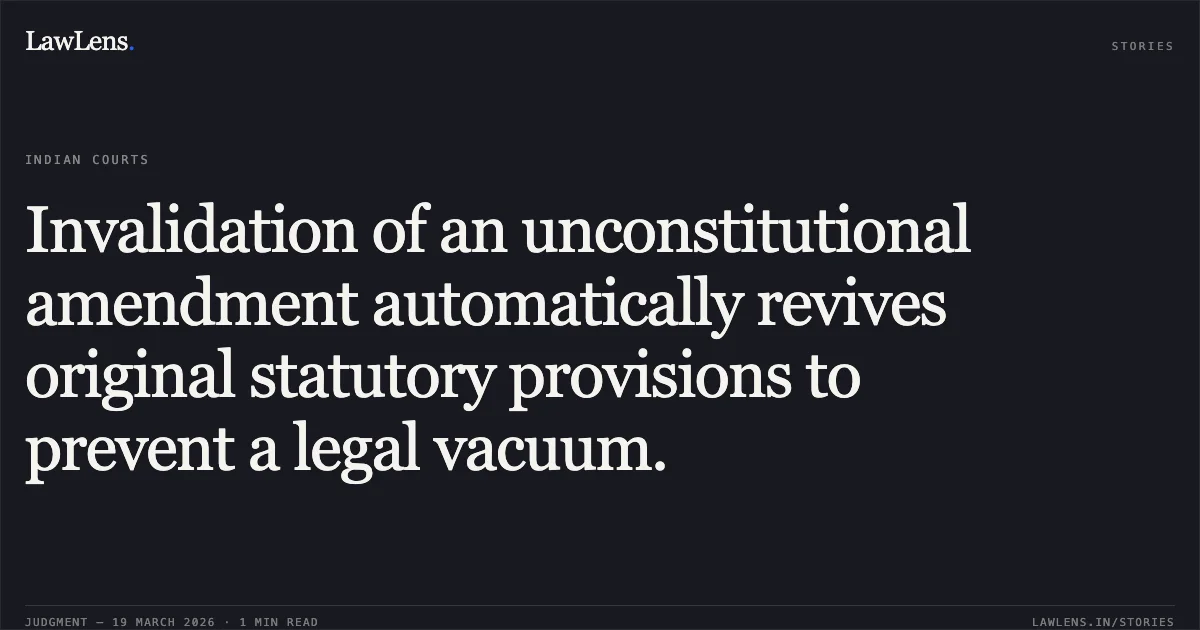
Doctrine of Revival as elucidated by the Supreme Court in Property Owners Association v. State of Maharashtra (2024), which holds that if an amending text is invalidated, the original text is revived to prevent a legal vacuum
Source reference: para. 6-8The jurisdiction to decide substantial questions of law is a core constitutional value vested in the High Courts and the Supreme Court that cannot be wholly divested by statute
Source reference: para. 7/175Section 35G of the Central Excise Act, 1944, and Section 130 of the Customs Act, 1962, regarding the statutory right of appeal
Source reference: para. 9Reasoning
The court reasoned that the striking down of the NTTA in its entirety by the Supreme Court meant the "edifice" of that Act was removed, rendering its distributive effects (such as the omission of Section 35G) void
Source reference: para. 7/139if an unconstitutional amendment resulted in the permanent deletion of a valid original provision, it would create a "legal vacuum" never intended by the legislature
Source reference: para. 6, 10The court emphasized that the power to decide substantial questions of law is a fundamental feature of the Indian constitutional scheme
Source reference: para. 7/175, 10Therefore, when the NTTA—which sought to transfer this power from the High Courts to a Tribunal—was declared unconstitutional, the status quo ante was restored
Source reference: para. 11The court rejected the respondents' reliance on previous interim observations of the High Court, asserting that the revival of the omitted sections is automatic and requires no further legislative action
Source reference: para. 11Holding
The Court held that the miscellaneous appeals are maintainable
It concluded that following the Supreme Court's decision in Madras Bar Association, Section 35G of the Central Excise Act, 1944, and Section 130 of the Customs Act, 1962, stood automatically revived
Source reference: para. 11The preliminary objections raised by the respondents were rejected
Source reference: para. 11The Court directed the Office to list the appeals separately for hearing on their individual merits under Order 41 Rule 11 of the CPC
Source reference: para. 12-14Acts & Sections Cited
9 provisions across 5 statutes referred to in this judgment. Each provision opens on LawLens.
Maharashtra Housing and Area Development Act, 1976.1
Customs Act,19621
Central Excise Act, 19441
Code of Civil Procedure, 19081
National Tax Tribunal Act, 20055
Original Court PDF
The Commissioner of Central Excise and Services TaxvsM/s Indian Oil Corporation Limited
Click to open original judgment
Original judgment, available to read, download and summarize on LawLens.in