Facts
The appellant, a registered manufacturer, was investigated by the Directorate General of Anti-Evasion during 1996–1997 for allegedly availing inadmissible MODVAT credit.
Source reference: pp. 4, 12During the investigation, it deposited an aggregate amount of ₹50,00,000 through five payments made between 27 July 1996 and 1 February 1997, before issuance of any show-cause notice.
Source reference: pp. 4, 12A show-cause notice dated 2 May 2000 alleged wrongful availment of MODVAT credit amounting to ₹78,91,213.
Source reference: pp. 2–3, 12–15After remand and re-adjudication, the Tribunal, by Final Order Nos. 75049–75050 of 2020 dated 3 January 2020, set aside the demand and allowed the appeals with consequential benefits.
Source reference: pp. 2–3, 12–15The appellant thereafter sought refund of the ₹50,00,000 deposit. The amount was refunded on 17 June 2020 without interest.
Source reference: pp. 3, 5The Commissioner (Appeals) denied interest on the ground that the refund application had been filed on 25 February 2020 and the refund was granted within three months, applying Section 11BB of the Central Excise Act, 1944.
Source reference: pp. 3, 6Issues
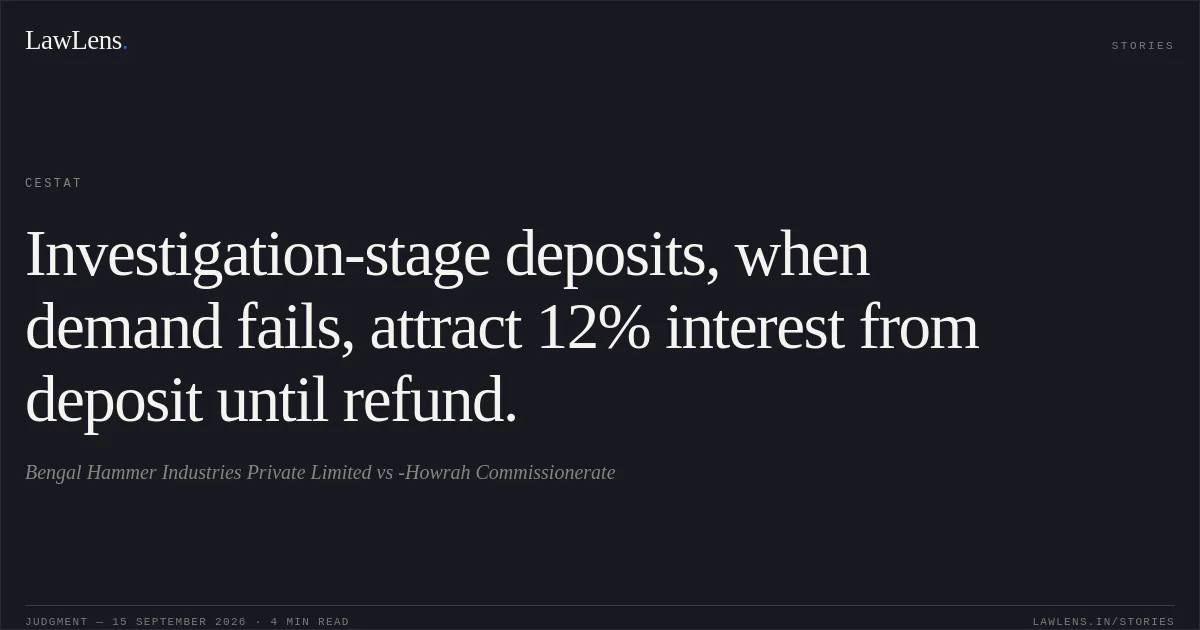
Whether the amount deposited during investigation, after the underlying MODVAT demand was set aside, constituted a revenue deposit refundable with interest rather than duty governed by Sections 11B and 11BB of the Central Excise Act, 1944?
Source reference: pp. 7–9, 13–15Whether the appellant was entitled to interest from the respective dates of deposit until the date of actual refund, notwithstanding the filing of the refund claim on 25 February 2020?
Source reference: pp. 6–8, 12–15If interest was payable, whether the appropriate rate was 12% per annum?
Source reference: pp. 6–10, 32–35Law Applied
Section 11B of the Central Excise Act, 1944 concerns refund of duty, while Section 11BB provides statutory interest for delayed refund of duty ordered under Section 11B(2), ordinarily after expiry of three months from receipt of the refund application.
Source reference: pp. 7–9, 16–17The Tribunal held that an amount deposited during investigation, particularly before issuance of a show-cause notice and without a sustainable demand, is a revenue deposit and not excise duty; consequently, Sections 11B and 11BB do not govern its refund.
Source reference: pp. 8–9, 13–15The Tribunal relied on Commissioner of Central Excise v. ITC Ltd., Sandvik Asia Ltd. v. Commissioner of Income Tax-I, Parle Agro Pvt. Ltd. v. Commissioner, CGST, Riba Textiles Ltd., Green Valley Industries Pvt. Ltd., and Indore Treasure Market City Pvt. Ltd., which recognise compensation by way of interest where the Revenue wrongfully retains an assessee’s money.
Source reference: pp. 9–10, 18–29It also relied on the Calcutta High Court’s decision in Rajendra Kumar Jain v. Commissioner of Customs (Port), Kolkata, holding that, in the absence of a specific statutory rate governing investigation deposits, interest at 12% per annum is payable for the relevant pre-statutory period.
Source reference: pp. 32–35The constitutional principle under Article 300A—that no person may be deprived of property except by authority of law—was also invoked.
Source reference: p. 31Reasoning
The Tribunal found that the ₹50,00,000 was paid during investigation, several years before issuance of the show-cause notice, and was never lawfully appropriated against a confirmed demand.
Source reference: pp. 4, 12–15The Tribunal’s earlier order had finally set aside the MODVAT demand and granted consequential benefits, and the Revenue had not challenged that order or the subsequent refund of the principal amount.
Source reference: pp. 12–15Accordingly, the deposit lost any character of excise duty and remained money belonging to the appellant.
Source reference: pp. 12–15The Department could not rely on the appellant’s use of Form R or the date of the refund application to invoke Section 11BB, because those provisions apply to refund of duty and not to an investigation-stage revenue deposit.
Source reference: pp. 7–9, 13–15Since the Revenue had retained money to which it had no legal claim from the dates of deposit until 17 June 2020, the appellant was entitled to compensatory interest for the entire period.
Source reference: pp. 13–15In determining the rate, the Tribunal followed the consistent line of authority applying 12% per annum to refunds of investigation deposits, including the binding jurisdictional position of the Calcutta High Court.
Source reference: pp. 28–35Holding
The appeal was allowed and the impugned order was set aside.
The Tribunal held that the amounts deposited during investigation ceased to have the character of excise duty once the demand was set aside; the Revenue was required to refund them with interest; and Sections 11B and 11BB could not be used to deny interest.
Source reference: p. 35The appellant was held entitled to simple interest at 12% per annum on each deposit from its respective date of deposit until 17 June 2020, the date of refund.
Source reference: p. 35The Revenue was directed to calculate and pay the interest within eight weeks from receipt of the Tribunal’s order.
Source reference: p. 35Acts & Sections Cited
4 provisions across 2 statutes referred to in this judgment. Each provision opens on LawLens.
Central Excise Act, 19443
Customs Act,19621
Original Court PDF
Bengal Hammer Industries Private Limitedvs-Howrah Commissionerate
Click to open original judgment
Original judgment, available to read, download and summarize on LawLens.in