Facts
The appellant purchased a general-class railway ticket at Wair Railway Station on 24 June 2013 for travel to Shahibabad and boarded Train No. 64151. He alleged that, owing to overcrowding, a sudden jerk and jostling caused him to fall from the moving train, resulting in grievous injuries and amputation of both legs below the knees.
Source reference: p. 3He was thereafter taken to Dr. Kailash Hospital, Noida.
Source reference: p. 3The Railway Claims Tribunal dismissed his compensation claim, principally because no ticket was recovered from him immediately after the incident and because his statement regarding the time of purchase conflicted with the CRIS record, which showed that the ticket had been issued at 7:42 a.m. on the date of the accident.
Source reference: p. 3The Tribunal also relied on medical records referring to injuries sustained while crossing the railway track.
Source reference: p. 4The appellant challenged the dismissal under Section 23 of the Railway Claims Tribunal Act, 1987.
Source reference: p. 3The High Court first condoned a delay of 103 days in filing the appeal, considering his severe injuries, loss of both legs, financial hardship, and the beneficial nature of the legislation.
Source reference: pp. 1–2The railway Station Master/Dead and Injured Register recorded that a person had “fallen from Train No. 64151 UP” and had been injured at the relevant kilometre.
Source reference: p. 6Issues
1. Whether the appellant established that he was a bona fide passenger despite the non-recovery of the ticket immediately after the incident and the discrepancy regarding the time of its purchase?
Source reference: pp. 4–52. Whether the injuries resulted from an “untoward incident”, namely, the accidental falling of a passenger from a train under Section 123(c)(2) of the Railways Act, 1989?
Source reference: pp. 6–73. Whether the allegation that the appellant was standing near the train gate or was otherwise negligent constituted a statutory defence to the Railway’s liability under Section 124-A?
Source reference: pp. 7–8Law Applied
The Court applied Section 23 of the Railway Claims Tribunal Act, 1987, governing appeals from orders of the Tribunal.
Source reference: p. 3Under Section 123(c)(2) of the Railways Act, 1989, the “accidental falling of any passenger from a train carrying passengers” constitutes an “untoward incident”.
Source reference: p. 7Section 124-A imposes no-fault liability on the Railway for death or injury arising from such an incident, subject to statutory exceptions.
Source reference: p. 7Relying on Union of India v. Rina Devi, the Court held that non-recovery of a ticket is not, by itself, sufficient to disprove bona fide passenger status and that negligence or contributory negligence does not amount to “self-inflicted injury” unless the act was intentional.
Source reference: pp. 4, 7–8The Court also relied on Sh. Prempal Singh v. Union of India for the principle that a passenger travelling alone cannot reasonably be expected to preserve evidence concerning every detail of the journey.
Source reference: p. 5The Court also relied on Ravikant & Ors. v. Union of India for the proposition that a claim cannot be rejected merely because the ticket was produced later or was not mentioned in the panchnama when its issuance is otherwise verified.
Source reference: pp. 5–6In relation to condonation of delay, the Court applied the liberal approach adopted in Mohsina v. Union of India and Reshma v. Union of India, particularly in view of the beneficial nature of the legislation and the claimant’s financial hardship.
Source reference: p. 2Reasoning
The Court held that the subsequent production of the ticket, coupled with independent CRIS verification showing its issuance on the date of the accident, sufficiently supported the appellant’s bona fide passenger status.
Source reference: pp. 4–5The discrepancy in his statement regarding the time of purchase was treated as an explainable error arising from nervousness and was not considered decisive, particularly given the catastrophic nature of his injuries.
Source reference: pp. 4–5The contemporaneous railway register specifically recorded a fall from Train No. 64151, and the Court gave greater evidentiary weight to that immediate official record than to medical histories referring generally to injuries sustained while crossing the track, since those medical entries were not based on eyewitness accounts.
Source reference: pp. 6–7The Court further reasoned that even if the appellant had been standing near the gate, such conduct could amount, at most, to negligence; under Rina Devi, it did not constitute an intentional self-inflicted injury and therefore did not exclude the Railway’s no-fault liability under Section 124-A.
Source reference: pp. 7–8Considering the evidence cumulatively, the Court found that the appellant’s injuries arose from an accidental fall from a passenger train.
Source reference: no citationHolding
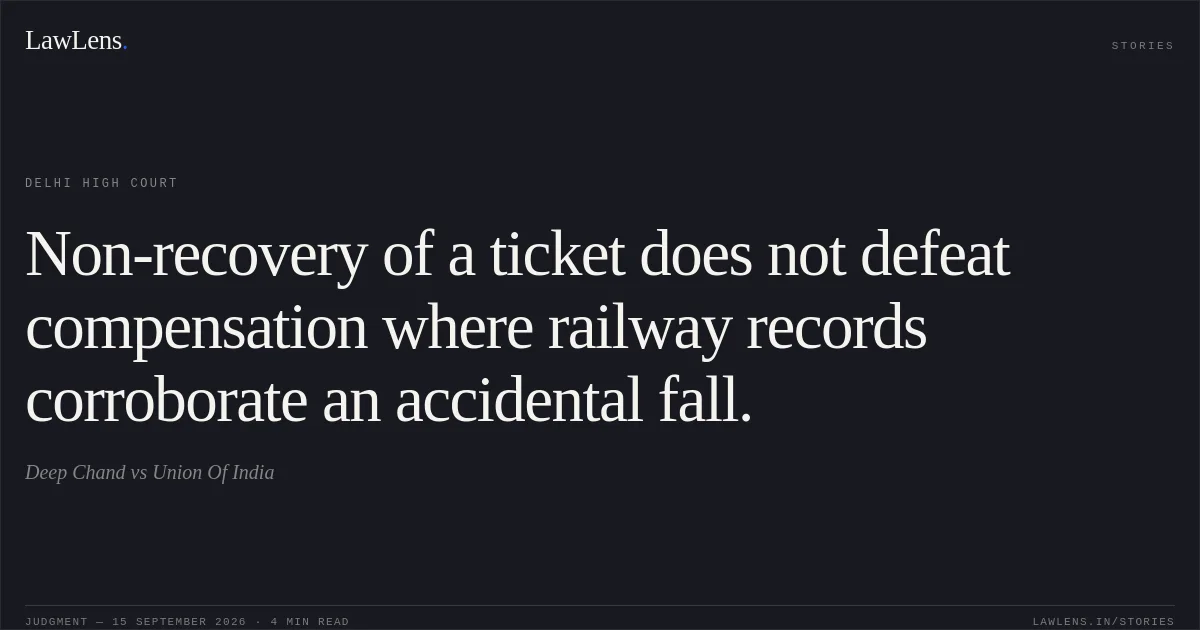
The Court held that the appellant was a bona fide passenger and that he suffered injuries in an untoward incident within the meaning of Section 123(c)(2) of the Railways Act, 1989.
The Tribunal’s dismissal of the claim was set aside.
Source reference: p. 8The matter was remanded to the Tribunal to assess the compensation payable in accordance with law and to direct disbursement by the concerned authorities within two months of receiving the High Court’s order.
Source reference: p. 8The matter was directed to be listed before the Tribunal on 7 October 2026.
Source reference: p. 8The appeal was accordingly allowed and disposed of.
Source reference: p. 8Acts & Sections Cited
2 provisions across 2 statutes referred to in this judgment. Each provision opens on LawLens.
Railway Claims Tribunal Act, 19871
Railways Act, 19891
Original Court PDF
Deep ChandvsUnion Of India
Click to open original judgment
Original judgment, available to read, download and summarize on LawLens.in