Facts
The petitioners claimed that LR Plot Nos. 479 and 483, Mouza Dakshin Bhatra, Malda, had been settled in their favour through pattas issued in 2003 pursuant to Patta Case No. 48/XII/R/2002–2003.
Source reference: paras. 1–4They alleged continuous cultivation and complained that the police seized harvested paddy from the disputed land on 29 November 2023 and 10 May 2024, and threatened interference with their cultivation.
Source reference: paras. 1–4Respondent Nos. 10 and 11 disputed the petitioners’ entitlement and challenged the legal efficacy of the pattas by relying on earlier revenue proceedings, including proceedings under Section 44(2a) of the West Bengal Estates Acquisition Act, 1953, and an order dated 28 March 1977 setting aside the earlier order dated 8 September 1970.
Source reference: paras. 5–10Earlier proceedings before the High Court in C.O. No. 4447(W) of 1991 and CR 14127(W) of 1993 also concerned settlement and cancellation or recall of pattas relating to the land.
Source reference: paras. 11–14A revenue application for correction of the Record of Rights remained pending, while the disputed plots were recorded in LR Khatian No. 1.
Source reference: paras. 16–18The police reported seizure of approximately 800 kilograms and 680 kilograms of harvested paddy on the two occasions, with both rival groups claiming ownership.
Source reference: paras. 26–30The petitioners sought police protection for cultivation and return of the seized crop.
Source reference: no citationIssues
Whether the High Court, in exercise of jurisdiction under Article 226, could grant police protection by effectively recognising the petitioners’ disputed claim to possession and cultivation on the basis of the 2003 pattas.
Source reference: paras. 20–25Whether the Court could determine the validity and legal effect of the petitioners’ pattas, the earlier revenue proceedings, and the rival claims to title and possession in the present writ proceeding.
Source reference: paras. 14–15, 21–24Whether the seized paddy could be directed to be returned to the petitioners when its ownership and entitlement were disputed and the seizure was connected with the criminal process.
Source reference: paras. 30–34Whether the existing revenue entry or the pending application for correction conclusively determined the parties’ substantive rights in the disputed land.
Source reference: paras. 16–21Law Applied
Section 44(2a) of the West Bengal Estates Acquisition Act, 1953 provides for revision of entries in a finally published record of rights after notice, hearing, and reasons, while Section 44(3) provides a statutory appeal against such orders; an appellate order setting aside an earlier revenue order cannot be treated as deciding matters beyond its express determination.
Source reference: paras. 6–9Sections 50 and 51 of the West Bengal Land Reforms Act, 1955 govern the maintenance, updating, revision, and correction of the Record of Rights, while Section 51C restricts civil-court jurisdiction in specified matters but does not confer unrestricted jurisdiction on a writ court to adjudicate disputed title.
Source reference: paras. 19–20Revenue entries are fiscal and statutory records and do not, by themselves, constitute declarations of title.
Source reference: para. 21Article 226 jurisdiction may correct public-law errors, but a writ court should not determine seriously disputed private rights or grant police protection that effectively recognises one rival claimant’s possession.
Source reference: paras. 23–25Custody, release, and delivery of property seized in connection with a criminal occurrence ordinarily fall within the jurisdiction of the competent criminal court.
Source reference: paras. 31–34Reasoning
The Court held that the dispute could not be resolved merely by examining the 2003 pattas or the present revenue entry.
Source reference: paras. 14–15, 22, 37–38Their validity and legal effect depended on the earlier proceedings, the authority under which the pattas were issued, the status of the land, and the competing claims to possession—questions requiring examination of original records and evidence beyond the scope of the writ proceeding.
Source reference: paras. 14–15, 22, 37–38The 1977 appellate order only set aside the 1970 order; it neither established the absolute ownership of Respondent Nos. 10 and 11 nor determined the validity of the 2003 pattas.
Source reference: paras. 8–10Similarly, the pending correction application did not confer title, and the existing revenue entry did not extinguish any otherwise establishable right.
Source reference: paras. 16–18Granting police protection would, in practical effect, require the police to recognise the petitioners’ possession and exclude the rival claimants, which could not be done through mandamus where possession itself was contested.
Source reference: paras. 23–25The Court also declined to decide the competing accounts concerning seizure of the paddy and held that its release had to be sought before the competent criminal court, particularly because entitlement to the crop was derivative of the disputed claim to cultivation.
Source reference: paras. 26–34The allegation of political influence was unsupported by sufficient material and could not establish mala fide police action.
Source reference: para. 35Holding
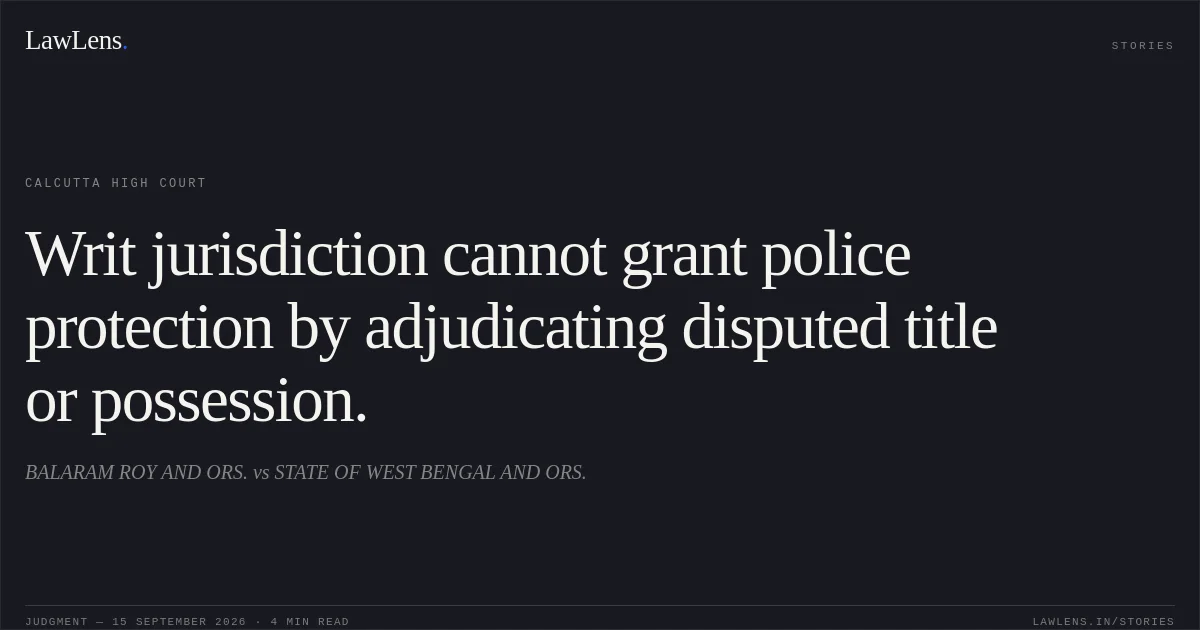
The Court dismissed the writ petition and refused both police protection for the petitioners’ cultivation and return of the seized paddy, holding that such relief would require adjudication of disputed title, possession, cultivation, and crop ownership.
The parties were left free to pursue appropriate statutory or judicial remedies, and the revenue authorities were permitted to deal with the pending Record of Rights application in accordance with law.
Source reference: para. 41The Court expressly declared that its order did not determine title, possession, cultivation, or entitlement to the seized crop in favour of either party; the police remained free to take lawful measures to prevent breach of peace without recognising either claimant as exclusively entitled to possession.
Source reference: para. 42The writ petition was dismissed without costs, with all parties’ rights and contentions preserved.
Source reference: paras. 44–46Acts & Sections Cited
3 provisions across 2 statutes referred to in this judgment. Each provision opens on LawLens.
west bengal estates acquisition act, 19531
west bengal land reforms act, 19552
Original Court PDF
BALARAM ROY AND ORS.vsSTATE OF WEST BENGAL AND ORS.
Click to open original judgment
Original judgment, available to read, download and summarize on LawLens.in