01Facts
The Coimbatore Corporation Contractors Welfare Association (CCCWA) filed a complaint in 2021 alleging price-fixing cartelization by nine specific steel manufacturers in Tamil Nadu.
p. 2The CBI forwarded the complaint to the Director General (DG) of the Competition Commission of India (CCI).
p. 2The Madras High Court subsequently directed the DG to take action "in accordance with law".
p. 3On August 23, 2021, the CCI directed its Secretariat to register the matter as a suo motu case and instructed the DG to investigate based on the High Court’s order.
p. 3Although Petitioner No. 1 was not named in the original complaint, the DG conducted search and seizure operations at its premises in December 2022 and issued summons to its employees in March 2023.
p. 3The Petitioner discovered it was arrayed as an "Opposite Party" only upon inspecting records in August 2025.
pp. 4-5Consequently, the Petitioner challenged the investigation as illegal and without jurisdiction.
p. 102Issues
i.1. Whether the Madras High Court's order dated 29.07.2021 dispensed with the statutory requirement of forming a prima facie opinion under Section 26(1) of the Competition Act?
p. 11, 12 / para. 30, 31ii.2. Whether the investigation is vitiated for want of a prior Section 26(1) order by the CCI?
p. 11, 17 / para. 30, 46iii.3. Whether the DG acted beyond its statutory mandate by investigating an entity not named in the initial complaint without specific CCI direction?
p. 11, 23 / para. 30, 66iv.4. Whether the impleadment of the Petitioner without notice violated principles of natural justice?
p. 12, 29 / para. 30, 82v.5. Whether the writ petition is maintainable despite objections of delay and territorial jurisdiction?
p. 12, 34 / para. 30, 9503Law Applied
The Court applied Section 26(1) of the Competition Act, 2002, which mandates that the Commission must form a prima facie opinion of a contravention before directing the DG to investigate.
p. 13It relied on CCI v. Steel Authority of India Limited (SAIL), which established that the formation of a prima facie view is a condition precedent and must be recorded, even if briefly, in the CCI's minutes.
p. 18, 20The Court distinguished Agni Steels Pvt. Ltd. v. Union of India, noting that an SLP dismissal in limine does not constitute a binding precedent under Article 141.
pp. 19-20It further applied the principle from MRF Ltd. v. CCI & Ors., stating that an entity must be informed of its status (third party vs. opposite party) as it carries grave legal implications.
p. 32Regarding jurisdiction, the Court applied Article 226(2) of the Constitution, holding that a High Court has jurisdiction if a part of the cause of action arises within its territory.
p. 36Provisions in the judgment · 5 · Linked ones open on LawLens
Competition Act, 2002 Section 16Section 19Section 26Section 41
Code of Criminal Procedure, 1973 Section 482
04Reasoning
The Court reasoned that the Madras High Court’s direction to act "in accordance with law" did not override the mandatory procedure under Section 26(1); rather, it reinforced the obligation to follow the statute.
p. 14, 16The CCI committed a "fatal error" by treating the judicial order as a substitute for its own independent satisfaction.
pp. 14-15Upon reviewing the CCI's minutes dated August 23, 2021, the Court found a complete absence of application of mind or recorded prima facie opinion regarding the Petitioner, who was not even named in the original complaint.
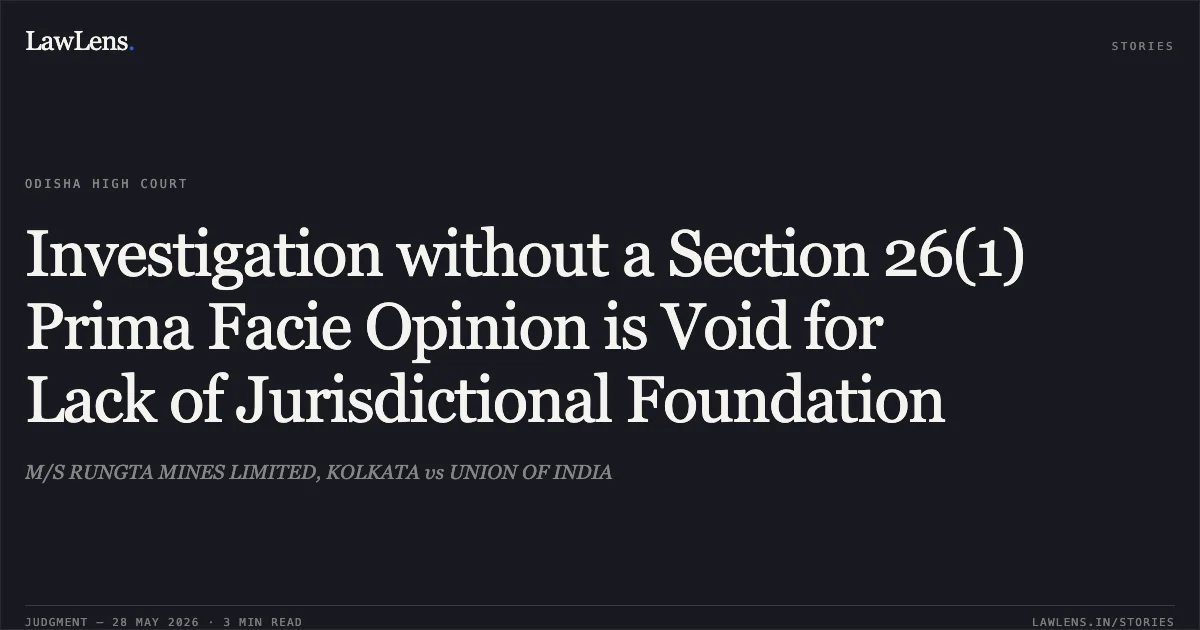
pp. 20-21Since the formation of a prima facie opinion is a "jurisdictional fact," its absence rendered the DG’s investigation void ab initio.
p. 22Furthermore, while the DG can expand the scope of a validly initiated investigation, it cannot assume jurisdiction over new entities in the absence of a foundational order.
p. 27The Court also highlighted the breach of natural justice, noting that the Petitioner was subjected to coercive search and seizure without being informed of its status as an "Opposite Party," which deprived it of informed legal recourse.
p. 31, 3305Holding
The Court allowed the writ petition and held that the investigation against the Petitioners was unsustainable due to fundamental jurisdictional infirmities.
p. 38It ruled that: (i) the Madras High Court order did not dispense with Section 26(1) requirements; (ii) the CCI failed to form an independent prima facie opinion; and (iii) the petition was maintainable as the cause of action arose upon the discovery of the illegal impleadment in 2025.
p. 16, 22, 35, 38The Court quashed the investigation arising out of Suo Moto Case No. 02 of 2021 insofar as it related to the Petitioners and set aside all consequential actions, including search, seizure, and summons.
p. 41Original Court PDF
M/S RUNGTA MINES LIMITED, KOLKATAvsUNION OF INDIA
Click to open original judgment
Original judgment, available to read, download and summarize on LawLens.in