Facts
The petitioners alleged that Enormous Industries Limited, Barkha Financiers Limited, and their directors/promoters had collected money from investors through redeemable preference shares and various schemes, and sought refund with 12% annual interest, investigation, attachment of properties, and other consequential reliefs.
Source reference: pp. 2–4, para. 2By order dated 6 August 2026, the claims against respondent nos. 4 to 15 were dismissed for non-compliance with an earlier order dated 22 September 2025; the writ petition thereafter proceeded only against respondent nos. 1 to 3, including the Union of India and the Reserve Bank of India.
Source reference: p. 2, para. 1During hearing, the parties submitted that the controversy was covered by the Division Bench judgment in Dilip Kumar Ravidas & Ors. v. State of Bihar & Ors., C.W.J.C. No. 13358 of 2019, decided on 2 December 2022.
Source reference: pp. 4–5, para. 3Issues
Whether the petitioners were entitled to direct writ relief against the concerned authorities for refund of money allegedly collected by the private respondent companies and their directors/promoters, together with interest and consequential measures such as investigation and property attachment?
Source reference: pp. 2–4, para. 2Whether the writ petition should be disposed of in accordance with the directions issued in Dilip Kumar Ravidas concerning submission and consideration of a representation before the Securities and Exchange Board of India?
Source reference: pp. 4–6, paras. 3–5Law Applied
The Court applied the principle that where an identical controversy has already been adjudicated by a Division Bench, a subsequent petition raising the same issue may be disposed of in terms of that binding or persuasive precedent.
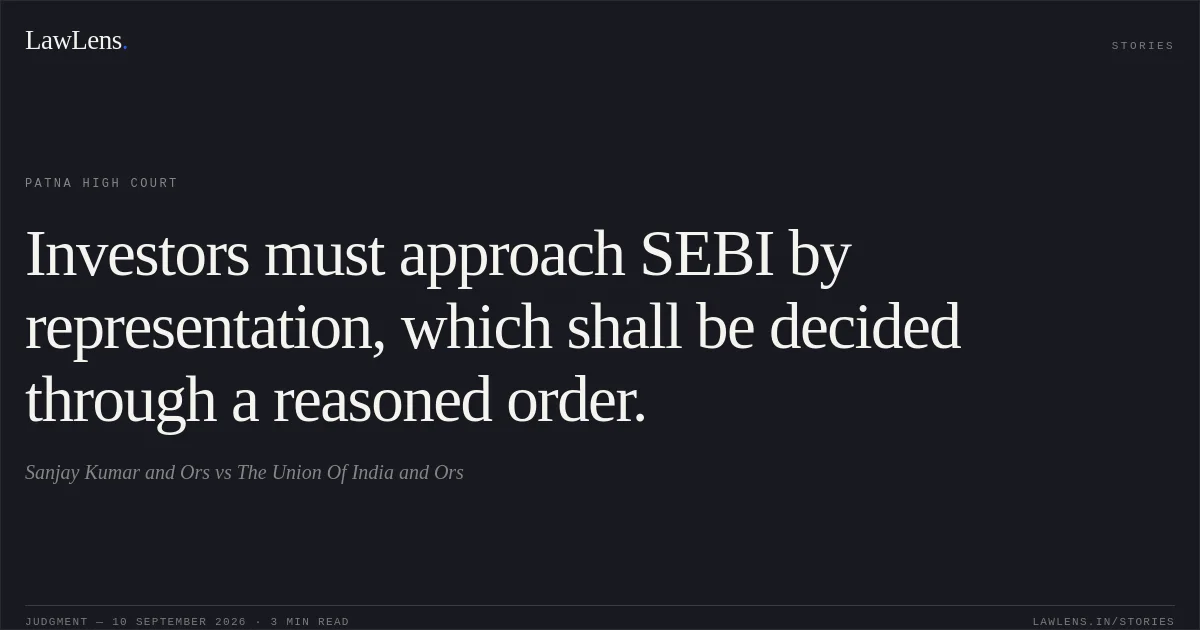
Source reference: pp. 5–7, para. 4Under Dilip Kumar Ravidas, the petitioners were required to approach the Securities and Exchange Board of India by filing a representation; SEBI was directed to consider and decide the representation by a reasoned and speaking order within four months, after complying with the principles of natural justice and permitting the parties to place relevant materials on record.
Source reference: pp. 5–7, para. 4The precedent further preserved the petitioners’ liberty to pursue alternative remedies and to approach the Court again, if necessary, without any expression of opinion on the merits.
Source reference: pp. 6–7, para. 4Reasoning
The Court did not independently adjudicate the allegations of illegal collection of funds, entitlement to refund, or liability of the private companies and their directors.
Source reference: pp. 4–5, para. 3Having noted that the parties agreed that the issue was covered by Dilip Kumar Ravidas, the Court adopted the procedural solution prescribed in that judgment.
Source reference: pp. 4–5, para. 3Accordingly, rather than issuing direct refund, attachment, or investigative directions against the authorities, it required the petitioners to pursue their grievance before SEBI through a formal representation.
Source reference: pp. 5–7, paras. 4–5The Court also left all merits and other legal remedies open.
Source reference: pp. 5–7, paras. 4–5Holding
The writ petition was disposed of in terms of Dilip Kumar Ravidas.
The petitioners were required to approach SEBI by filing a representation within four weeks; SEBI was directed to consider and decide it expeditiously, preferably within four months, by a reasoned and speaking order, after providing hearing and an opportunity to submit relevant documents.
Source reference: pp. 5–6, para. 4The order was to be communicated to the petitioners. Liberty was reserved to pursue alternative remedies and to approach the Court subsequently if required; no opinion was expressed on the merits.
Source reference: pp. 6–7, para. 4Any interlocutory application was also disposed of.
Source reference: p. 7, para. 6Original Court PDF
Sanjay Kumar and OrsvsThe Union Of India and Ors
Click to open original judgment
Original judgment, available to read, download and summarize on LawLens.in