Facts
In 2007, an FIR was registered against nine accused persons for offences including murder and attempted murder under Sections 302, 307, and 120B of the IPC
Source reference: para 3.1On 27.03.2009, the Trial Court framed charges, but the formal document remained unsigned as one accused (A3) was absent
Source reference: para 3.4On 01.06.2009, all accused appeared, and the court recorded that charges were framed, subsequently proceeding with the trial for over fourteen years
Source reference: para 3.4, 4.2After the prosecution evidence was closed and the case reached the stage of Section 313 Cr.P.C. statements, the Presiding Officer noticed the unsigned formal charge and framed fresh charges on 11.09.2024 to cure the defect
Source reference: para 3.5The Trial Court allowed the appellant’s application to proceed from the current stage using existing evidence, noting that two key witnesses had died and the accused had extensively cross-examined the witnesses
Source reference: para 3.6However, the High Court set aside this order and directed a de novo (fresh) trial under Sections 241 and 242 Cr.P.C.
Source reference: para 2, 3.7Issues
1. Whether there was substantial compliance with the requirement of framing charges in accordance with the law?
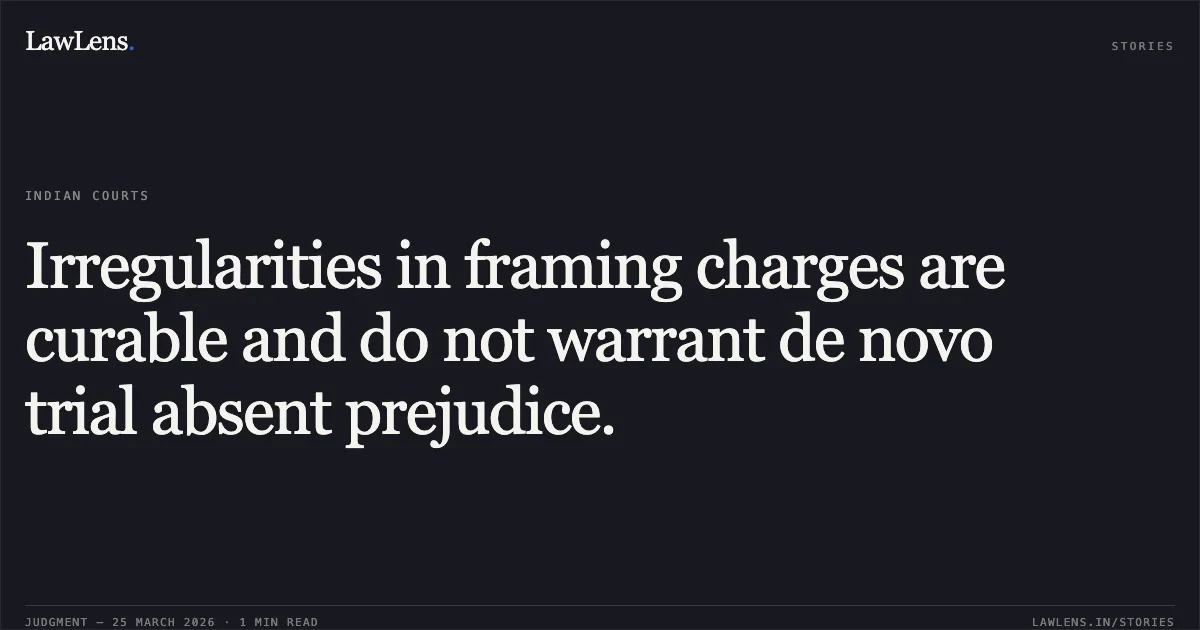
Source reference: para 13(i)2. Whether the defect in framing or signing the charges constitutes a jurisdictional illegality vitiating the trial or a curable irregularity under Sections 215 and 464 Cr.P.C.?
Source reference: para 13(ii)3. Whether the High Court was justified in directing a de novo trial after the trial had substantially progressed and key witnesses had expired?
Source reference: para 13(iii)Law Applied
The Court primarily applied Section 215 and Section 464 of the Cr.P.C., which stipulate that errors, omissions, or irregularities in charges do not invalidate a finding unless they occasion a "failure of justice"
Source reference: para 15.1, 15.2It relied on the Constitution Bench precedent in Willie (William) Slaney v. State of Madhya Pradesh, which established that procedural laws are designed to further justice, and substantial compliance is sufficient if the accused understands the nature of the offence
Source reference: para 14.2The Court also invoked the principle from Main Pal v. State of Haryana that the object of a charge is notice, not ritualistic formality
Source reference: para 14.3State of M.P. v. Bhooraji, which cautions appellate courts against ordering fresh trials for technical irregularities
Source reference: para 16.2Reasoning
The Court reasoned that the fundamental purpose of framing a charge is to provide the accused with precise notice of the allegations to enable a fair defence
Source reference: para 14.1In this case, the accused actively participated in the trial for fourteen years and conducted extensive cross-examinations, proving they were fully aware of the prosecution's case and were not misled
Source reference: para 14.6The Court distinguished between a "fundamental illegality" and a "curable irregularity," holding that the absence of a signature on a charge sheet is a mere procedural lapse
Source reference: para 15.4, 15.7It observed that a de novo trial is an exceptional remedy reserved for cases where the trial is fundamentally flawed
Source reference: para 16.1, 16.4The Court found that the High Court failed to demonstrate any "failure of justice" or "prejudice" caused to the accused
Source reference: para 16.10Furthermore, it noted that ordering a fresh trial after the death of crucial eyewitnesses (PW-1 and PW-3) would irretrievably prejudice the prosecution and defeat the ends of justice
Source reference: para 16.9Holding
The Supreme Court allowed the appeal and set aside the High Court’s order
It held that the defect in signing the charges was a curable procedural irregularity under Sections 215 and 464 Cr.P.C. and did not vitiate the trial
Source reference: para 15.12The Court answered that there was substantial compliance with the law as the accused had full knowledge of the case
Source reference: para 14.8The Trial Court's order dated 07.10.2024 was restored, and the Court directed that the trial proceed from the stage of Section 313 Cr.P.C. statements to ensure an expeditious conclusion
Source reference: para 18Acts & Sections Cited
20 provisions across 2 statutes referred to in this judgment. Each provision opens on LawLens.
Indian Penal Code, 18606
Original Court PDF
Sandeep YadavvsSatish
Click to open original judgment
Original judgment, available to read, download and summarize on LawLens.in