Facts
The petitioners challenged the legality of an order dated 11.10.2013 passed by the Central Administrative Tribunal (CAT), Jabalpur Bench, which had refused their claim for regularization.
Source reference: para 1The petitioners sought regularization based on the principles laid down in T.N. Godavarman Thirumulpad v. Union of India and parity with the Supreme Court judgment in Ravi Verma And Ors. v. Union of India And Ors. (Civil Appeal Nos. 2795-2796 of 2018).
Source reference: para 1-2The common CAT order dated 11.10.2013, which affected the petitioners and Ravi Verma, had already been set aside by the Supreme Court in the Ravi Verma matter.
Source reference: para 5The respondents opposed the petition primarily on the grounds of delay and laches.
Source reference: para 3Issues
1. Whether the petitioners are entitled to regularization of service with effect from 01.07.2006 based on parity with the decision in Ravi Verma v. Union of India.
Source reference: para 2, 62. Whether the petition is liable to be dismissed due to delay and laches.
Source reference: para 3Law Applied
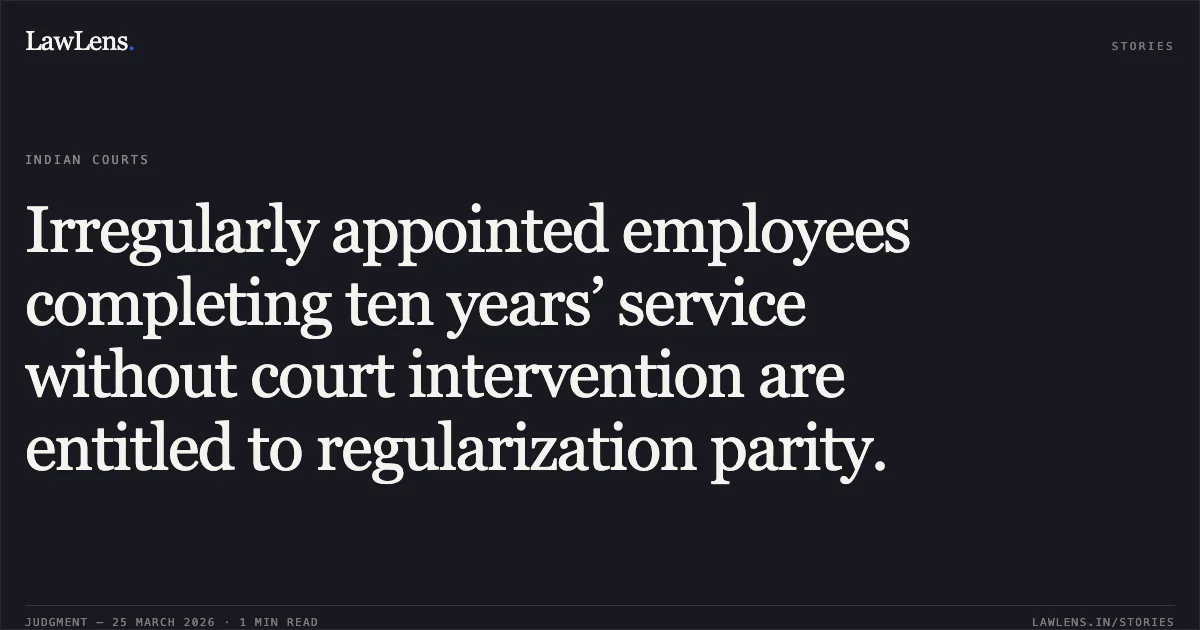
The court primarily applied the "one-time measure" regularization principle established in paragraph 53 of Secretary, State of Karnataka v. Umadevi (3) (2006) 1 SCC 1, which permits the regularization of irregularly appointed persons who have worked for ten years or more in duly sanctioned vacant posts without the intervention of court orders.
Source reference: para 5It further relied on the Supreme Court’s ruling in Ravi Verma And Ors. v. Union of India And Ors. (2018), which held that failing to regularize similarly situated employees who met the Umadevi criteria constituted discriminatory treatment and illegality.
Source reference: para 5Reasoning
The High Court observed that the petitioners were similarly situated to the appellants in the Ravi Verma case.
Source reference: para 6The Supreme Court had already reviewed the common CAT order from 11.10.2013 and determined that the denial of regularization was improper because the appointments were merely "regular" rather than "illegal," and the employees had completed the requisite service.
Source reference: para 5The Court found that because the Supreme Court had already set aside the 2013 CAT order for other employees in the same position, the petitioners were entitled to identical relief to avoid discriminatory treatment.
Source reference: para 6The court implicitly rejected the respondents' argument regarding delay, focusing instead on the fact that the underlying order of the Tribunal had already been declared unsustainable by the apex court.
Source reference: para 6-7Holding
The High Court allowed the petition and set aside the CAT order dated 11.10.2013 insofar as it related to the petitioners.
The court directed the respondents to regularize the petitioners' services effective from 01.07.2006 and grant all consequential benefits within three months.
Source reference: para 7It further ordered that if the benefits are not granted within the stipulated period, they shall carry an interest rate of 10% per annum.
Source reference: para 7Original Court PDF
RAJESH BAISvsUNION OF INDIA
Click to open original judgment
Original judgment, available to read, download and summarize on LawLens.in