Facts
The parties married on 9 May 1987 and had four children.
Source reference: paras. 2–8Both were government servants posted in different departments and resided separately in Gwalior.
Source reference: paras. 2–8The appellant-husband filed a divorce petition under the Hindu Marriage Act, 1955, alleging desertion and cruelty, including refusal by the respondent-wife to cohabit, insistence on separate residence, physical assaults, and failure to perform matrimonial and parental obligations.
Source reference: paras. 2–8He had previously instituted a divorce petition, which was withdrawn in 2004 for the sake of the children.
Source reference: paras. 2–8The Family Court dismissed Civil Suit No. 309/2012 on 9 January 2014.
Source reference: paras. 2–8The husband preferred the present first appeal.
Source reference: paras. 2–8Issues
Whether the appellant proved that the respondent had deserted him so as to entitle him to a decree of divorce under the Hindu Marriage Act, 1955.
Source reference: para. 12Whether the respondent’s alleged conduct, including physical assault, refusal to maintain matrimonial relations, and other asserted acts, amounted to cruelty warranting divorce.
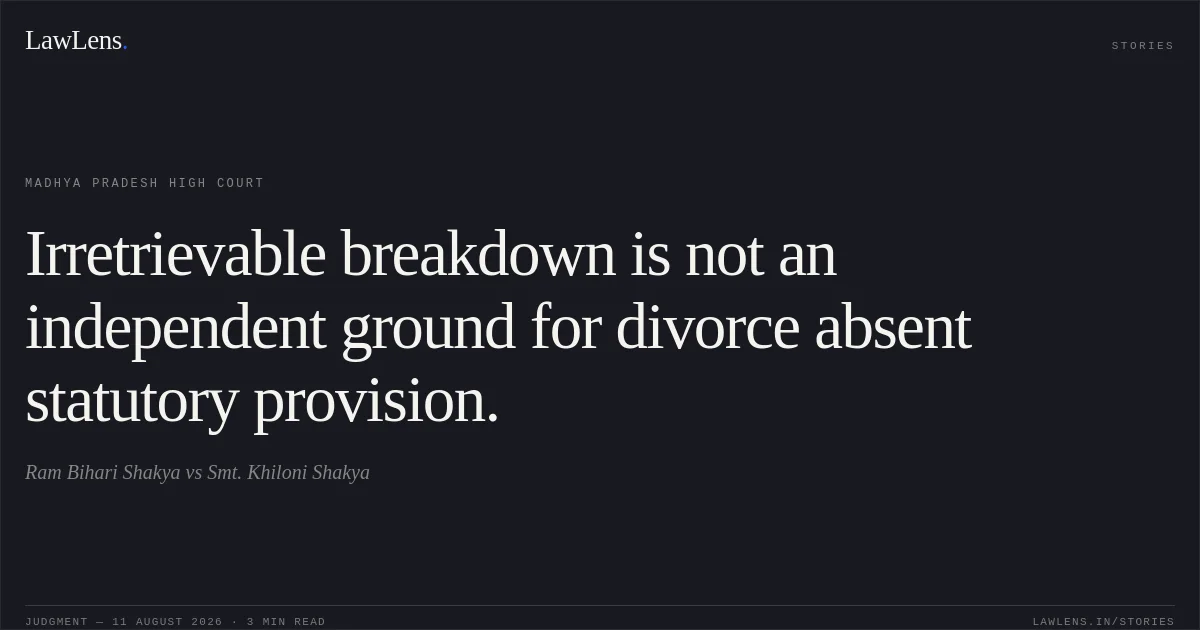
Source reference: paras. 13–14Whether the appellant was entitled to divorce on the ground of irretrievable breakdown of marriage in the absence of proof of a statutory ground under the Hindu Marriage Act.
Source reference: paras. 15–16Whether the alleged acquittal in the dowry-harassment case established cruelty or otherwise supported the appellant’s claim.
Source reference: paras. 10–11Law Applied
The Court applied Sections 13(1)(ia) and 13(1)(ib) of the Hindu Marriage Act, 1955, under which cruelty and desertion are statutory grounds for divorce; the party seeking divorce must establish the pleaded ground through reliable evidence.
Source reference: paras. 10–11, 16The Court also applied the principle that suppression or withholding of material evidence may justify an adverse inference, particularly where the evidence is directly relevant to the claim.
Source reference: paras. 10–11It relied on V. Bhagat v. Mrs. D. Bhagat, 1994 AIR (SC) 710, for the rule that irretrievable breakdown of marriage is not, by itself, a statutory ground for divorce and that the High Court cannot exercise the Supreme Court’s power under Article 142 of the Constitution to dissolve a marriage solely on that basis.
Source reference: paras. 10–11, 16Reasoning
The Court found the appellant’s case unreliable and inconsistent.
Source reference: para. 12Although he pleaded that the parties had lived separately since 2006, his cross-examination showed that he stayed with the respondent in the DRP Line house even thereafter and again lived with her for two to three months pursuant to a 2009 compromise.
Source reference: para. 12His own evidence also indicated that he would not resume cohabitation, despite the respondent’s willingness to restore the marital relationship; therefore, the alleged desertion was held to be mala fide and deceptive.
Source reference: para. 12The allegation of physical cruelty was unsupported apart from one complaint, Ex. P/3, while the police enquiry did not substantiate the appellant’s version and he took no further legal action.
Source reference: paras. 13–14Further, the appellant relied on the alleged acquittal in the dowry case but failed to produce the judgment or disclose material particulars.
Source reference: paras. 10–11The Court independently located the criminal case and found that it had ended on the basis of a compromise, not an honourable acquittal; the suppression of this fact warranted an adverse inference.
Source reference: paras. 10–11Finally, the long separation did not permit the High Court to grant divorce on irretrievable breakdown, particularly when the respondent remained willing to resume the marriage and the appellant had failed to prove cruelty or desertion.
Source reference: paras. 15–16Holding
The Court held that the appellant failed to establish either desertion or cruelty under the Hindu Marriage Act and was not entitled to divorce on the ground of irretrievable breakdown of marriage.
The Family Court’s dismissal of the divorce petition was found to be consistent with the evidence and legally sound.
Source reference: paras. 17–19The first appeal was accordingly dismissed, and the judgment and decree of the Family Court were upheld.
Source reference: paras. 17–19A decree was directed to be prepared and the judgment and decree were ordered to be transmitted to the trial Court.
Source reference: paras. 17–19Original Court PDF
Ram Bihari ShakyavsSmt. Khiloni Shakya
Click to open original judgment
Original judgment, available to read, download and summarize on LawLens.in