Facts
The parties married on 23 April 2014 and had a daughter.
Source reference: no citationThe wife petitioned for divorce, alleging cruelty, including physical abuse, pressure to borrow money for the husband, and a forced abortion. The husband denied the allegations and maintained that the wife had left the matrimonial home and refused to return.
Source reference: pp. 2–6, paras. 1–5The Family Court dismissed the petition; the wife appealed under Section 19(1) of the Family Courts Act.
Source reference: pp. 2–6, paras. 1–5Issues
1. Whether the wife established cruelty by the husband as a ground for divorce under Section 13 of the Hindu Marriage Act, 1955.
Source reference: pp. 34–36, paras. 50–522. Whether the parties’ prolonged separation and alleged irretrievable breakdown of the marriage independently warranted a divorce decree.
Source reference: pp. 36–38, paras. 53–55Law Applied
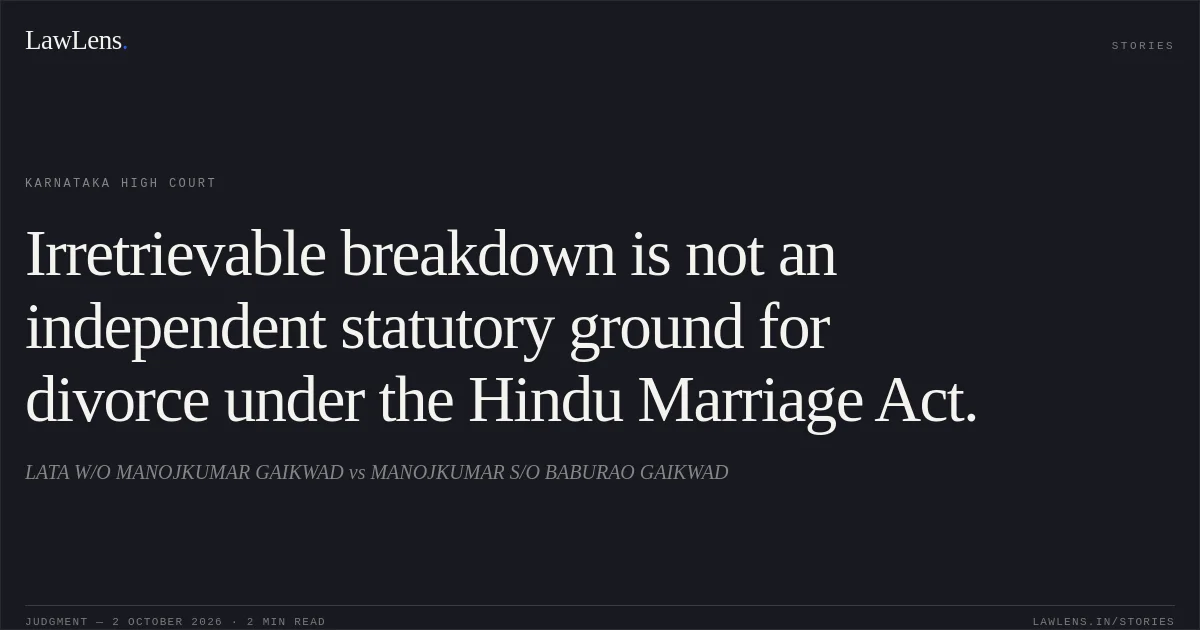
Section 13 of the Hindu Marriage Act, 1955 provides the statutory grounds for divorce; irretrievable breakdown of marriage is not, by itself, an independent ground under that provision.
Source reference: pp. 36–38, paras. 53, 55Section 20(1) of the Act requires a petition to state distinctly the facts on which the claim for relief is founded.
Source reference: pp. 28–30, paras. 43–44In Bondar Singh v. Nehal Singh, (2003) 4 SCC 161, the Supreme Court held that evidence ordinarily cannot establish a material fact absent necessary pleadings.
Source reference: pp. 12, 27–30, paras. 16–17, 41–44Sarwan Singh v. State of Punjab, AIR 2002 SC 3652, was cited for the principle that evidence on a point may be accepted where the opposing party declines to challenge it in cross-examination.
Source reference: pp. 20–21, paras. 29–30Balu Sudam Khalde v. State of Maharashtra, AIR 2023 SC 1736, was cited for the proposition that an incriminating suggestion made in cross-examination may bind the party whose counsel made it.
Source reference: pp. 22–24, paras. 34–35Reasoning
The Court held that the wife’s dowry allegation was absent from the petition and was not supported by the evidence of either the wife or her mother; the alleged demand for her salary was raised only through suggestions in cross-examination and lacked a foundation in the pleadings.
Source reference: pp. 9–13, 26–30, paras. 11–17, 41–44It treated the allegation of forced abortion as unsupported by medical or other documentary evidence and found no documentary support for the alleged police complaint.
Source reference: pp. 34–36, para. 51The oral accounts of the parties on the remaining allegations were in conflict, while the husband’s account of how the wife left the matrimonial home had not been specifically challenged in cross-examination.
Source reference: pp. 18–21, 31–33, paras. 26–30, 47–48On the evidence as a whole, the Court concluded that cruelty was not proved; separation and alleged irretrievable breakdown could not independently supply a statutory ground for divorce.
Source reference: pp. 36–38, paras. 52–55Holding
The Court answered both issues against the wife.
It held that she had not established cruelty or another statutory ground for divorce, and that prolonged separation or irretrievable breakdown alone did not entitle her to a decree.
Source reference: pp. 36–38, paras. 52–55The appeal was dismissed, and the Family Court’s judgment and decree were left undisturbed.
Source reference: p. 39, para. 56Acts & Sections Cited
4 provisions across 2 statutes referred to in this judgment. Each provision opens on LawLens.
Family Courts Act, 19841
Hindu Marriage Act, 19553
Original Court PDF
LATA W/O MANOJKUMAR GAIKWADvsMANOJKUMAR S/O BABURAO GAIKWAD
Click to open original judgment
Original judgment, available to read, download and summarize on LawLens.in