Facts
Jagrutiben, married to accused No. 1 about one and a half years before her death, died after consuming poison on 3 May 2012.
Source reference: pp. 2, 5 (paras. 2, 10)The Sessions Court acquitted the accused of offences under Sections 498A, 306 and 114 IPC. The State appealed under Section 378 CrPC. During the appeal, respondent No. 2 died, and the appeal against him abated.
Source reference: pp. 1–2 (paras. 1, 1.1)Issues
1. Whether the prosecution proved beyond reasonable doubt that the respondents subjected Jagrutiben to cruelty within the meaning of Section 498A IPC or abetted her suicide under Sections 306 and 107 IPC.
Source reference: pp. 5–8, 12–13 (paras. 11–16, 21–22)2. Whether the Sessions Court’s acquittal disclosed an error warranting appellate interference.
Source reference: pp. 9–12 (paras. 17–20)Law Applied
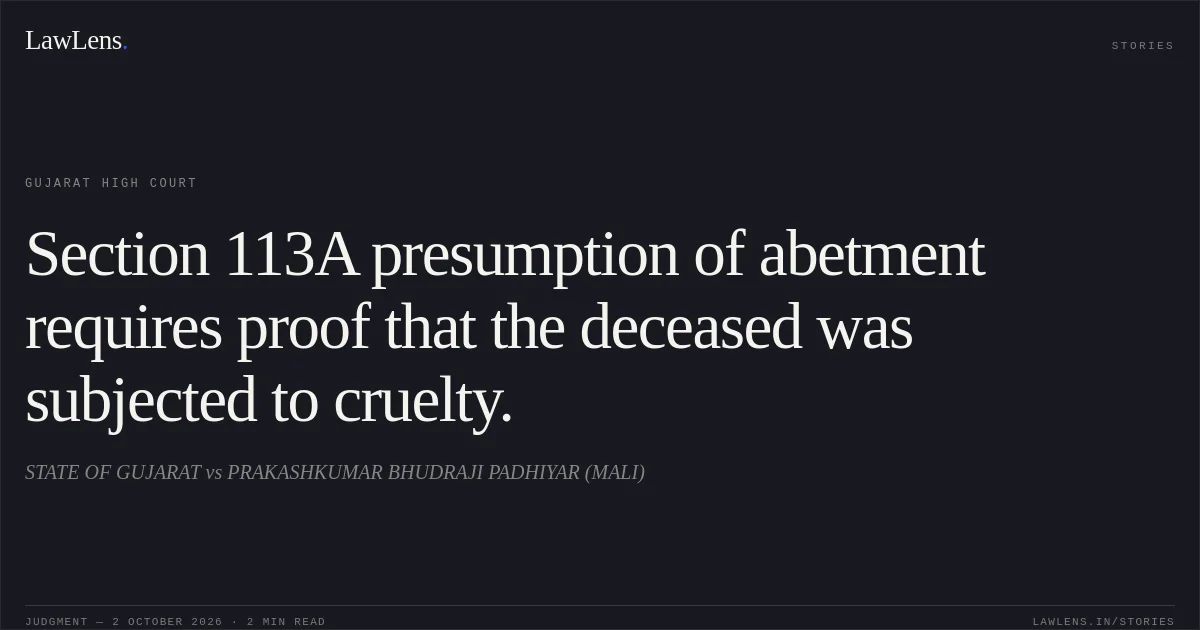
Sections 498A, 306 and 107 IPC require proof of the relevant cruelty and of abetment; the court held that the prosecution must establish a factual basis of cruelty before a presumption relating to abetment can arise.
Source reference: pp. 6–8 (paras. 12–13)Section 113A of the Evidence Act permits—but does not compel—a presumption of abetment where a married woman dies by suicide within seven years of marriage and is shown to have been subjected to cruelty; Section 113B concerns dowry death and requires proof of cruelty or harassment for, or in connection with, a dowry demand soon before death.
Source reference: pp. 7–8 (paras. 13–13.1)The Court relied on Ramesh Kumar v. State of Chhattisgarh, (2001) 9 SCC 618, and Ram Pyare v. State of Uttar Pradesh, (2025) 6 SCC 820, among other decisions, on the requirements for abetment and statutory presumptions.
Source reference: pp. 7–8, 9–12 (paras. 13–14, 19–20)On an appeal against acquittal, the appellate court may review the evidence, but must account for the reinforced presumption of innocence; where two reasonable views are possible, it should not displace the acquittal.
Source reference: pp. 9–12 (paras. 17–20), applying Chandrappa v. State of Karnataka, (2007) 4 SCC 415Reasoning
The Court found material contradictions in the accounts of prosecution witnesses PW-1 to PW-4. The father’s trial testimony added a dowry-cruelty allegation absent from the FIR, but no evidence established a dowry demand; the brother’s account was also exaggerated, and the evidence did not substantiate specific cruelty or harassment by the respondents.
Source reference: pp. 5–6 (paras. 11–12)The deceased and her husband lived separately from the other respondents, while the alleged complaints about cooking and household maintenance were not, on this record, supported by specific evidence of cruelty. The deceased had recently attended a family ceremony, and no harassment was reported or noticed then.
Source reference: pp. 6, 8 (paras. 11–12, 15)Because the evidentiary foundation for cruelty was lacking, the Court found no basis to invoke Section 113A; the dowry-related requirements of Section 113B were likewise unsupported. Applying the deferential standard for appeals against acquittal, the Court found no perversity or material error in the trial Court’s assessment.
Source reference: pp. 8–12 (paras. 15–20)Holding
The High Court held that the prosecution had not proved the charged offences beyond reasonable doubt and that the trial Court’s acquittal was not erroneous.
The State’s appeal was dismissed, the acquittal confirmed, and the bail bonds cancelled.
Source reference: pp. 12–13 (paras. 21–23)The appeal against respondent No. 2 had already abated following his death.
Source reference: p. 1 (para. 1.1)Acts & Sections Cited
5 provisions across 2 statutes referred to in this judgment. Each provision opens on LawLens.
Code of Criminal Procedure, 19732
Indian Penal Code, 18603
Original Court PDF
STATE OF GUJARATvsPRAKASHKUMAR BHUDRAJI PADHIYAR (MALI)
Click to open original judgment
Original judgment, available to read, download and summarize on LawLens.in