Facts
The claimants brought a claim under Section 163A of the Motor Vehicles Act, 1988, arising from an accident involving a motorcycle.
Source reference: pp. 3–4, para. 5The Tribunal awarded ₹3,72,500 with 7.5% annual interest, but exonerated the insurer after finding that the driver did not hold a valid and effective driving licence; liability was imposed on the driver and owner.
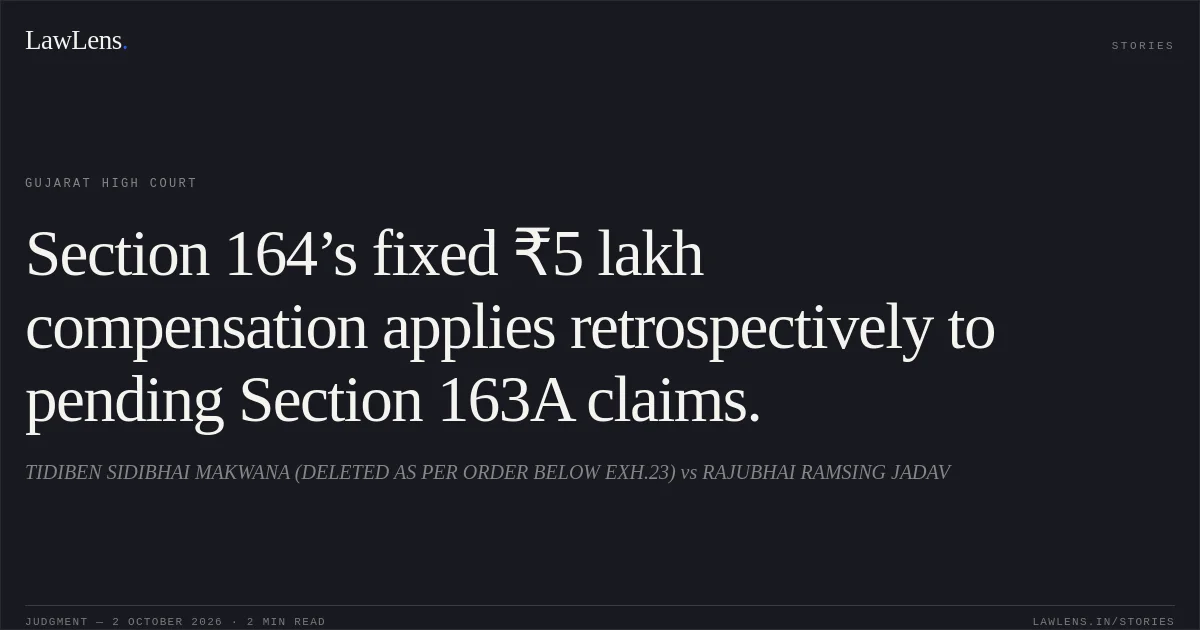
Source reference: pp. 3–4, para. 5The claimants appealed, seeking an order requiring the insurer to pay and recover from the owner and contending that the fixed ₹5 lakh compensation under Section 164 applied to their pending Section 163A claim.
Source reference: pp. 2–3, para. 3Issues
Whether the insurer should be directed to satisfy the award and recover the amount from the vehicle owner despite the driver’s lack of a valid driving licence.
Source reference: p. 1, para. 1; pp. 4–9, paras. 6–9Whether claimants in a pending Section 163A claim are entitled to the fixed compensation of ₹5 lakh under Section 164 of the Motor Vehicles Act.
Source reference: p. 1, para. 1; pp. 9–11, para. 10Law Applied
Section 163A of the Motor Vehicles Act provides for compensation claims on a structured basis, while Section 164 provides fixed compensation for death or injury; the court treated the Section 164 amendment as applicable to pending claims, relying on New India Assurance Co. Ltd. v. Urmila Halder and the principle that beneficial legislation should benefit claimants absent a specific bar.
Source reference: pp. 2, 9–11, paras. 3, 10On insurer liability, the court relied on Jawahar Singh v. Bala Jain, National Insurance Co. Ltd. v. Swaran Singh, Shamanna v. Oriental Insurance Co. Ltd., and Manuara Khatun v. Rajesh Kumar Singh for the pay-and-recover approach: in appropriate cases, the insurer may be directed to pay the claimant first and recover the amount from the insured or owner.
Source reference: pp. 4–9, paras. 6–9Reasoning
The Tribunal’s finding that the driver lacked a valid licence supported exoneration of the insurer from ultimate liability, but did not prevent the court from applying the pay-and-recover principle.
Source reference: pp. 4–9, paras. 6–9Following the cited authorities, the court concluded that the claimants should not be left to recover compensation solely from the owner; the insurer was therefore directed to satisfy the award and pursue recovery from the owner.
Source reference: pp. 4–9, paras. 6–9, 13On quantum, the court applied Urmila Halder as holding that the beneficial Section 164 amendment could apply to pending claims, and substituted the fixed ₹5 lakh compensation for the Tribunal’s award.
Source reference: pp. 9–11, paras. 10–12Holding
The appeal was allowed and the Tribunal’s award modified.
The claimants were held entitled to ₹5 lakh with 9% annual interest from the date of the claim petition until realization; the insurer was directed to deposit that amount within eight weeks and was entitled to recover it from the owner by executing the judgment.
Source reference: pp. 11–12, paras. 11–17The Tribunal was directed to disburse the deposited amount, with accrued interest, to the claimants after verification and subject to deduction of any unpaid court fees.
Source reference: p. 11, paras. 14–16Acts & Sections Cited
3 provisions across 1 statute referred to in this judgment. Each provision opens on LawLens.
Motor Vehicles Act, 19883
Original Court PDF
TIDIBEN SIDIBHAI MAKWANA (DELETED AS PER ORDER BELOW EXH.23)vsRAJUBHAI RAMSING JADAV
Click to open original judgment
Original judgment, available to read, download and summarize on LawLens.in