Facts
The prosecution alleged that, on 30 June 1993, the accused attacked Kalubhai and his nephew Bhurabhai with an axe and sticks while they were returning to their village.
Source reference: p. 1–2; para. 1–2, 8Kalubhai was treated at hospital and later died from septicaemia during treatment.
Source reference: p. 1–2; para. 1–2, 8The Sessions Court acquitted the accused of offences including under Sections 302, 324, 34 and 114 of the IPC and Section 135 of the Bombay Police Act; the State appealed under Section 378 CrPC.
Source reference: p. 1–2; para. 1–2, 8Accused No. 3 died during the appeal, which therefore continued against the remaining respondents.
Source reference: p. 1–2; para. 1–2, 8Issues
1. Whether the trial Court’s acquittal was perverse or otherwise legally unsustainable so as to warrant appellate interference.
Source reference: p. 11–15; para. 19–252. Whether the prosecution evidence proved the accused’s involvement in the assault and the charges beyond reasonable doubt.
Source reference: p. 11, 15; para. 19, 24–25Law Applied
The appeal was brought under Section 378 CrPC against an acquittal.
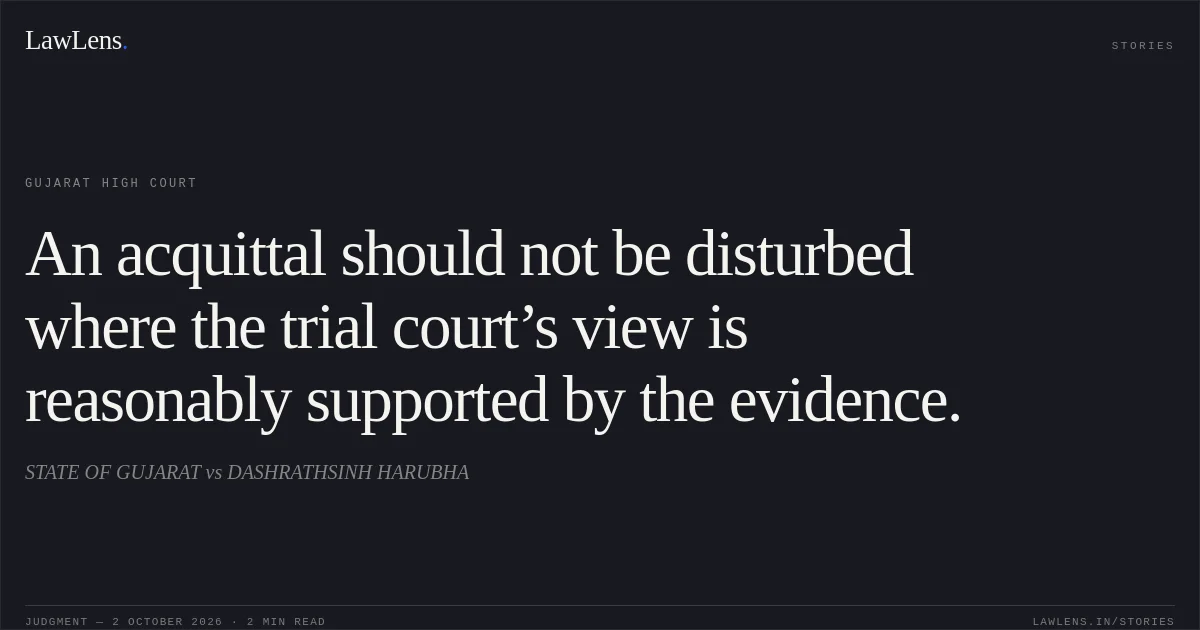
Source reference: no citationThe Court applied the principles in Chandrappa v. State of Karnataka, as reaffirmed in Rajesh Prasad v. State of Bihar, Babu Sahebagouda Rudragoudar v. State of Karnataka and Ramesh v. State of Karnataka: an appellate court may review and reappreciate the evidence, but an acquittal carries a strengthened presumption of innocence; where two reasonable views are possible, the acquittal should not be disturbed.
Source reference: p. 12–14; para. 20–23Interference is warranted where the trial Court’s approach is manifestly illegal or its conclusion perverse.
Source reference: p. 12–14; para. 20–23Reasoning
The Court found material reasons to doubt the prosecution case: the FIR was not lodged promptly; the medical evidence did not clearly support the eyewitnesses’ account of a head injury; Bhurabhai’s alleged injury was not medically substantiated and his conduct in leaving the scene was unexplained; and the prosecution did not produce records establishing Kalubhai’s condition during his prolonged treatment or examine his wife, who had accompanied him.
Source reference: p. 8–11; para. 13–19The medical evidence attributed death to septicaemia, while the evidentiary gaps left the alleged assault and the accused’s roles unproved beyond reasonable doubt.
Source reference: p. 8–11; para. 13–19The Court concluded that the trial Court’s assessment was a reasonable view and disclosed no error warranting appellate intervention.
Source reference: p. 15; para. 24–25Holding
The Court held that the prosecution had not proved the charges beyond reasonable doubt and that no basis existed to disturb the acquittal.
The State’s appeal was dismissed, the trial Court’s acquittal was confirmed, the bail bond was cancelled, and the record and proceedings were directed to be returned to the trial Court.
Source reference: p. 15–16; para. 24–26Acts & Sections Cited
6 provisions across 2 statutes referred to in this judgment. Each provision opens on LawLens.
Code of Criminal Procedure, 19732
Indian Penal Code, 18604
Original Court PDF
STATE OF GUJARATvsDASHRATHSINH HARUBHA
Click to open original judgment
Original judgment, available to read, download and summarize on LawLens.in