Facts
The petitioner, an Inspector in the Backward Classes and Minority Welfare Department, applied directly to the Indian Institute of Information Technology and Management, Gwalior, for the post of Assistant Registrar without routing the application through the competent departmental authority.
Source reference: paras. 2–6A charge-sheet was issued on 13.12.2023, and the petitioner submitted an 11-page reply on 18.03.2024. The disciplinary authority imposed the minor punishment of withholding two annual increments without cumulative effect by order dated 24.04.2024, stating that the petitioner had admitted applying without departmental permission.
Source reference: paras. 2–6The petitioner challenged the punishment order under Article 226, contending that it was non-speaking and failed to consider her detailed explanation. She had also filed an appeal against the punishment order. During the relevant period, a promotion order dated 11.07.2026 was issued in her favour, but no posting order followed.
Source reference: paras. 2–6Issues
1. Whether the punishment order dated 24.04.2024 was liable to be quashed for being non-speaking, unreasoned, and passed without proper consideration of the petitioner’s detailed reply
Source reference: paras. 5, 7–122. Whether the petitioner’s act of directly submitting an application for another post, allegedly contrary to departmental procedure, constituted misconduct warranting disciplinary punishment
Source reference: paras. 13–163. Whether the respondents were required to extend consequential benefits and act upon the petitioner’s promotion order dated 11.07.2026
Source reference: paras. 17–18Law Applied
The Court applied Article 226 of the Constitution and the principle that a disciplinary authority exercising quasi-judicial power must pass a reasoned and speaking order after considering the employee’s defence.
Source reference: paras. 9–10In State of Punjab v. Bandip Singh, (2016) 1 SCC 724, the Supreme Court held that administrative decisions must be composite, self-sustaining, and supported by the reasons that actually influenced the decision.
Source reference: paras. 9–10Kranti Associates Pvt. Ltd. v. Masood Ahmed Khan, (2010) 9 SCC 496, established that reasons are an essential component of fair decision-making and must demonstrate objective consideration of relevant facts.
Source reference: para. 11Under Oryx Fisheries Pvt. Ltd. v. Union of India, (2010) 13 SCC 427, reasons in an appellate order cannot cure the absence of reasons in the original order.
Source reference: para. 12The Court further relied on Union of India v. J. Ahmed, (1979) 2 SCC 286, Inspector Prem Chand v. Government of NCT of Delhi, (2007) 4 SCC 566, and S.D. Bind v. Union of India, 2015 (1) MPLJ 574, for the rule that an isolated error of judgment, negligence simpliciter, or procedural lapse, absent wilful or blameworthy conduct, does not ordinarily constitute misconduct.
Source reference: paras. 13–14The punishment was imposed under the Madhya Pradesh Civil Services (Classification, Control and Appeal) Rules, 1966.
Source reference: para. 6Reasoning
The Court found that although the disciplinary authority referred generally to the petitioner’s reply and treated her conduct as an admission, it did not examine the specific facts and grounds contained in the detailed 11-page explanation or provide adequate reasons for rejecting them.
Source reference: paras. 7–12Since the punishment order affected the petitioner’s service rights, the authority was required to record cogent reasons; the existence of an appellate remedy did not justify requiring the petitioner to pursue an appeal against an invalid original order.
Source reference: paras. 7–12On the merits, the alleged misconduct consisted only of a procedural departure in forwarding the application.
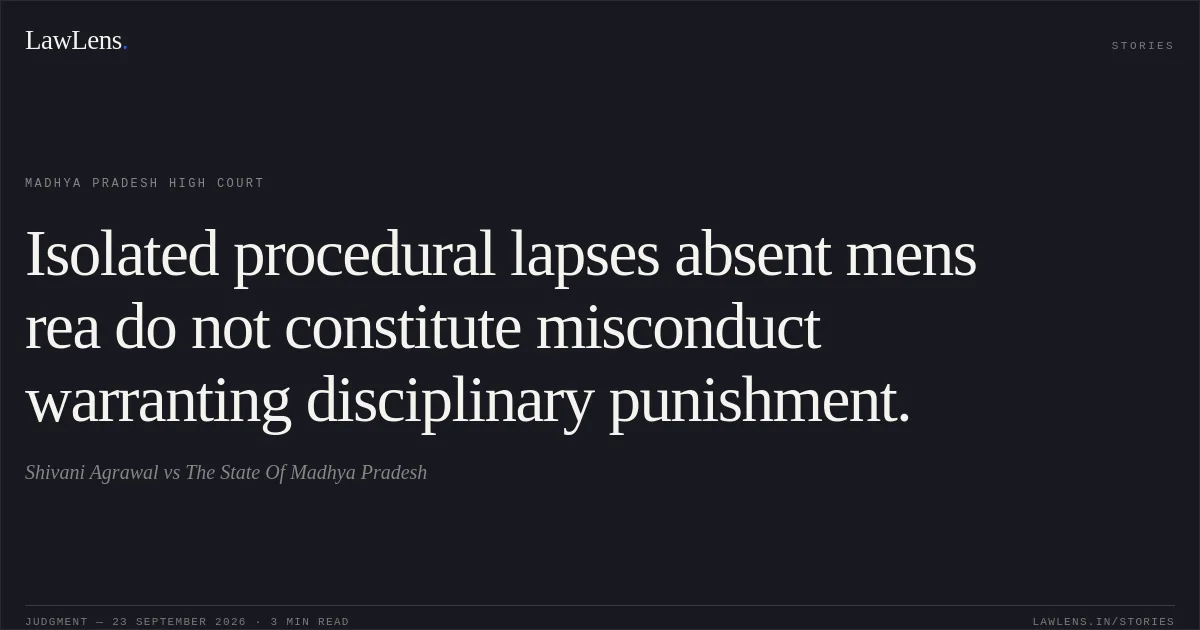
Source reference: paras. 13–16Applying J. Ahmed, Prem Chand, and S.D. Bind, the Court held that the isolated procedural lapse did not establish wilful or blameworthy conduct, misconduct, or mens rea sufficient to sustain disciplinary punishment.
Source reference: paras. 13–16Holding
The Court held that the punishment order dated 24.04.2024 was non-speaking, inadequately reasoned, and based on conduct that did not constitute punishable misconduct.
It accordingly set aside the punishment order and directed the respondents to grant all consequential benefits within one month from receipt of the certified order.
Source reference: para. 17The respondents were further directed to pass an appropriate order in accordance with the petitioner’s promotion order dated 11.07.2026.
Source reference: para. 18The writ petition was disposed of accordingly.
Source reference: para. 19Original Court PDF
Shivani AgrawalvsThe State Of Madhya Pradesh
Click to open original judgment
Original judgment, available to read, download and summarize on LawLens.in