Facts
The applicant was awarded a contract for construction work by the respondents via an agreement dated May 23, 2016.
Source reference: para. 2The work was completed on September 20, 2019, and the final bill was paid on September 7, 2020.
Source reference: para. 2However, a dispute arose regarding the non-payment of the second and final escalation bill amounting to ₹27,28,030/-.
Source reference: para. 2The applicant requested the appointment of an Arbitrator via a notice dated March 22, 2023, but the respondents failed to take action under Clause 64 of the agreement.
Source reference: para. 2Consequently, the applicant filed the present application under Section 11(6) and 11(8) of the Arbitration and Conciliation Act, 1996.
Source reference: para. 1The respondents opposed the application, contending it was barred by limitation as it was filed more than three years after the initial cause of action arose on September 7, 2020.
Source reference: para. 3Issues
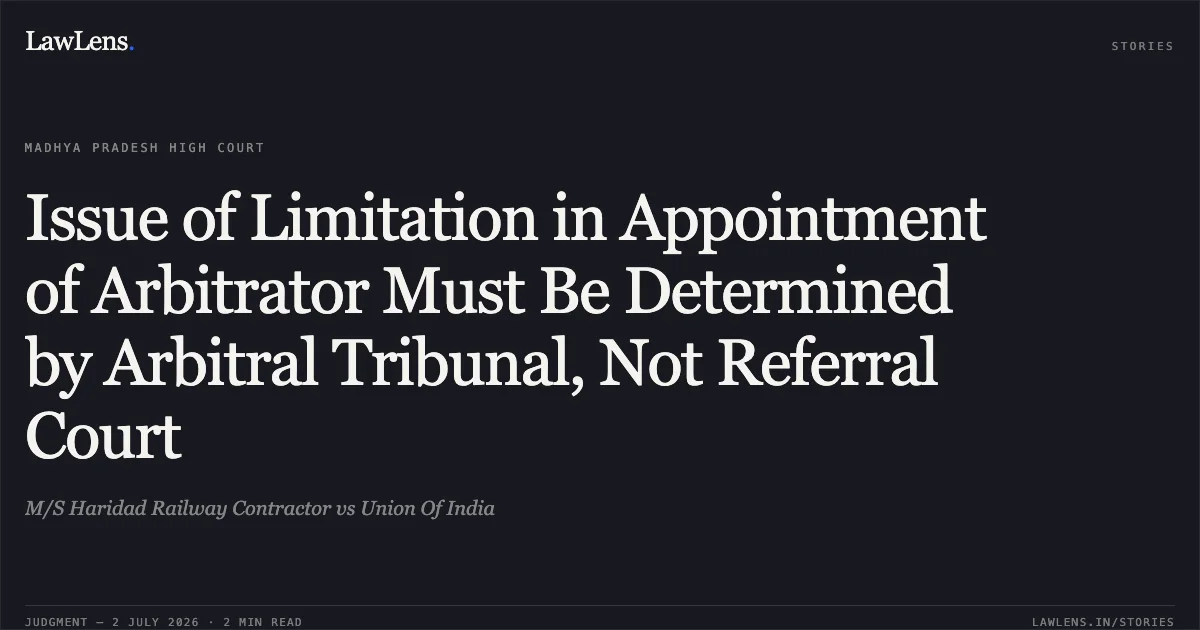
1. Whether the present application for the appointment of an arbitrator is barred by the period of limitation.
Source reference: para. 5Law Applied
Section 11(6-A) of the Arbitration and Conciliation Act, 1996, which confines judicial examination to the existence of an arbitration agreement.
Source reference: para. 7.3The kompetenz-kompetenz principle enshrined in Section 16, affirming that the Arbitral Tribunal is empowered to rule on its own jurisdiction, including issues of limitation.
Source reference: para. 7.11Uttarakhand Purv Sainik Kalyan Nigam Ltd. v. Northern Coal Field Ltd. (2020), which established that limitation is a jurisdictional issue to be decided by the arbitrator.
Source reference: para. 7SBI General Insurance Co. Ltd. v. Krish Spinning (2024), which clarified that the referral court should only perform a prima facie scrutiny of the agreement's existence.
Source reference: para. 11Reasoning
The court observed that the existence of the arbitration agreement and the arbitrability of the dispute were not denied by the respondents.
Source reference: para. 5Regarding the objection of limitation, the court noted that the legislative intent of the 2015 Amendment (Section 11(6-A)) was to minimize judicial intervention at the pre-reference stage.
Source reference: para. 7.7-7.8The court reasoned that limitation is a mixed question of fact and law and falls under the "kompetenz-kompetenz" doctrine, meaning it must be determined by the Arbitrator under Section 16 rather than the High Court under Section 11.
Source reference: para. 7.13The court further found that since the notice invoking arbitration was sent on March 22, 2023, the application was prima facie within time from that date for the purpose of referral, and any intricate inquiry into whether the claim was "stale" should be left to the tribunal.
Source reference: para. 8, 12Holding
The court allowed the application, holding that all questions regarding limitation and jurisdiction are to be decided by the Arbitrator.
The court appointed Justice Shri Ajit Singh (Former Judge, High Court of M.P.) as the sole Arbitrator to resolve the dispute.
Source reference: para. 14The parties were directed to deposit necessary charges as per the M.P. Arbitration Centre Rules, 2019, and the arbitration is to be conducted at Jabalpur.
Source reference: para. 14Acts & Sections Cited
8 provisions across 2 statutes referred to in this judgment. Each provision opens on LawLens.
Arbitration and Conciliation Act, 19967
Indian Contract Act, 18721
Original Court PDF
M/S Haridad Railway ContractorvsUnion Of India
Click to open original judgment
Original judgment, available to read, download and summarize on LawLens.in