Facts
The petitioners (Defendants 5 and 6) purchased the suit property via a registered sale deed in 1984
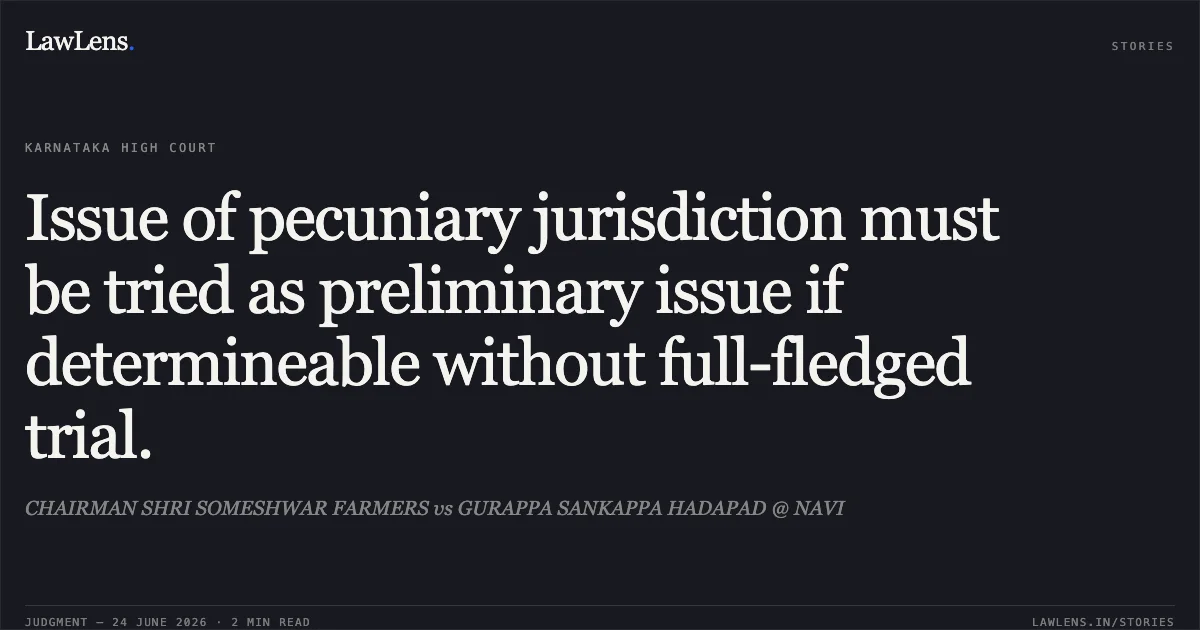
Source reference: para. 2In the underlying original suit (O.S.No.19/2017), the petitioners filed an application (I.A. No. 6) asserting that the Trial Court lacked pecuniary jurisdiction because the property had been converted from agricultural to industrial use, significantly increasing its value
Source reference: para. 5, 7The Trial Court framed an additional issue regarding valuation and court fees but declined to treat it as a preliminary issue, ruling that it should be decided alongside other issues during a full trial
Source reference: para. 3The petitioners challenged this deferment via a writ petition under Articles 226 and 227 of the Constitution
Source reference: p. 2Issues
1. Whether an issue regarding the valuation of the suit and the resulting pecuniary jurisdiction of the court must be tried as a preliminary issue rather than being relegated to a final adjudication
Source reference: para. 2, 62. Whether the Trial Court’s refusal to determine the question of pecuniary jurisdiction as a preliminary issue was contrary to established precedent
Source reference: para. 4Law Applied
The court primarily applied Section 11 of the Karnataka Court Fees and Suits Valuation Act, 1958, in conjunction with Order XIV Rule 2 of the Code of Civil Procedure, 1908, which governs the court's duty to decide issues of law or jurisdiction as preliminary matters
Source reference: para. 4principles established by the Full Bench of the Karnataka High Court in Venkatesh R. Desai vs. Smt. Pushpa Hosmani and Others (W.P.No.8087/2018), which held that while not every court fee issue is preliminary, those touching upon the court's jurisdiction that could dispose of the suit should be determined early
Source reference: para. 4, 6Reasoning
The High Court found that the Trial Court’s approach was legally flawed because the objection raised was not a simple dispute over the adequacy of fees, but a fundamental challenge to the court's competence to hear the case
Source reference: para. 6The court reasoned that since the petitioners provided factual grounds—specifically the change in land nature from agricultural to industrial—the determination of this issue could potentially obviate the need for a full-scale trial
Source reference: para. 6, 7Forcing parties to undergo a protracted trial before a court that might ultimately lack jurisdiction wastes judicial resources and defeats the purpose of procedural rules intended to expedite jurisdictional determinations
Source reference: para. 7The court emphasized that the Trial Court should have allowed limited evidence specifically focused on valuation rather than deferring the matter entirely
Source reference: para. 7Holding
The High Court allowed the writ petition and quashed the Trial Court’s order dated 13.06.2019
The court held that the issue of valuation and pecuniary jurisdiction must be tried as a preliminary issue
Source reference: para. 7The matter was remitted to the Trial Court with directions to permit limited evidence on the question of valuation and to decide I.A. No. 6 within three months
Source reference: para. 8All other contentions on the merits of the suit remain open for later adjudication
Source reference: para. 8Acts & Sections Cited
1 provisions across 1 statute referred to in this judgment. Each provision opens on LawLens.
KARNATAKA COURT-FEE AND SUITS VALUATION ACT, 1958.1
Original Court PDF
CHAIRMAN SHRI SOMESHWAR FARMERSvsGURAPPA SANKAPPA HADAPAD @ NAVI
Click to open original judgment
Original judgment, available to read, download and summarize on LawLens.in