Facts
The respondent–complainant alleged that the petitioner, a retired Government employee, borrowed ₹4,00,000 from him on 5 October 2015, agreeing to repay it with 18% interest, and subsequently issued a cheque for ₹4,00,000 towards repayment.
Source reference: para. 3The cheque was dishonoured, following which the complainant initiated proceedings under Section 138 of the Negotiable Instruments Act, 1881 (“NI Act”).
Source reference: para. 3The Trial Court convicted the petitioner in C.C. No. 120 of 2019 by judgment dated 8 February 2024, and the Appellate Court confirmed the conviction in Crl.A. No. 82 of 2024.
Source reference: paras. 2, 4In revision, the petitioner contended that the cheque had been issued after expiry of three years from the original transaction and therefore represented a time-barred debt. He also disputed service of the statutory demand notice, alleging that it was sent to an incorrect address.
Source reference: paras. 5–6Issues
1. Whether a cheque issued after expiry of three years from the original loan transaction, towards a time-barred debt, could attract penal liability under Section 138 of the NI Act
Source reference: para. 9(i)2. Whether the statutory demand notice under Section 138 of the NI Act was duly served on the petitioner
Source reference: para. 143. Whether the concurrent findings of conviction warranted interference in revision
Source reference: para. 14Law Applied
The Court applied Section 138 of the NI Act, which penalises dishonour of a cheque issued towards a legally enforceable debt or liability, read with Section 25(3) of the Indian Contract Act, 1872 (“Contract Act”), under which a written and signed promise to pay a debt barred by limitation constitutes a valid and enforceable agreement.
Source reference: paras. 10–13The Court held that issuance of a cheque for a time-barred debt may amount to a fresh promise or acknowledgment under Section 25(3), thereby making the liability legally recoverable to the extent of the cheque amount.
Source reference: paras. 10–13It relied on A.V. Murthy v. B.S. Nagabasavanna, (2000) 2 SCC 642; Dr. K.K. Ramakrishnan v. Dr. K.K. Parthasaradhy; H. Narasimha Rao v. R. Venkataram; Dinesh B. Chokshi v. Rahul Vasudeo Bhatt; Sultan Singh v. Tej Partap; and the principles discussed in the Karnataka High Court’s earlier decision in Crl.R.P. No. 400/2016, holding that a cheque may resurrect and enforce a time-barred debt when the requirements of Section 25(3) are satisfied.
Source reference: paras. 8, 11–12The Court further applied the presumption of due service arising from the postal acknowledgment and the correctness of the address shown in the notice and complaint.
Source reference: para. 14Reasoning
The Court rejected the petitioner’s argument that the cheque was unenforceable merely because it was issued more than three years after the original loan transaction.
Source reference: paras. 10–13It reasoned that the cheque itself constituted a written acknowledgment and promise to pay, bringing the liability within Section 25(3) of the Contract Act and rendering it legally enforceable for purposes of Section 138 of the NI Act.
Source reference: paras. 10–13The Court distinguished the petitioner’s reliance on Sasseriyil Joseph v. Devassia, observing that the Supreme Court’s dismissal of the relevant special leave petition did not lay down any law concerning Section 25(3) of the Contract Act.
Source reference: para. 10On service of notice, the Court relied on the copy of the legal notice, postal receipts and postal acknowledgment, and noted that the address in the notice corresponded with the address in the complaint. The petitioner’s own evidence also supported the existence of prior loan transactions and the complainant’s financial capacity.
Source reference: para. 14Since both lower courts had properly appreciated the evidence and their findings did not suffer from illegality, perversity or jurisdictional error, the limited revisional jurisdiction was not attracted.
Source reference: para. 14Holding
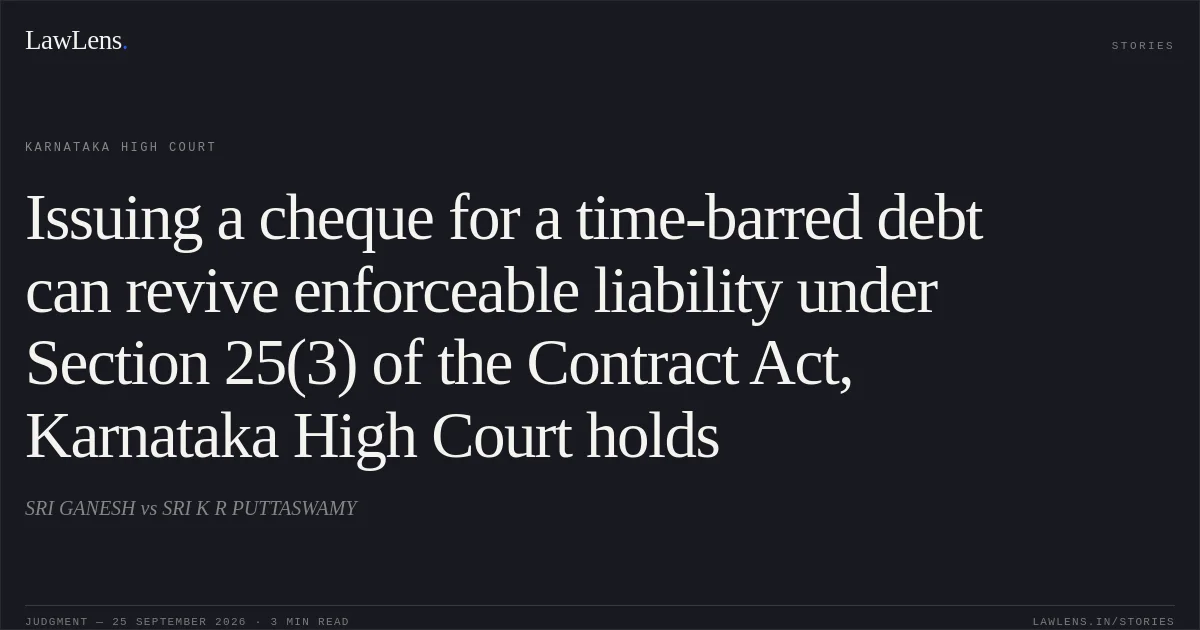
The Court answered the principal issue against the petitioner, holding that issuance of a cheque for a time-barred debt can create an enforceable liability under Section 25(3) of the Contract Act and support prosecution under Section 138 of the NI Act, provided the statutory requirements are otherwise fulfilled.
It also held that the demand notice had been duly served and that the concurrent findings of the Trial Court and Appellate Court did not warrant interference.
Source reference: para. 14Accordingly, the Criminal Revision Petition was dismissed and the conviction was upheld.
Source reference: para. 15Acts & Sections Cited
6 provisions across 4 statutes referred to in this judgment. Each provision opens on LawLens.
Code of Criminal Procedure, 19732
Bharatiya Nagarik Suraksha Sanhita, 20232
Negotiable Instruments Act, 18811
Indian Contract Act, 18721
Original Court PDF
SRI GANESHvsSRI K R PUTTASWAMY
Click to open original judgment
Original judgment, available to read, download and summarize on LawLens.in