01Facts
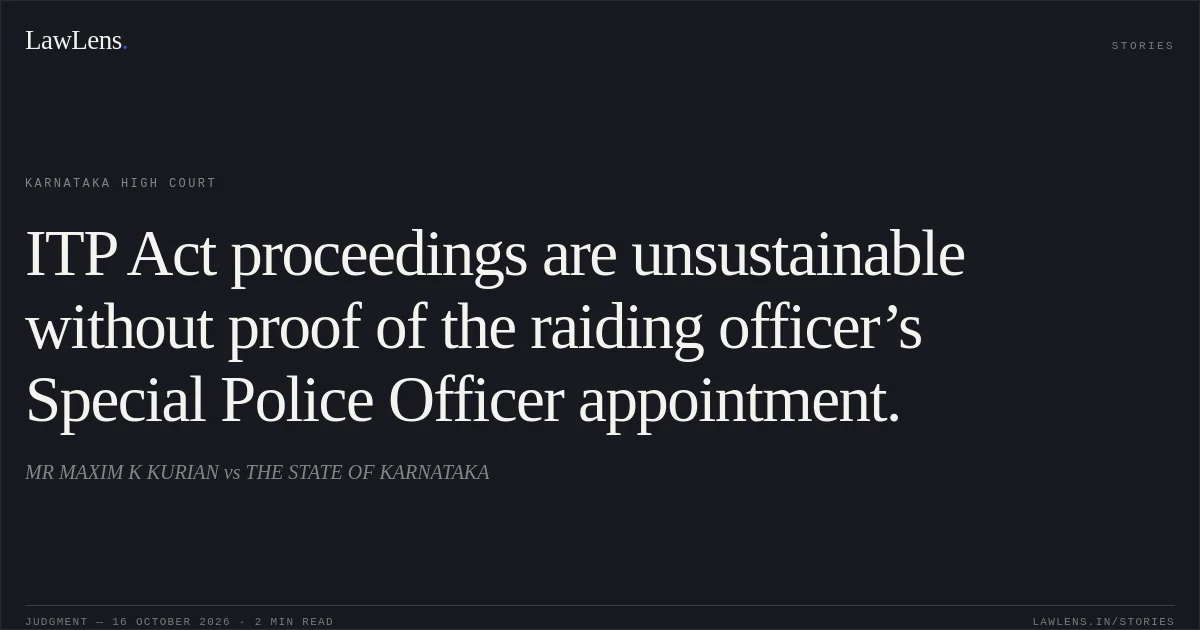
The petitioner sought to quash two sets of proceedings under the Immoral Traffic (Prevention) Act, 1956 (“ITP Act”): C.C. No. 3260/2017, arising from Barke Police Station Crime No. 8/2017, in which he was accused No. 5 of offences under Sections 3(1), 4, 5 and 8;
pp. 4–5and C.C. No. 2311/2019, arising from Mangaluru East Police Station Crime No. 73/2017, in which he was accused No. 1 of offences under Sections 4 and 5.
pp. 4–5He argued that the raids and investigation were invalid because the officers had not been notified or appointed as Special Police Officers under the ITP Act.
pp. 5–6The State submitted that the raiding officer was an Inspector of Police but relied on no notification appointing him as a Special Police Officer.
p. 702Issues
i.1. Whether the proceedings could be sustained where the raids were conducted without evidence that the officers were appointed or authorized as Special Police Officers under the ITP Act.
pp. 5–7ii.2. Whether the alleged absence of a search warrant independently invalidated the raids, given the requirements of Section 15 of the ITP Act.
p. 503Law Applied
Sections 13 and 15 of the ITP Act govern, respectively, the appointment and authority of Special Police Officers and the conduct of searches.
p. 5The Court noted that Section 15 permits a search without a warrant in the circumstances provided by that section, but the raid must be conducted by a Special Police Officer authorized under Section 13.
p. 5Relying on the coordinate Bench decisions discussed in Crl.P. No. 101909/2023, Crl.P. No. 201645/2023, Dharmanna v. State of Karnataka, Shri Rajath v. State of Karnataka and Mr. Praveen Kumar M.S. v. State of Karnataka, the Court treated compliance with the relevant statutory requirements as necessary and held that, absent a notification showing the investigating officer’s appointment as a Special Police Officer, the investigation could not be sustained.
pp. 5–6Provisions in the judgment · 8 · Linked ones open on LawLens
Code of Criminal Procedure, 1973 Section 482
Immoral Traffic (Prevention) Act, 1956 Section 2Section 3Section 4Section 5Section 8Section 13Section 15
04Reasoning
The petitioner specifically challenged the officers’ authority to conduct the raids and investigate the ITP Act offences.
p. 7Although the State stated that the raiding officer held the rank of Inspector, it produced or relied on no notification appointing him as a Special Police Officer.
p. 7The Court held that rank alone did not establish the required statutory authorization and applied the coordinate Bench decisions concerning non-compliance with Sections 13 and 15.
pp. 6–7It therefore found the same legal defect in both matters, notwithstanding that they arose from different police stations and involved different charges under the Act.
p. 705Holding
The Court answered the central issue in the petitioner’s favour, allowed both petitions, and quashed the proceedings against him in C.C. Nos. 3260/2017 and 2311/2019.
p. 8Original Court PDF
MR MAXIM K KURIANvsTHE STATE OF KARNATAKA
Click to open original judgment
Original judgment, available to read, download and summarize on LawLens.in