Facts
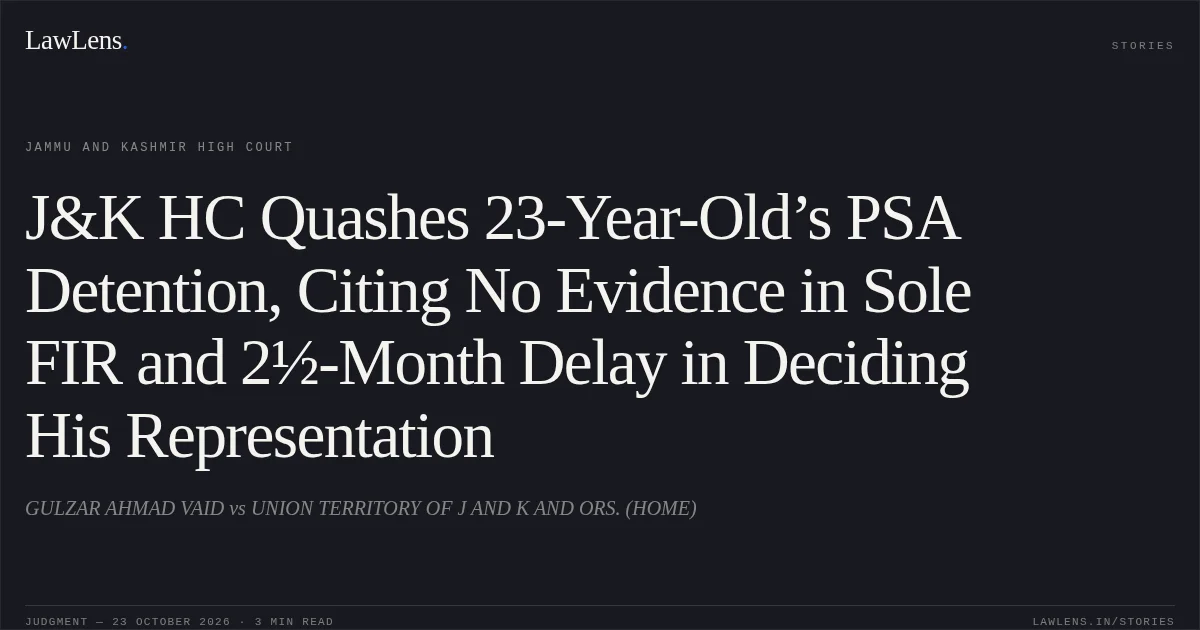
The petitioner was detained under the Jammu and Kashmir Public Safety Act, 1978 (PSA), by order dated 31 December 2024.
Source reference: pp. 2–3; paras. 2–4The order relied on a police dossier linking him to an alleged terror-support network and to FIR No. 219/2022 under Sections 120-B and 130 IPC and Sections 18 and 39 of the Unlawful Activities (Prevention) Act.
Source reference: pp. 2–3, 5–6; paras. 2–4, 14–16The dossier stated that investigators were still collecting evidence and that the petitioner had been bound down and released on a surety bond; it did not set out further details of the security proceedings or allege that any bond conditions had been breached.
Source reference: pp. 2–3, 5–6; paras. 2–4, 14–16The petitioner challenged the detention as founded on vague and unsupported allegations and as procedurally unlawful.
Source reference: pp. 3, 7; paras. 5–10, 18–19He also relied on delay in deciding his representation: it was sent by the Home Department to the District Magistrate on 3 February 2025 and disposed of on 22 April 2025.
Source reference: pp. 3, 7; paras. 5–10, 18–19Issues
1. Whether the detention order was sustainable where the allegations against the petitioner rested on an unsubstantiated apprehension and did not establish a live and proximate link between the alleged activity and the need for detention.
Source reference: pp. 4–6; paras. 13–152. Whether the detaining authority adequately explained why ordinary security proceedings under the BNSS were insufficient to prevent the alleged prejudicial activities.
Source reference: pp. 6–7; paras. 16–173. Whether the delay in deciding the petitioner’s representation violated the safeguards governing preventive detention.
Source reference: pp. 7–8; paras. 18–23Law Applied
Article 21 protects life and personal liberty, while Article 22(5) requires that a detenue be afforded an effective opportunity to make a representation against preventive detention.
Source reference: pp. 4, 7; paras. 12–13, 20Under the PSA, including Sections 8(1) and 13 as discussed by the Court, the grounds of detention must support the detention and the representation must be considered expeditiously.
Source reference: pp. 7–8; paras. 21–23Preventive detention is an executive measure distinct from security proceedings under the BNSS, but where such proceedings are relied upon, the authority must demonstrate why they are insufficient; the Court referred to Sections 129 and 135(3) BNSS in considering the proceedings described in the dossier.
Source reference: p. 6; paras. 16–17Relying on Sarabjeet Singh Mokha v. District Magistrate, Jabalpur, (2021) 20 SCC 98, the Court reiterated that delay in considering a representation can deprive a detenue of a valuable procedural right and cannot be justified merely by a reference to the Advisory Board.
Source reference: pp. 7–8; paras. 20–22Reasoning
The Court found that the detention rested on a solitary FIR and an allegation of association with other over-ground workers, while the respondents’ own case was that evidence against the petitioner was still being collected and that he would be formally arrested if such evidence emerged.
Source reference: pp. 5–6; paras. 14–15The Court therefore considered the detention to be based on apprehension rather than evidence against the petitioner.
Source reference: pp. 5–6; paras. 14–15It further noted that the dossier and grounds did not explain the status or outcome of the security proceedings, whether the petitioner had been required to execute a bond, or whether he had breached any bond conditions; the authorities had not shown why those proceedings were inadequate.
Source reference: p. 6; paras. 16–17Finally, the representation remained undecided for approximately two and a half months.
Source reference: pp. 7–8; paras. 19–23Applying the principle in Sarabjeet Singh Mokha, the Court held that this unexplained delay infringed the detenue’s procedural right to expeditious consideration.
Source reference: pp. 7–8; paras. 19–23Holding
The Court allowed the petition and quashed the detention order dated 31 December 2024.
It directed the petitioner’s immediate release, unless he was required to be detained in connection with another case.
Source reference: p. 8; paras. 24–25Acts & Sections Cited
7 provisions across 4 statutes referred to in this judgment. Each provision opens on LawLens.
Public Sector Iron and Steel Companies (Restructuring) and Miscellaneous Provisions Act, 19782
Indian Penal Code, 18601
Unlawful Activities (Prevention) Act, 19672
Bharatiya Nagarik Suraksha Sanhita, 20232
Original Court PDF
GULZAR AHMAD VAIDvsUNION TERRITORY OF J AND K AND ORS. (HOME)
Click to open original judgment
Original judgment, available to read, download and summarize on LawLens.in