Facts
The petitioner, a nominated representative of the Archery Association of J&K, challenged the election of the office-bearers and Executive Committee of the J&K Olympic Association (“JKOA”), conducted on 15 December 2024.
Source reference: paras. 5–19The election process commenced with a newspaper notice dated 4 November 2024, followed by the appointment of respondent No. 5 as Returning Officer and issuance of an election schedule dated 27 November 2024.
Source reference: paras. 5–19Twenty-five sports associations initially formed the electoral college, which was subsequently expanded to twenty-eight representatives.
Source reference: paras. 20–22, 33The petitioner contested the post of President, but four electors, including the petitioner, boycotted the poll and recorded written protests alleging irregularities.
Source reference: paras. 25, 34Respondent No. 6, Dushyant Sharma, was declared elected President, along with other office-bearers and Executive Committee members.
Source reference: paras. 35–43The petitioner challenged the entire election as contrary to the National Sports Development Code of India, 2011 (“NSDCI”), the JKOA’s governing framework, and applicable governmental instructions, seeking annulment of the election and a fresh election under an independent authority.
Source reference: paras. 44, 85The contesting respondents disputed maintainability, questioned the applicability of the NSDCI, relied upon an arbitration clause, and defended the election as having been conducted in the presence of an observer deputed by the Indian Olympic Association (“IOA”).
Source reference: paras. 88–91Issues
Whether the writ petition under Article 226 of the Constitution was maintainable against the JKOA, a registered sports society performing public and sports-governance functions?
Source reference: paras. 96–112, 124–128Whether the NSDCI and the constitutional and governance requirements applicable to the IOA were applicable to the JKOA as its affiliated State Olympic Association?
Source reference: paras. 118–128Whether the election process initiated and conducted by the JKOA in November–December 2024 was fair, transparent, legally valid, and consistent with the NSDCI and the applicable constitutional framework?
Source reference: paras. 5–44, 118–123Whether the election of respondent No. 6 and the other declared office-bearers was invalid on account of tenure restrictions, procedural irregularities, lack of prior governmental permission, and the Returning Officer’s alleged lack of independence?
Source reference: paras. 82–84, 90–91, 121What consequential directions were required to ensure lawful administration and fresh elections of the JKOA?
Source reference: para. 122, 130–134Law Applied
The Court applied Article 226 principles permitting judicial review of private or registered bodies performing public functions, relying on Secretary, Ministry of Information & Broadcasting v. Cricket Association of Bengal, Zee Telefilms Ltd. v. Union of India, and the Delhi High Court’s decisions in Rahul Mehra v. Union of India and Narinder Batra v. Union of India.
Source reference: paras. 95–112It treated the NSDCI, together with applicable governmental sports-governance guidelines, as requiring democratic, transparent, professionally administered sports bodies and reasonable tenure limitations for office-bearers.
Source reference: paras. 103–111, 116–117The Court also relied on BCCI v. Cricket Association of Bihar, Maharashtra Archery Association v. Rahul Mehra, and All India Football Federation v. Rahul Mehra, holding that sports organisations exercising public or sports-governance functions cannot evade judicial scrutiny or democratic governance requirements merely because they are registered societies.
Source reference: paras. 117, 124–128The Court further considered the JKOA’s own Rules and Regulations, particularly the provisions concerning membership, elections, tenure, voting, and management by the Executive Committee, alongside the IOA’s revised constitutional provisions prescribing four-year terms, cooling-off requirements, age restrictions, and limits on successive terms.
Source reference: paras. 46–55, 61–71Reasoning
The Court found that the JKOA’s election process was procedurally defective and lacked institutional independence.
Source reference: paras. 121–124The initial election notice did not specify the election date, venue, method of nomination, or the identity of the issuing authority, and did not identify the affiliated associations to which it was addressed.
Source reference: paras. 5–10The Returning Officer’s appointment and the fixation of the election date appeared to have been arranged through the outgoing General Secretary, respondent No. 6, without a demonstrated decision of the outgoing Executive Committee or a formal acceptance by the Returning Officer.
Source reference: paras. 11–18The Court further noted inconsistencies in the electoral college, nomination records, scrutiny process, and participation of electors, as well as the Returning Officer’s alleged dependence on the outgoing office-bearer’s “script”.
Source reference: paras. 23–30, 33–43, 121Since the IOA had itself aligned its governance structure with the NSDCI, the JKOA, as its affiliated State Olympic Association, could not continue under an archaic and inconsistent constitution.
Source reference: paras. 118–120, 126–128The Court consequently treated the election as a sham process inconsistent with the requirements of transparency, institutional integrity, democratic governance, and professional sports administration.
Source reference: paras. 121–124Holding
The Court held that the JKOA was subject to judicial review under Article 226 and that the NSDCI’s governance principles applied to it.
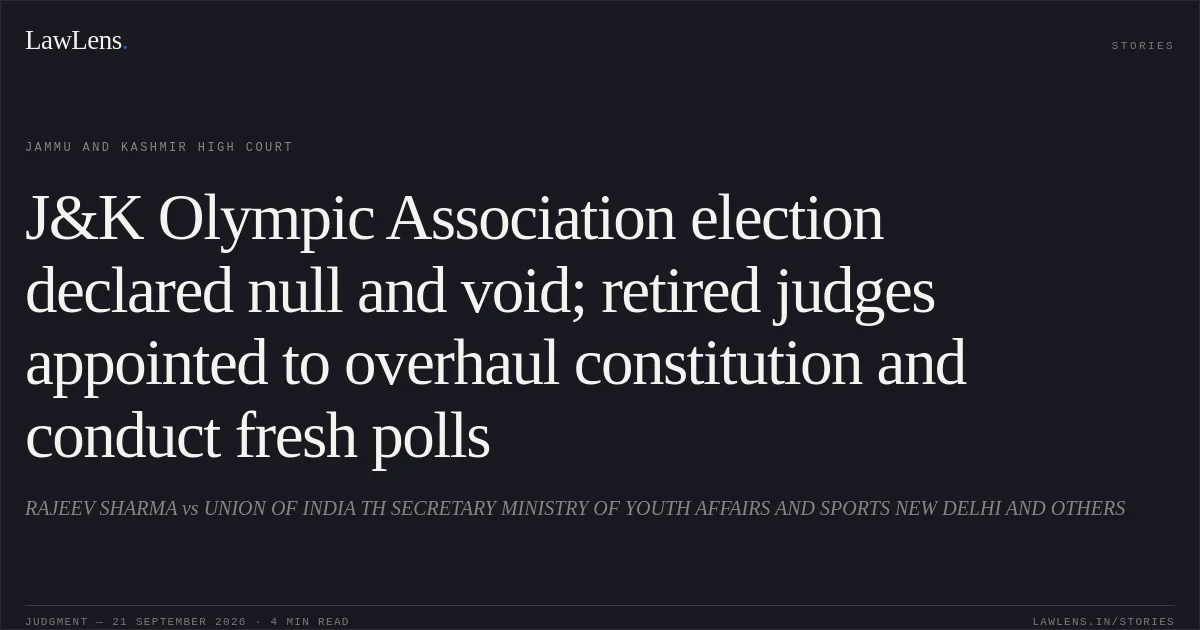
The election process culminating in the declaration dated 15 December 2024 was declared null and void, having been conducted in derogation of the NSDCI and the requirements of fair and transparent sports administration.
Source reference: para. 123Rather than declaring the petitioner elected, the Court appointed a two-member Committee of Administrators comprising Sh. Chain Lal Bavoria and Sh. Virender Singh Bhau, both retired District and Sessions Judges, to assume administration of the JKOA, revise its constitution in alignment with the IOA’s constitution and the NSDCI, and thereafter conduct fresh elections.
Source reference: paras. 130–131The Committee was directed to submit its report by 29 January 2027, with the existing JKOA office-bearers directed to hand over all records and affiliated sports associations directed to cooperate with the Committee.
Source reference: paras. 131–134The writ petition was accordingly disposed of.
Source reference: para. 135Original Court PDF
RAJEEV SHARMAvsUNION OF INDIA TH SECRETARY MINISTRY OF YOUTH AFFAIRS AND SPORTS NEW DELHI AND OTHERS
Click to open original judgment
Original judgment, available to read, download and summarize on LawLens.in