01Facts
The appellant-husband sought dissolution of the marriage under Sections 13(1)(ia) and 13(1)(ib) of the Hindu Marriage Act, 1955, alleging cruelty and desertion.
¶ 3–6The Family Court dismissed the suit, finding cruelty unproved and the statutory period for desertion unmet; the husband appealed.
¶ 10–12The parties’ daughter was born in May 2007, and the husband admitted that he first saw her in October 2007.
¶ 24The High Court also considered the respondent’s pending application for interim maintenance for herself and the daughter.
¶ 32–3502Issues
i.1. Whether the appellant proved that the respondent treated him with cruelty so as to entitle him to a divorce under Section 13(1)(ia) of the Hindu Marriage Act
¶ 19ii.2. Whether the appellant proved desertion by the respondent so as to entitle him to a divorce under Section 13(1)(ib) of the Hindu Marriage Act
¶ 19, 28–30iii.3. What order should be made on the pending application for interim maintenance for the daughter
¶ 32–3803Law Applied
Section 13(1)(ia) of the Hindu Marriage Act permits divorce on proof of cruelty, assessed in the circumstances of each case; mental cruelty requires consideration of the parties’ conduct and its effect on the spouse.
¶ 20–23The Court relied on Shobha Rani v. Madhukar Reddi (1988) 1 SCC 105, Vijaykumar Ramchandra Bhate v. Neela Vijay Kumar Bhate (2003) 6 SCC 334, Joydeep Majumdar v. Bharti Jaiswal Majumdar (2021) 3 SCC 742, and the illustrative principles in Samar Ghosh v. Jaya Ghosh (2007) 4 SCC 511.
¶ 20–23Section 13(1)(ib) requires desertion for a continuous period of at least two years immediately before the petition; desertion entails both separation and animus deserendi—the intention permanently to abandon the matrimonial relationship, without consent or reasonable cause.
¶ 11, 29–30For the maintenance application, the Court referred to the parties’ affidavits filed in terms of Rajnesh v. Neha (2021) 2 SCC 324.
¶ 34Provisions in the judgment · 3 · Linked ones open on LawLens
Hindu Marriage Act, 1955 Section 13Section 24
Code of Criminal Procedure, 1973 Section 204
04Reasoning
The Court found no proved conduct by the respondent amounting to cruelty.
¶ 26–27The respondent’s complaint against the appellant and his family could not, by itself, establish cruelty; it had not been dismissed as false or unsubstantiated, but for non-prosecution after requisites were not filed.
¶ 26–27The allegation that the appellant’s parents died from shock caused by the complaint was unsupported by evidence.
¶ 26–27On desertion, the petition was filed in June 2008, less than two years after the parties last lived together in October 2007.
¶ 28–30The respondent’s reply to the legal notice expressly stated her desire to resume conjugal life, undermining any inference of animus deserendi.
¶ 28–30The appellant’s assertion that the October 2007 visit was only to collect documents did not cure the absence of specific pleadings and sufficient evidence establishing desertion for the statutory period.
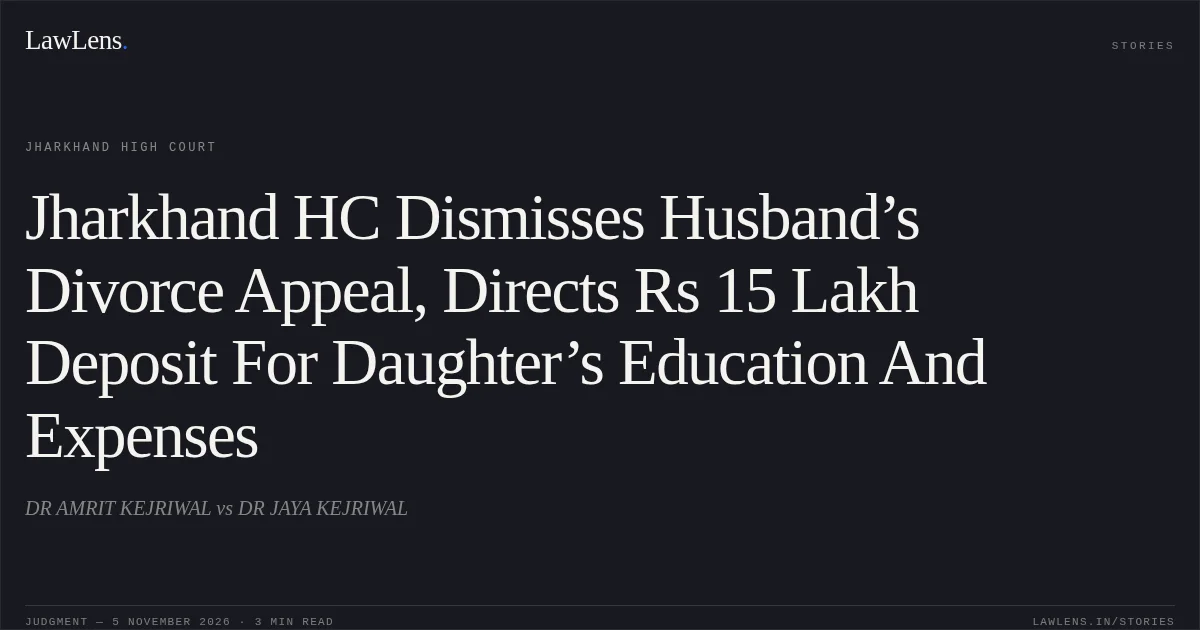
¶ 28–30As to maintenance, the Court directed a deposit of ₹15 lakh for the daughter’s education and other expenses, without prejudice to her right to seek maintenance under applicable law.
¶ 35–3805Holding
The Court held that neither cruelty nor desertion had been established and dismissed the appeal without costs, affirming the dismissal of the divorce suit.
¶ 31, 39It disposed of I.A. No. 702 of 2021 by directing the appellant to deposit ₹15 lakh with the Principal Judge, Family Court, Bokaro, for transfer to an account opened in the minor daughter’s name through her mother.
¶ 37–38The deposit was without prejudice to the daughter’s right to claim maintenance; any later maintenance order must take the deposit into account.
¶ 37–38Original Court PDF
DR AMRIT KEJRIWALvsDR JAYA KEJRIWAL
Click to open original judgment
Original judgment, available to read, download and summarize on LawLens.in