01Facts
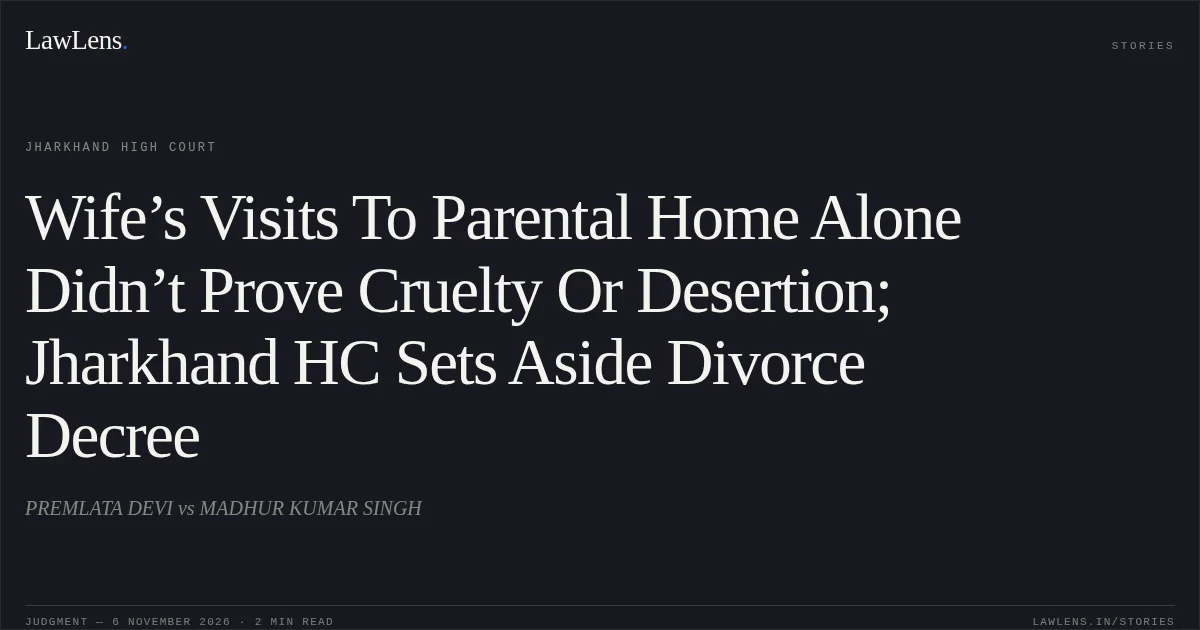
The parties married on 9 May 2006 and had two children.
¶ 3–12, 14–19, 73–76The husband alleged that the wife frequently stayed at her parental home, left the matrimonial home on 14 August 2019, and did not return; he sought divorce on grounds of cruelty and desertion under Section 13(1)(ia) and (ib) of the Hindu Marriage Act, 1955.
¶ 3–12, 14–19, 73–76The Family Court proceeded ex parte and granted a divorce decree.
¶ 3–12, 14–19, 73–76The wife appealed, disputing the allegations and asserting that she had been subjected to dowry-related cruelty and forced to leave; a related criminal case was pending.
¶ 3–12, 14–19, 73–7602Issues
i.1. Whether the husband proved cruelty by the wife sufficient to justify divorce under Section 13(1)(ia) of the Hindu Marriage Act
¶ 76ii.2. Whether the husband proved desertion under Section 13(1)(ib), including separation without reasonable cause and the intention permanently to end cohabitation
¶ 76, 87–89iii.3. Whether the Family Court’s ex parte decree could stand when the wife challenged effective service and the sufficiency of the evidence
¶ 29, 99–10203Law Applied
Under Section 13(1)(ia) of the Hindu Marriage Act, cruelty must be assessed contextually; the conduct must be sufficiently grave and weighty, rather than mere trivial irritation or ordinary marital discord, to make continued cohabitation unreasonable.
¶ 45–59Under Section 13(1)(ib), desertion requires both the factum of separation and *animus deserendi*, without reasonable cause and against the other spouse’s wish, continuing for the statutory period.
¶ 61–71*Lachman Utamchand Kirpalani v. Meena*, AIR 1964 SC 40, discussed at para. 70; *Debananda Tamuli v. Kakumoni Kataky*, (2022) 5 SCC 459, discussed at para. 70.
¶ 70An ex parte proceeding does not relieve the court of its duty to test the evidence for legal sufficiency, and a restitution-of-conjugal-rights decree does not by itself establish a ground for divorce.
¶ 85–86, 94–102Section 19(1) of the Family Courts Act, 1984 permits an appeal on fact and law, allowing the High Court to reappraise the evidence.
¶ 34–37Provisions in the judgment · 7 · Linked ones open on LawLens
Family Courts Act, 1984 Section 7Section 19
Hindu Marriage Act, 1955 Section 9Section 13
Dowry Prohibition Act, 1961 Section 3Section 4
Code of Civil Procedure, 1908 Section 96
04Reasoning
The husband’s allegations that the wife stayed at her parental home and that her family wanted him to live as a “Gharjamai” were general and did not identify specific acts establishing cruelty; the two supporting witnesses substantially repeated his account.
¶ 77–80The wife’s pending dowry-related criminal case did not establish that the allegations against the husband were true, but neither could its mere filing be treated as proof that the wife had deserted him or acted cruelly.
¶ 81, 90–93The husband did not establish that the wife left without reasonable cause or with an intention permanently to end cohabitation.
¶ 87–98The Court also found that the Family Court had not adequately addressed effective service or independently assessed whether the unchallenged evidence met the statutory requirements.
¶ 99–10205Holding
The High Court held that the husband had failed to prove cruelty or desertion under Section 13(1)(ia) and (ib) of the Hindu Marriage Act.
¶ 103–106It quashed and set aside the Family Court’s judgment dated 5 December 2023 and allowed the appeal; any pending interlocutory application was disposed of.
¶ 107–110Original Court PDF
PREMLATA DEVIvsMADHUR KUMAR SINGH
Click to open original judgment
Original judgment, available to read, download and summarize on LawLens.in