01Facts
The prosecution alleged that, on 25 June 1998, the appellants and others assaulted Gour Thakur with a crowbar and lathis at a barn following a land dispute, causing his death.
¶ 2–8The Sessions Court convicted the appellants under Sections 147, 148, 447 and 304/149 IPC; Pushu Thakur was also convicted under Section 302/149 IPC.
¶ 3During the appeal, appellant Golak Thakur died and the appeal against him abated.
¶ 2The remaining appellants challenged the convictions, principally disputing the reliability of the alleged eyewitnesses and pointing to inconsistencies between their evidence and the medical and investigative evidence.
¶ 12, 30, 3702Issues
i.Whether the evidence of PWs 1, 2, 3 and 8, projected as eyewitnesses, was trustworthy and reliable enough to sustain the appellants’ convictions?
¶ 37ii.Whether the trial court’s judgment of conviction and sentence suffered from illegality or infirmity warranting appellate interference?
¶ 3703Law Applied
The prosecution must prove guilt beyond reasonable doubt; an accused is entitled to the benefit of a reasonable doubt, and where the evidence reasonably supports both guilt and innocence, the view favourable to the accused must be adopted.
¶ 60–65Under the principles discussed in Gangadhar Behera v. State of Orissa, (2002) 8 SCC 381, and State of Rajasthan v. Kalki, (1981) 2 SCC 752, ordinary discrepancies do not necessarily undermine a witness, but material contradictions affecting credibility may do so; evidence must be assessed by separating reliable parts from unreliable parts where possible.
¶ 42–45The Court also relied on Mohd. Jabbar Ali v. State of Assam, (2023) 19 SCC 672, concerning the effect of material contradictions, and on Rang Bahadur Singh v. State of U.P., (2000) 3 SCC 454, Krishnegowda v. State of Karnataka, (2017) 13 SCC 98, State of Haryana v. Bhagirath, (1999) 5 SCC 96, Allarakha K. Mansuri v. State of Gujarat, (2002) 3 SCC 57, and Sharad Birdhichand Sarda v. State of Maharashtra, (1984) 4 SCC 116, on proof beyond reasonable doubt and benefit of doubt.
¶ 61–65The convictions arose under Sections 147, 148, 447, 304/149 and 302/149 IPC.
¶ 3Provisions in the judgment · 7 · Linked ones open on LawLens
Indian Penal Code, 1860 Section 147Section 148Section 149Section 302Section 304Section 307Section 447
04Reasoning
The Court found material inconsistencies in the prosecution account concerning who was present before the assault, whether the witnesses arrived only after an alarm, and whether blood was present at the scene.
¶ 46–52The informant’s fardbeyan did not clearly state that he witnessed the assault, while his later testimony described the occurrence and an alleged attack on him; the evidence of PW 3 about the witnesses’ prior presence also conflicted with the informant’s account.
¶ 46–52Further, witness accounts of bleeding and multiple injuries were inconsistent with each other and with the post-mortem evidence, while the investigating officer found neither blood nor straw at the alleged place of occurrence.
¶ 53–55, 66–67Independent witnesses did not support the prosecution version, and evidence that the deceased may have fallen from a machan provided an alternative account.
¶ 68–71Taken cumulatively, these circumstances made the eyewitness evidence unsafe to rely upon and raised reasonable doubt about the prosecution case.
¶ 68–7105Holding
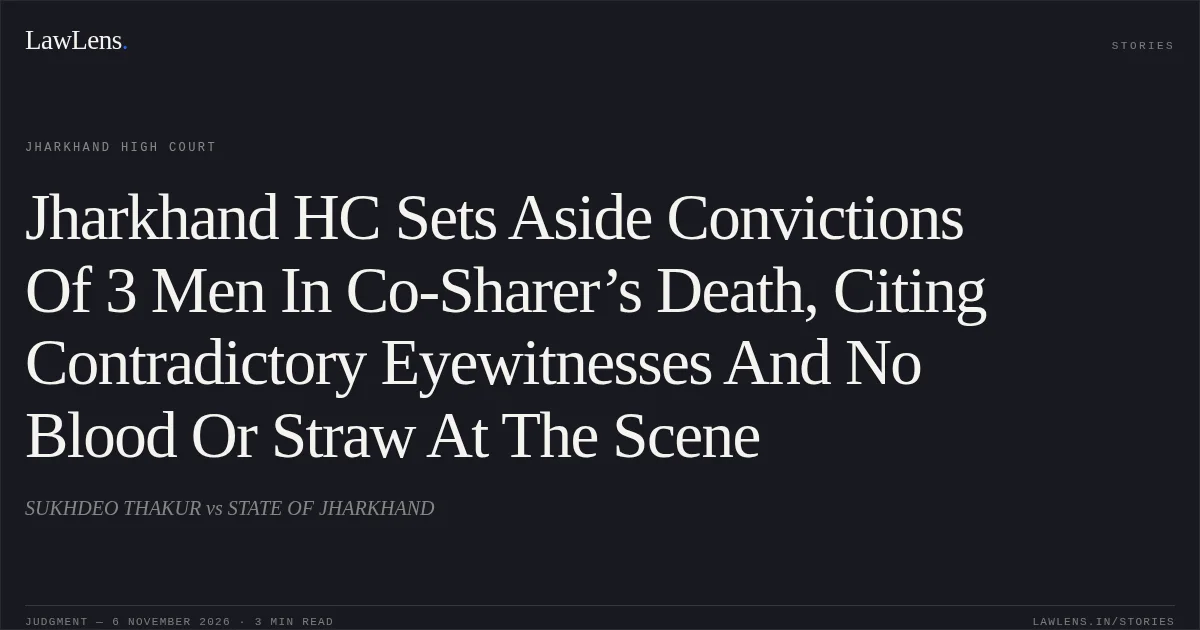
The Court held that the prosecution had not proved the charges against the appellants beyond reasonable doubt.
¶ 71–76It set aside the convictions and sentences imposed by the Sessions Court and allowed both appeals.
¶ 71–76Sukhdeo Thakur, Pushu Thakur and Naryaan Thakur, who were on bail, were discharged from their bail-bond liabilities; the appeal against Golak Thakur had already abated upon his death.
¶ 2, 71–76Original Court PDF
SUKHDEO THAKURvsSTATE OF JHARKHAND
Click to open original judgment
Original judgment, available to read, download and summarize on LawLens.in