01Facts
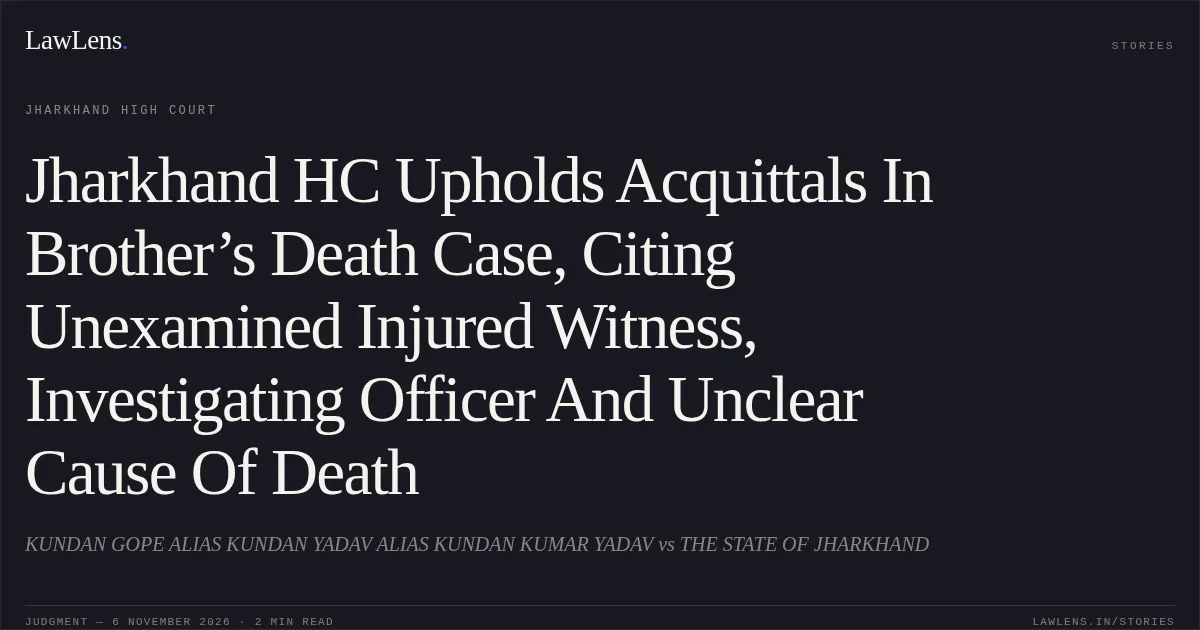
The informant alleged that, on 8 September 2010, the accused assaulted his brother, Kuldeep Yadav, and Kuldeep’s friend, Durga Gupta, with weapons, causing serious injuries; Kuldeep later died.
¶ 1–4At trial, only three prosecution witnesses were examined: the informant, a witness who was declared hostile, and a doctor. Neither the injured witness Durga Gupta nor the investigating officer was examined. The trial court acquitted the accused, and the informant appealed against that acquittal
¶ 12–1402Issues
i.1. Whether the trial court’s acquittal was perverse or otherwise warranted appellate interference under the principles governing appeals against acquittal
¶ 8–12ii.2. Whether the prosecution evidence established the accused respondents’ guilt beyond reasonable doubt
¶ 13–1503Law Applied
The respondents had been charged under Sections 147/149, 148/149, 323/149, 324/149, 325/149, 307/149 and 302 of the IPC
¶ 1In an appeal against acquittal, the appellate court may reappreciate the evidence, but must first determine whether the trial court’s view was a plausible one; an acquittal should not be reversed merely because another view is possible. Interference is justified where the acquittal is perverse or affected by an error of law or fact, and where two plausible views exist, the view favouring the accused prevails
¶ 8–11Provisions in the judgment · 8 · Linked ones open on LawLens
Indian Penal Code, 1860 Section 147Section 149Section 148Section 323Section 324Section 325Section 307Section 302
04Reasoning
The High Court found that the injured witness, Durga Gupta, had not been examined; the informant’s written report did not state that he was present at or witnessed the assault, despite his claim at trial to have seen it; and the other examined witness had been declared hostile. The investigating officer was also not examined, leaving the place of occurrence and relevant connecting circumstances unproved.
¶ 13–15Further, the postmortem report attributed death to cardio-respiratory failure associated with severe sepsis, kidney involvement, malnutrition and anaemia, possibly consequent on old injuries, and did not provide a definite opinion on the cause of death. In these circumstances, the prosecution had not established the respondents’ culpability, and the trial court’s acquittal was a plausible view rather than a perverse one
¶ 13–1505Holding
The Court held that the prosecution had failed to prove its case and that the trial court had correctly acquitted the respondents.
¶ 15–17Finding no merit in either appeal, it dismissed both acquittal appeals and directed that the trial court record be returned with a copy of the judgment; pending interlocutory applications were also disposed of
¶ 15–17Original Court PDF
KUNDAN GOPE ALIAS KUNDAN YADAV ALIAS KUNDAN KUMAR YADAVvsTHE STATE OF JHARKHAND
Click to open original judgment
Original judgment, available to read, download and summarize on LawLens.in