Facts
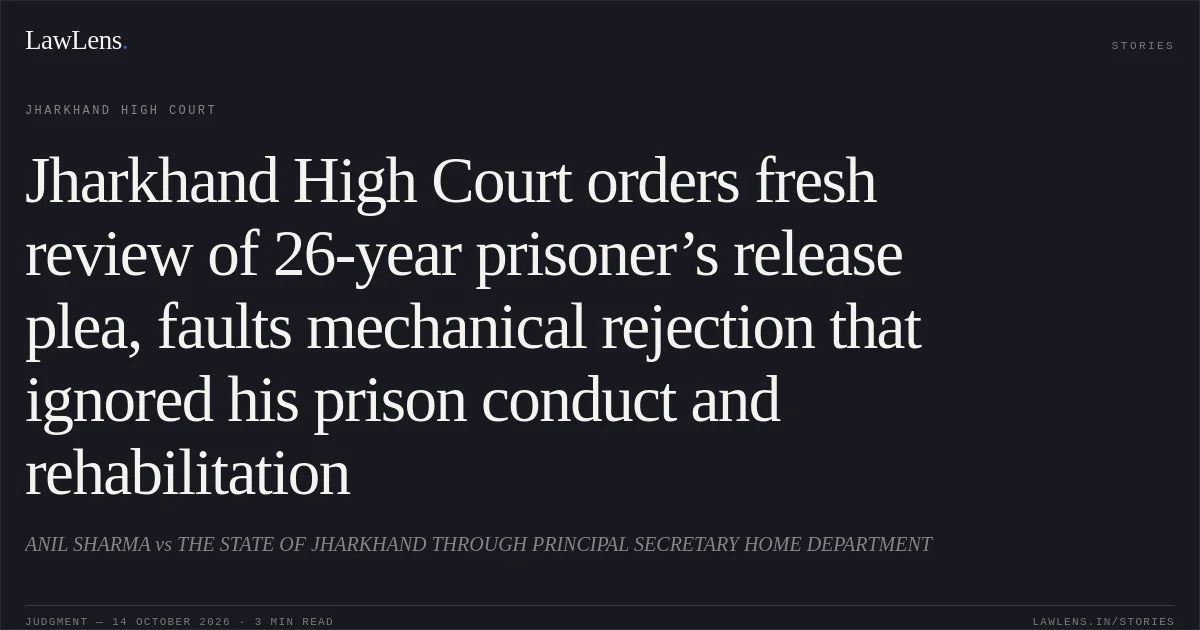
The petitioner was convicted under Sections 302/34 and 307/34 IPC and initially sentenced to death; the sentence was modified to life imprisonment by the High Court, and the Supreme Court dismissed his appeal.
Source reference: p. 4After completing 26 years of actual custody and 29 years including remission, he sought premature release under the Bihar Policy of 1984, or alternatively under Jharkhand’s later policy.
Source reference: pp. 7–9The State Sentence Review Board repeatedly rejected his applications, principally citing the murder of a fellow inmate, an alleged risk of gang war and disturbance of public peace, and his alleged escape from judicial custody.
Source reference: pp. 19–24The present petition challenged the Board’s notification dated 25.03.2026.
Source reference: no citationThe petitioner had, however, been acquitted in the escape case, and the Probation Officer’s report described his conduct in prison as satisfactory and found reduced risk of reoffending.
Source reference: pp. 24–25, 29Issues
Whether the Board’s rejection of premature release was arbitrary and inadequately reasoned, given the petitioner’s custody, prison conduct, rehabilitation prospects, and the reports before it.
Source reference: pp. 24–29, 36Whether the petitioner was entitled to release under the 1984 Bihar policy or the later Jharkhand policy, including any maximum period of custody prescribed by those policies.
Source reference: pp. 8–9, 26–29, 35Law Applied
Under State of Haryana v. Jagdish, (2010) 4 SCC 216, premature-release authorities must assess relevant circumstances including the nature and societal impact of the offence, the likelihood of reoffending, the prisoner’s potential for crime, the purpose of continued confinement, and the convict’s family circumstances.
Source reference: pp. 18–19The 1984 Bihar policy provided eligibility for consideration after 14 years’ actual custody and 20 years including remission for specified life convicts.
Source reference: pp. 8–10Jharkhand’s 2007 resolution likewise set eligibility thresholds, but its original provision barring custody beyond 25 years including remission was deleted by the 2009 resolution; the consolidated 2011 policy did not retain that mandatory-release clause.
Source reference: pp. 26–28Rohit Chaturvedi v. State of Uttarakhand, 2026 SCC OnLine SC 865, establishes that remission is a distinct, forward-looking executive function and cannot be denied solely because the offence was heinous; the decision requires a holistic assessment of conduct, reformation, and prospects of reintegration.
Source reference: pp. 30–36Reasoning
The Board’s notification repeated the gravity of the original offence, alleged risk of gang conflict, and prior escape, but did not explain the contents of the reports it relied on or reconcile its conclusions with the Probation Officer’s favourable assessment.
Source reference: pp. 24–26, 29–30The escape allegation was particularly weak because the petitioner had been acquitted in that case.
Source reference: p. 29The Board also failed to meaningfully assess the petitioner’s prison conduct, reformation, present risk of reoffending, and reintegration prospects, instead relying on a formulaic rejection focused on the past offence.
Source reference: pp. 24–25, 29–30, 36Although the petitioner claimed a right to release under the 1984 policy or the 25-year limit, the Court did not finally determine which policy governed or direct release; it noted the deletion of the 25-year clause from the later policy and focused on the defective decision-making process.
Source reference: pp. 26–29, 35Holding
The Court quashed the notification dated 25.03.2026 insofar as it concerned the petitioner and remanded the matter to the State Sentence Review Board for fresh consideration at its next meeting.
The Board was directed to issue a detailed, reasoned decision consistent with the Court’s observations and the principles stated in Rohit Chaturvedi.
Source reference: p. 37The petition was allowed, but the Court did not order the petitioner’s immediate release.
Source reference: p. 37Acts & Sections Cited
10 provisions across 4 statutes referred to in this judgment. Each provision opens on LawLens.
Bihar Reorganisation Act, 20002
Code of Criminal Procedure, 19734
Indian Penal Code, 18603
Prisons Act, 18941
Original Court PDF
ANIL SHARMAvsTHE STATE OF JHARKHAND THROUGH PRINCIPAL SECRETARY HOME DEPARTMENT
Click to open original judgment
Original judgment, available to read, download and summarize on LawLens.in