Facts
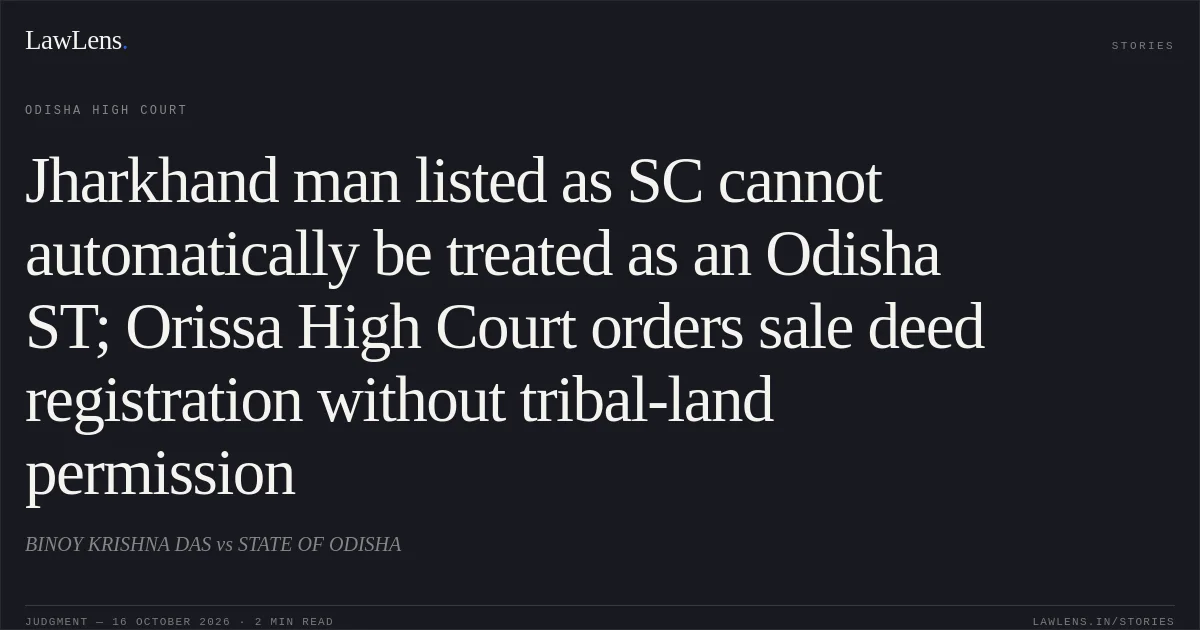
The petitioner, a Jharkhand resident whose caste, “Bhuiya,” is recognised as a Scheduled Caste in Jharkhand, owned land in Mayurbhanj, Odisha.
Source reference: pp. 2–4, paras. 2–3He presented a sale deed for registration, but the Sub-Registrar refused to accept it.
Source reference: pp. 2–4, paras. 2–3The District Registrar-cum-ADM subsequently informed him that Bhuiya is a Scheduled Tribe in Odisha and that permission under Odisha Regulation 2 of 1956 was required.
Source reference: pp. 2–4, paras. 2–3The petitioner challenged that requirement, contending that he could not be treated as a Scheduled Tribe in Odisha and that the Regulation did not apply to him.
Source reference: pp. 2–4, paras. 2–3The State filed no counter-affidavit but opposed the petition orally.
Source reference: p. 4, para. 4Issues
1. Whether a person migrating from one State to another may claim in the destination State the Scheduled Caste or Scheduled Tribe status recognised in the State of origin
Source reference: pp. 6–7, para. 92. Whether the petitioner, whose caste is recognised as a Scheduled Caste in Jharkhand but is listed as a Scheduled Tribe in Odisha, could automatically be treated as a Scheduled Tribe in Odisha, thereby attracting Odisha Regulation 2 of 1956 and Section 22 of the OLR Act
Source reference: pp. 6, 12–13, paras. 9, 13–15Law Applied
Articles 341(1) and 342(1) of the Constitution provide for specification of Scheduled Castes and Scheduled Tribes, respectively, “in relation to” a particular State or Union Territory; the status and associated benefits are therefore State-specific.
Source reference: pp. 6–12, paras. 9–12Under Marri Chandra Shekhar Rao v. Seth G.S. Medical College, (1990) 3 SCC 130, migration does not extinguish a person’s caste identity, but the person does not carry the originating State’s Scheduled Caste or Scheduled Tribe status and its associated privileges into another State.
Source reference: pp. 6–12, paras. 9–12Action Committee on Issue of Caste Certificate to SCs/STs v. Union of India, (1994) 5 SCC 244, likewise holds that inclusion in a State’s list does not automatically confer Scheduled Caste or Scheduled Tribe status in another State, even where the same community name appears in both lists.
Source reference: pp. 6–12, paras. 9–12Odisha Regulation 2 of 1956 and Section 22 of the OLR Act, as applied in this judgment, concern restrictions applicable to Scheduled Tribes in Odisha.
Source reference: p. 13, paras. 14–15Reasoning
The Court applied the State-specific character of Articles 341 and 342 to reject both parties’ positions.
Source reference: pp. 12–13, paras. 12–13The petitioner could not claim Scheduled Caste status in Odisha merely because Bhuiya is recognised as a Scheduled Caste in Jharkhand.
Source reference: pp. 12–13, paras. 12–13Conversely, the fact that Bhuiya appears in Odisha’s Scheduled Tribe list did not automatically make this petitioner a Scheduled Tribe member in Odisha, given that his relevant status was as a member of a Scheduled Caste in Jharkhand.
Source reference: pp. 12–13, paras. 12–13The District Registrar therefore erred in requiring permission under Regulation 2 of 1956: the petitioner could not, on the basis of the facts before the Court, be treated as a Scheduled Tribe in Odisha, and the Court held that neither the Regulation nor Section 22 of the OLR Act applied to him.
Source reference: p. 13, paras. 14–15Holding
The Court allowed the writ petition and quashed the District Registrar-cum-ADM’s letter dated 23 April 2026.
It directed the Sub-Registrar-cum-Tahasildar, Kuliana, to register the sale deed within three days after production of a certified copy of the judgment, subject to compliance with other statutory requirements.
Source reference: p. 14, para. 16Acts & Sections Cited
2 provisions across 2 statutes referred to in this judgment. Linked provisions open on LawLens.
Odisha Regulation 2 of 19561
Orissa Land Reforms Act, 19601
Original Court PDF
BINOY KRISHNA DASvsSTATE OF ODISHA
Click to open original judgment
Original judgment, available to read, download and summarize on LawLens.in